

Biodiversity, accessibility, and community innovation projects backed after second call for pilots
Life
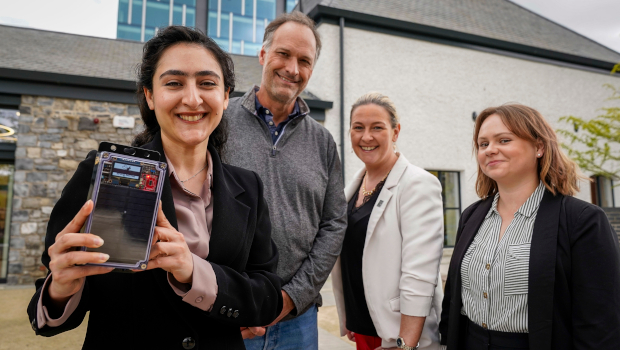
Pictured: Dr Maryam Norouzi, Principal Investigator, WingSense, Trinity College Dublin; Prof Dan Kilper, Connect; Nicola Graham, Dublin City Council; Dr Karolina Anielska, Smart Docklands
Four projects have been selected out of 53 applications to receive seed funding under the Smart Docklands Call for Pilots 2025/2026.
This year’s winning pilots – each of which received with €12,500 – span a range of disciplines from radar-based biodiversity monitoring and augmented reality heritage trails, to inclusive wayfinding for neurodiverse visitors and tangible tools for community participation in urban planning.
The four pilot winners are:

- WingSense: a biodiversity programme which uses a low-power mmWave radar sensors detect insect and pollinator activity continuously, day or night and in all weather conditions, without capturing images or audio. Machine learning transforms this data into actionable, privacy-safe biodiversity insights for cities.
- ScannAR: a Web-based AR experience delivered via QR codes. Scanning unlocks 3D experiences with audio narration and local storytelling, fully accessible to blind, visually impaired, deaf, and hard-of-hearing users.
- Arrow: An inclusive wayfinding layer co-designed with neurodiverse users, combining ‘what to expect’ guides, typical and real time sensory environment indicators into one coherent, place-based service.
- Raytown Roundtable, Codema: A touch-based interactive table piloted at the Raytown Energy Dock in Ringsend/Irishtown, giving residents a hands-on way to explore their neighbourhood and shape local decisions.
Smart Docklands is one of Dublin’s flagship smart districts – a unique collaboration across academia, industry and local government to advocate for and pilot community centred technology innovations.
The programme that supports the adoption of new and emerging technologies in cities is delivered in partnership between Dublin City Council and the Connect Research Ireland Centre for Future Networks headquartered at Trinity College Dublin.
Nicola Graham, Smart Cities programme manager, Dublin City Council, said: “Pilots like these are how we deliver meaningful change within the council. They let us trial new approaches in real-world settings, learn fast, and build the evidence needed to scale what works. The strong number of applications this year reflects a clear commitment to developing solutions to the challenges identified by the Docklands community.”
Prof Dan Kilper, Director CONNECT Centre, Trinity College Dublin said: “These pilots are not just proof-of-concept experiments – they are live research environments that generate insights no laboratory can replicate. Bridging that gap between academic innovation and lived experience is precisely what the Connect Centre exists to do, and Smart Docklands gives us the ideal platform to make it happen.”
Dr Karolina Anielska, Smart Docklands programme manager added: “When we launched the first Call for Pilots, we set out to put the community at the heart of smart city innovation – and the response has been overwhelming. To see that grow into 53 applications and four outstanding winners spanning biodiversity, accessibility, and digital inclusion is a moment to truly celebrate. This is exactly what Smart Docklands was built to do.”
TechCentral Reporters