

Haters gonna hate, but there are surely more than a few people looking at the original Cayenne in the classifieds now thinking, ‘hmm, that’s a lot of car for two and a half grand’, who were among the first to break out the barge poles in 2002. And who can blame them? Like all of its older models, the E1 Cayenne received Porsche Classic status on its 20th birthday, meaning everything from regular consumable parts to modernising upgrades are listed in the Classic Genuine Parts Catalogue. And yet, if you take a look here, you’ll discover that less than three grand buys you a V6 S and £7k gets you a seemingly mint Turbo. The model’s elevation to ‘classic’ hasn’t necessarily been heeded by secondhand buyers.
Given enough time, that will probably change; this is a Porsche after all. And while the Cayenne might be the most controversial ‘classic’ so far (what with it being an SUV that shared a platform with the VW Touareg), there’s no denying the E1’s place in history. Added to which, plenty of buyers have come around to the Cayenne once they realised just how over-engineered it was. Being newbies to the 4×4 segment, Porsche didn’t know exactly what its new customers might get up to, so it developed a car that would work pretty much anywhere.
To that end, the E1 got a proper mechanical locking differential, a heavy-duty low-range transfer case and standard-fit hill descent control from the off, as well as optional hydraulically decoupling rear anti-roll bars for greater articulation, meaning it could (theoretically) go toe-to-toe with the Range Rover on the rough stuff. But as a Porsche, it also needed to drive like a performance car, and so the E1’s on-road handling ranked it above even the more tarmac-focused BMW X5. And while it didn’t exactly receive all-round approval when the covers came off at the 2002 Paris Motor Show, 24 years on, it’s aged gracefully.

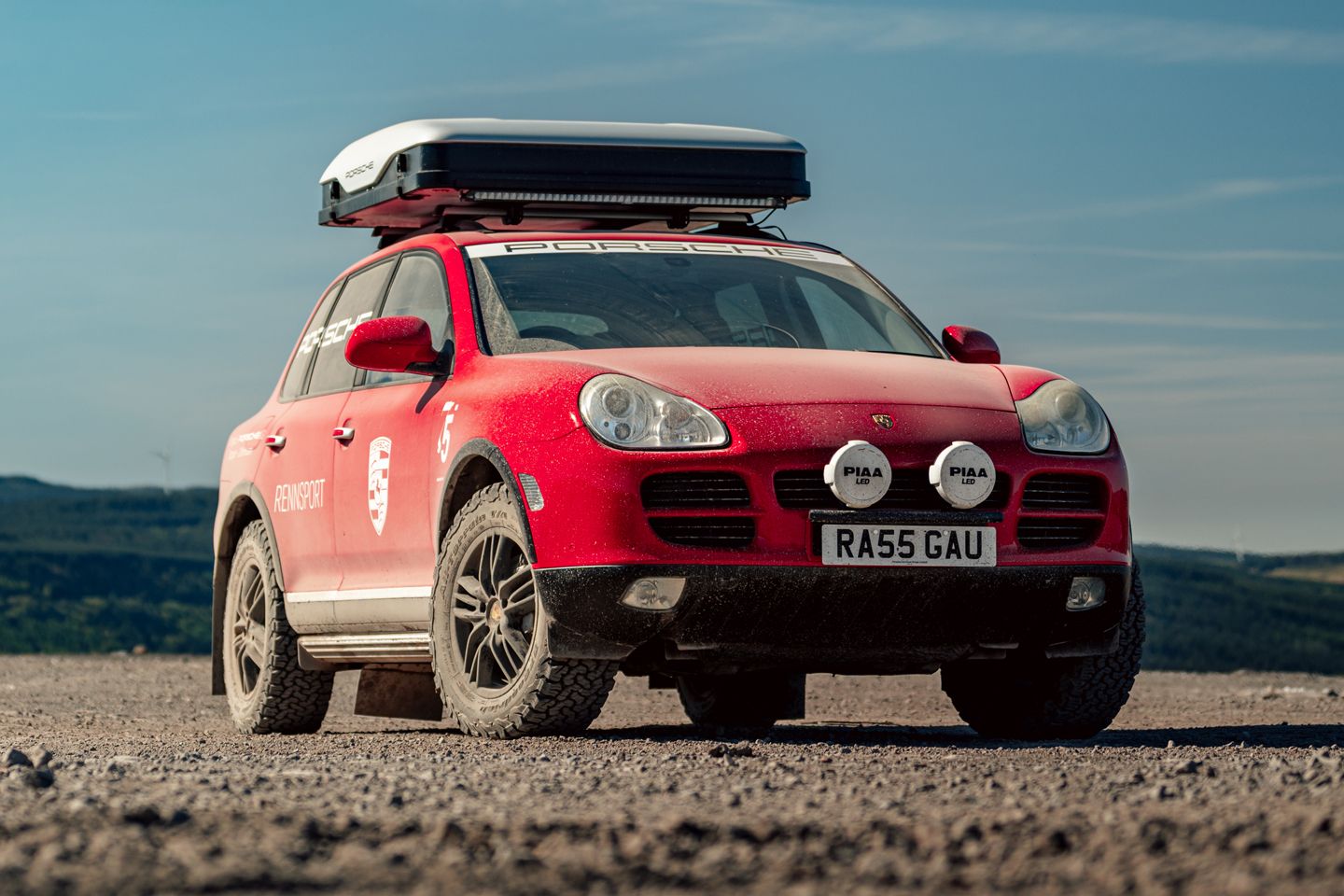
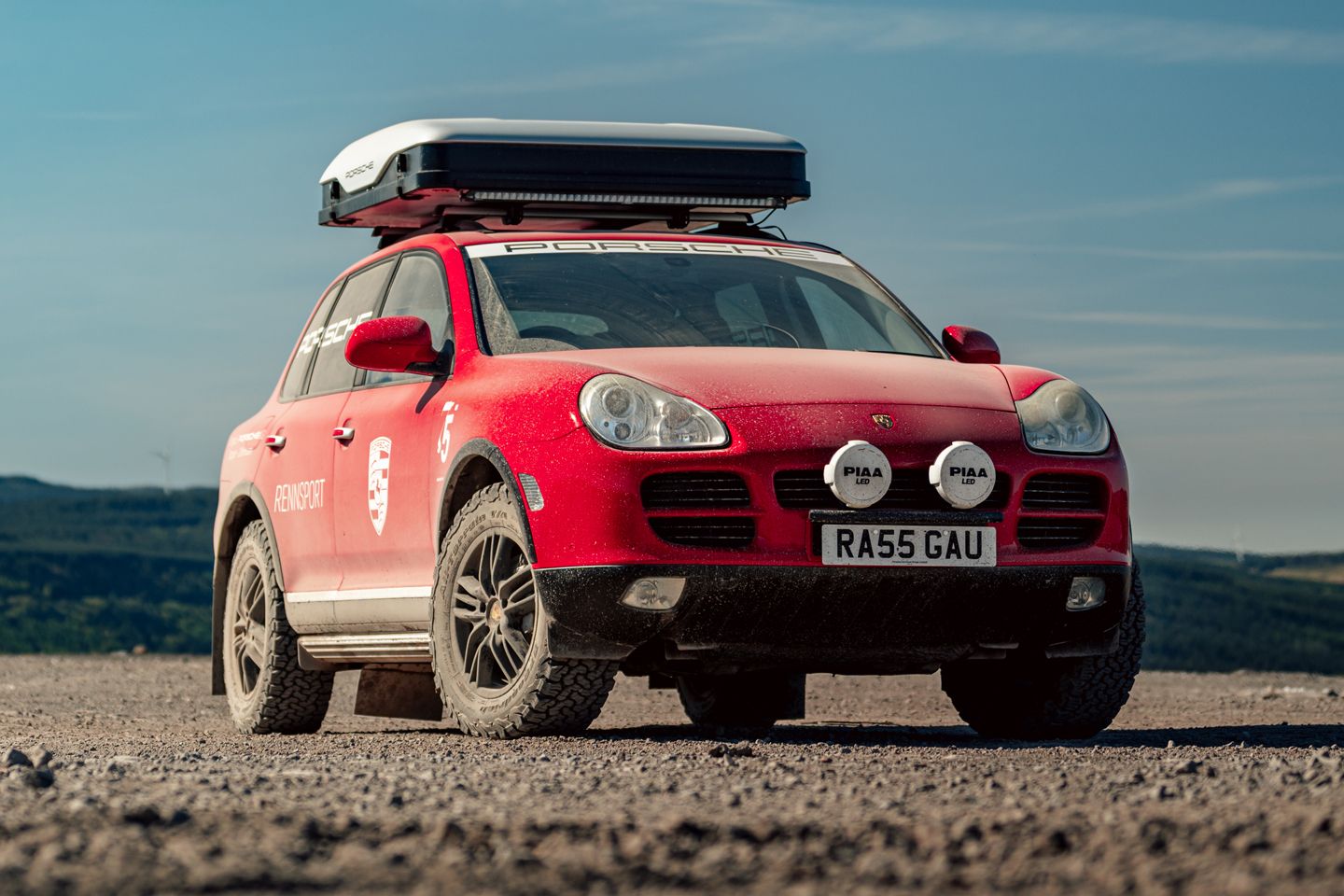
Well, normal examples have. The modified one you see here, a special creation of Porsche Cars GB (PCGB) in its 75th year to promote the catalogue of parts available to Porsche Classic models, looks wonderfully purposeful with its nose-mounted spotlights and chunky off-road rubber. And yet it turns out to be the least aggressive E1 in attendance at PCGB’s RE1nvent (see what they did there?) event in south Wales, where Porsche’s retailers have been invited to bring their own modified Cayennes for a non-competitive (read: very competitive) off-road challenge.
Much like an old Max Power hatchback might have been accused of crashing into Halfords, the Cayennes in attendance have effectively had their bodies and interior dipped in the Sherbert of Porsche Classic parts. And more besides, we’d guess, based on the side exit exhausts sprouting from one modified Turbo, and the bull-bar-wearing nose of another, which are cool – but don’t necessarily feel very ‘classic’ in the Porsche sense. Clearly, the teams have been allowed to have some fun with this challenge, but it’s PCGB’s red E1 that PH is sampling – and, as you might expect, it best represents a more on-brand vision of what is possible.
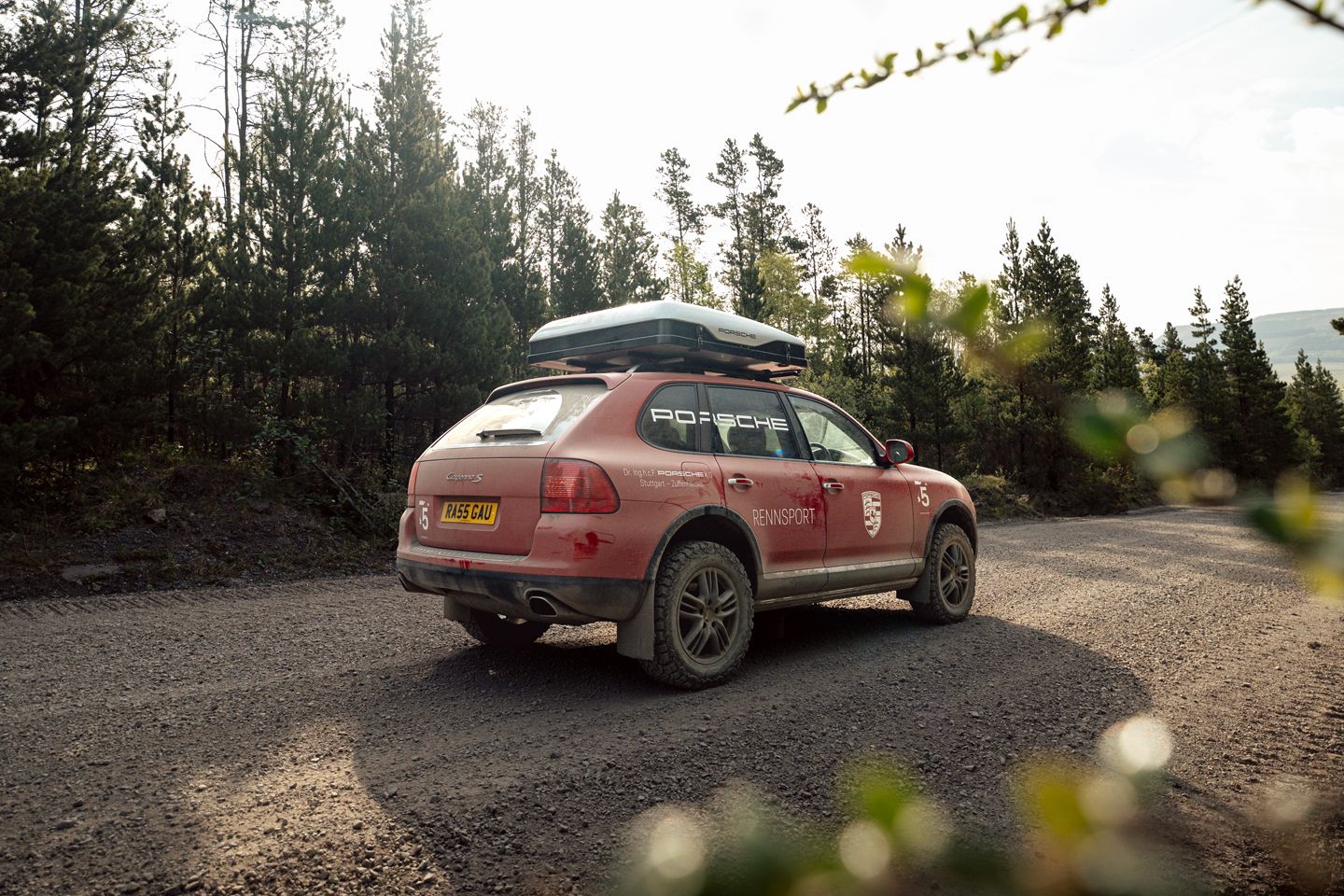
Along with that mud- and rock-ready rubber and PIAA lights, there’s a Porsche-branded storage box on the roof, while on the inside you get a Porsche Classic Communication Management infotainment system, complete with Apple Carplay and Android Auto. None of these parts is cheap – the PCCM alone costs an eye-watering £1,500 – but since they’re authentically Porsche, they give the car genuine OEM-plus status. Underneath, the original air suspension and surrounding consumables have been refreshed with Porsche Classic parts to create a 55-plate E1 that feels as fresh as it looks.
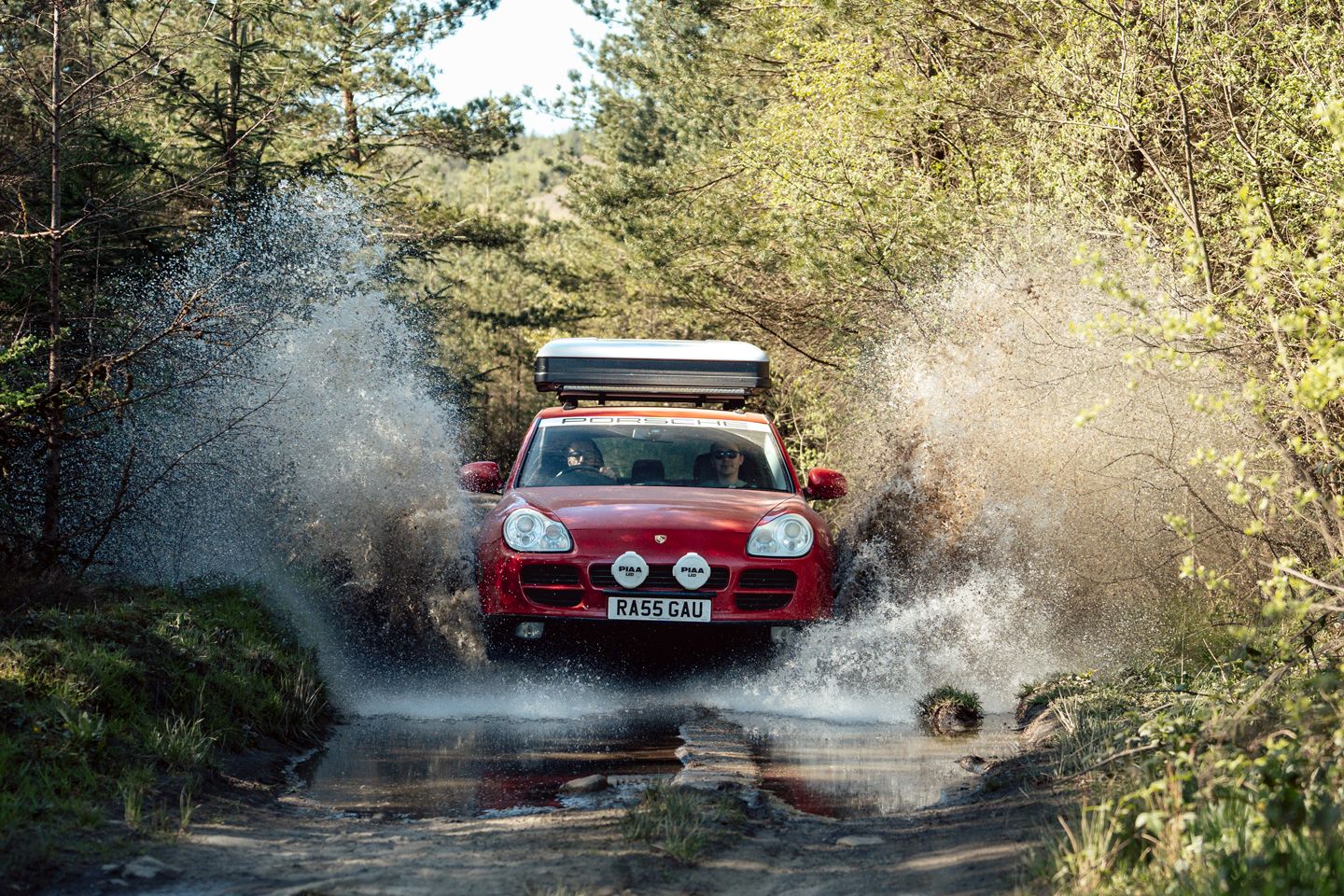
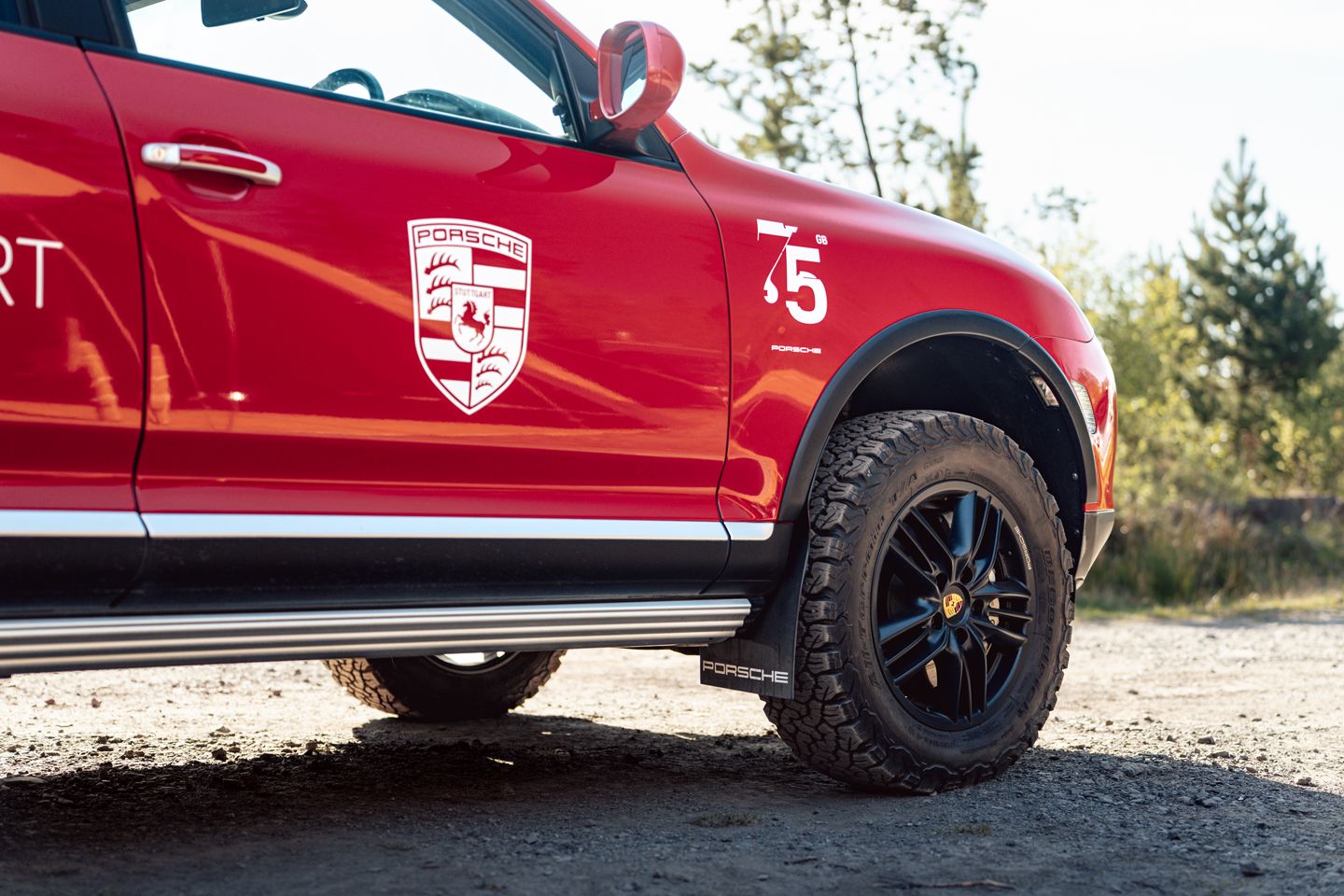
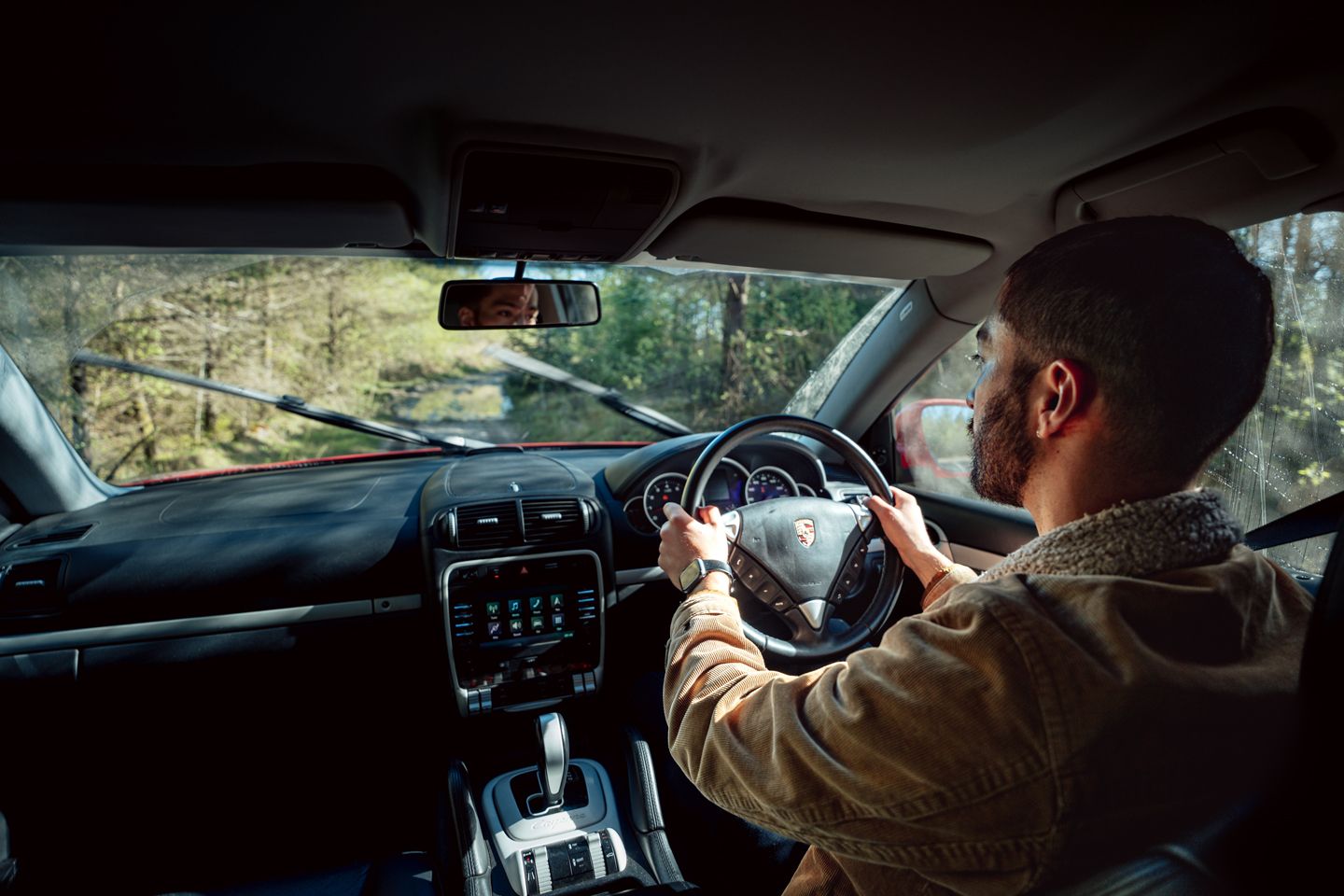
It also has a new red wrap, confirming that this is indeed an evolved version of the originally grey, 4.5-litre V8 Cayenne S that PCGB let Matt loose in back when the E1 went Classic in 2022. Four years on it retains the original Tiptronic slush box, which distributes 340hp across both axles, front leather seats that feel like armchairs, and a steering wheel that’s big, but falls naturally into your hands. They nailed the ergonomics (with a little help from VW), and the number of buttons on the dash is, as ever, a welcome change from a million-inch touchscreen. Although with the PCCM in the centre console, the cabin experience isn’t completely retro.
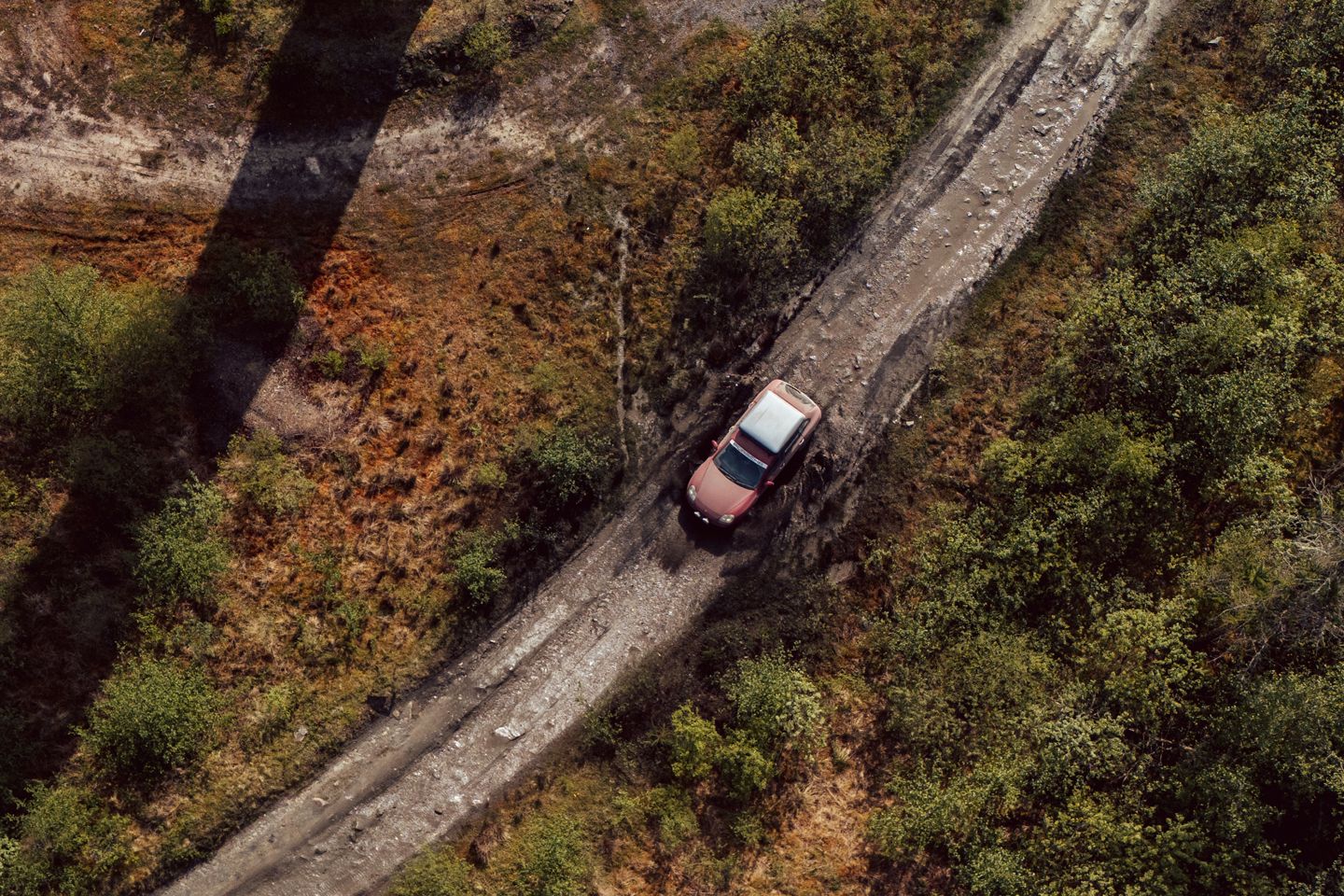
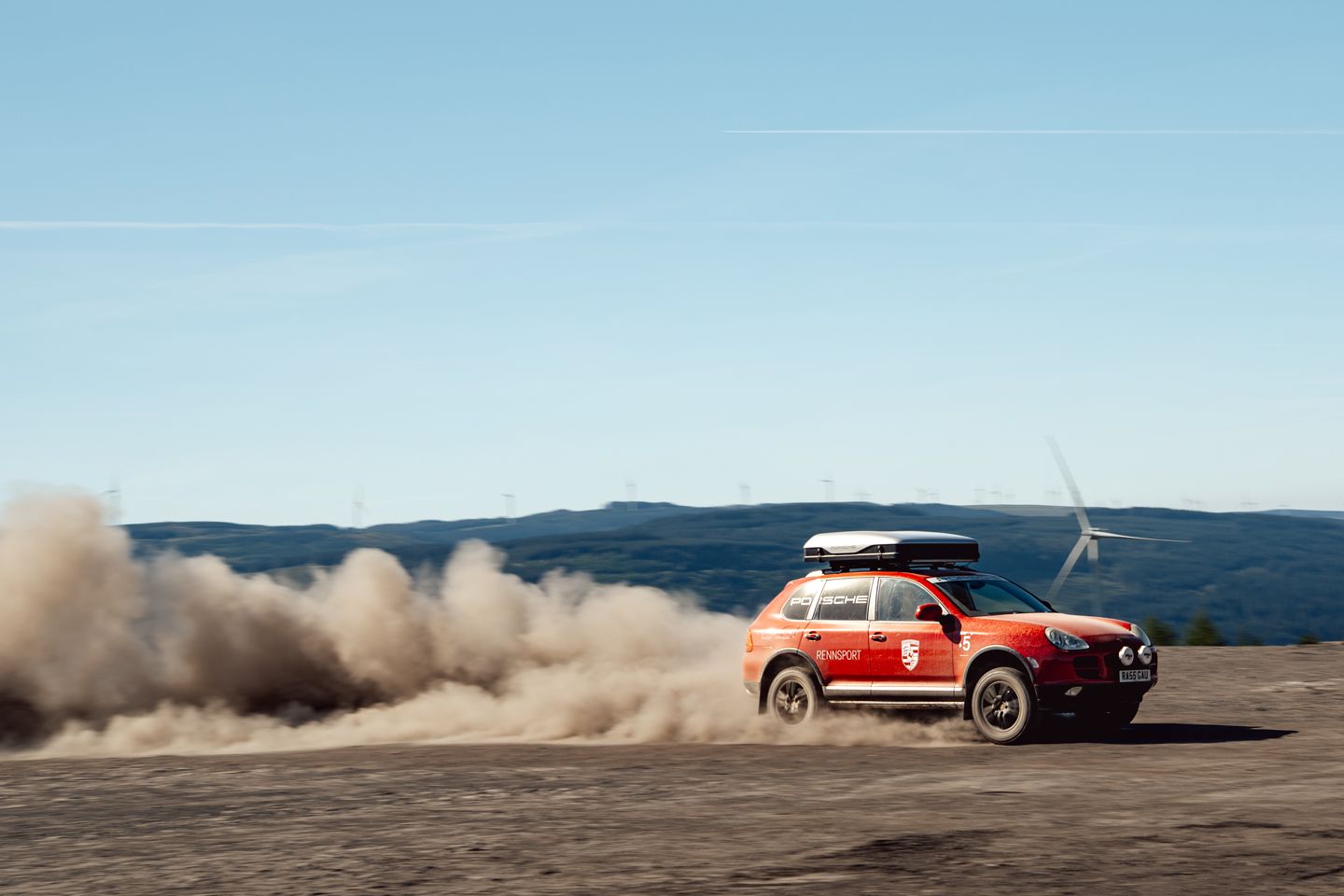
Neither is this E1’s off-road ability. The course at Walter’s Arena has a mix of steep, muddy inclines and declines, fords and rocky terrain, as well as a dusty plain that provides the perfect opportunity to go fully Dakar. The E1 eats it all up. We’re able to utilise the Cayenne’s different diff settings, controlled via buttons behind the gear selector, but even when yours truly forgets to shift the settings to suit new terrain, the Porsche Classic Cayenne just crawls, powers or splashes on. It feels just as solid as a new machine, although at the same time, as a 24-year-old design, it also feels compact and light-footed compared to modern SUVs. Assuming Porsche’s wider point is that the E1 is still good after all these years – and can be made better with a little additional help – point proven.
That said, for Porsche buyers on a budget, there’s probably a limit to the Classic catalogue’s appeal. Who buys a £2.5k V6 S to then fork out over half the car’s value on a touchscreen infotainment system? Same goes for everything else that might need replacing, meaning Porsche Classic’s catalogue of 90,000 parts, which includes every model, from its original 356 onwards, is intended more for purists than bargain hunters. No surprise there, of course – and despite the premium involved, you probably won’t be shocked to discover that the demand for those parts is very healthy. Porsche reckons 70 per cent of the cars it’s made are still on the road. Go figure.
For older Porsche owners, having a fully-stocked catalogue of replacement or upgrade parts certainly removes the headache of knowing which supplier or standard to choose. Better still, searching for said parts includes skimming through digitised copies of original brochures, so there’s a bit of history in the preservation of these catalogues, too. And a reverential level of respect for its own history, a quality that Porsche makes real on many levels, is often what people are buying into.
Beyond that warm and fuzzy feeling of belonging, PCGB’s E1 Cayenne is a reminder not just that Porsche is in the (highly profitable) business of keeping its cars on the road for as long as possible, but also that it embraces the idea that its owners might want to continue tinkering with their cars long after the point where a lesser brand’s products might have been put out to pasture. It’s nice to know that level of support does not decrease just because the car in question is not a showroom-quality 911. And that there’s plenty of life left in the one Porsche that can be snapped up for practically nothing.