

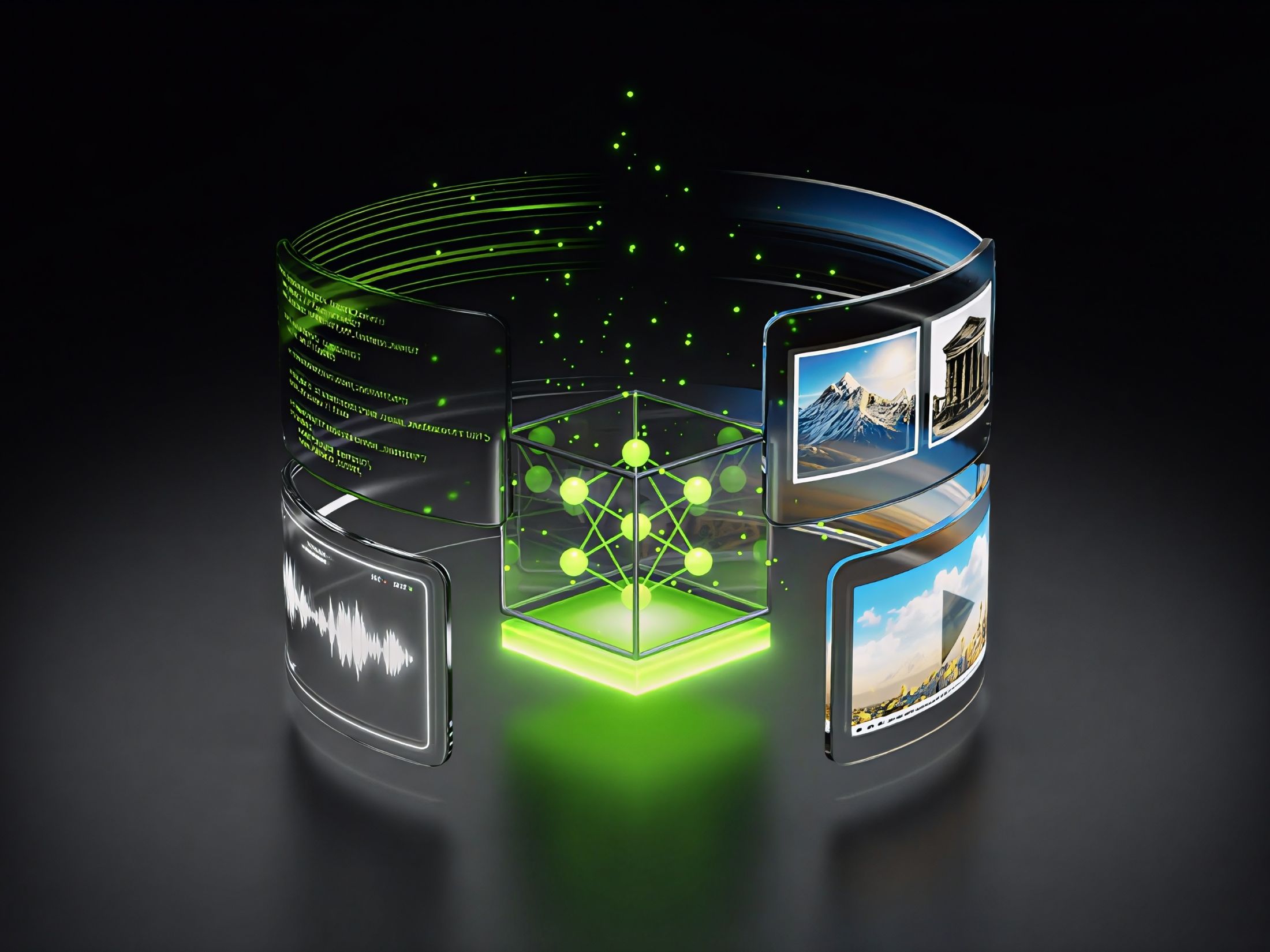
The launch of NVIDIA Nemotron 3 Nano Omni forces engineering teams to rethink multimodal AI deployment to maximise inference capacity.
Agentic systems routinely process screen interfaces, audio buffers, and text within a single perception-to-action sequence. Constructing these pipelines traditionally forces platform engineers to rely upon fragmented model chains encompassing entirely separate stacks for vision, audio, and text APIs.
Routing data through isolated transcription or object-detection services increases orchestration complexity and inference hops, driving up infrastructure costs while simultaneously weakening cross-modal context consistency.
NVIDIA designed Nemotron 3 Nano Omni to collapse these fragmented vision-language-audio stacks into a single open model. Functioning as a unified multimodal perception and context sub-agent, the model allows systems to perceive visual, audio, and textual inputs inside a shared loop, improving convergence and reducing architectural overhead.
Hybrid architectures and token mechanics
The core engine relies on a 30B-A3B hybrid mixture-of-experts architecture designed to activate only the required expert for each specific task and modality.
To balance memory constraints with reasoning demands, this hybrid foundation combines Mamba layers for sequence efficiency with standard transformer layers for precise logical deduction. This specific structural combination delivers up to four times better memory and compute efficiency compared to dense alternatives, making it highly suitable for continuous sub-agent roles requiring constant vigilance.
Within larger agent frameworks, it integrates neatly with planning and execution models like NVIDIA Nemotron 3 Super or Ultra, ensuring overall system modularity remains intact. Engineers dealing with high technical debt from chaining disconnected models can consolidate their perception layers here, replacing brittle network calls between audio transcription services and text engines with a single temporally-aligned multimodal context.
Visual inputs process through the C-RADIOv4-H encoder, functioning as a foundation model that balances high-resolution detail with efficient computation. This component maintains the ability to focus on specific image patches, preserving exact optical character recognition precision across complex documents without ballooning the active token count.
For high-density dynamic video, the architecture deploys tiered temporal-spatial processing to mitigate out-of-memory errors. A convolutional 3D mechanism captures motion between frames natively, while an inference-time Efficient Video Sampling layer compresses the remaining visual tokens into a concise footprint. By discarding temporally redundant data before it reaches the language model, the system prevents the input sequence from overwhelming the maximum context window.
Audio integration bypasses simple text transcription entirely, building upon the Parakeet encoder alongside specialised datasets to extract deeper auditory meaning directly into the shared sequence.
Managing inference capacity and quantisation
Pushing a unified multimodal model to production introduces distinct capacity challenges that require careful cluster provisioning. Evaluating systems on raw concurrency often masks latency degradation during peak loads.
When measured under a fixed interactivity threshold (the point where a user maintains a responsive, real-time experience) Nemotron 3 Nano Omni sustains higher aggregate throughput than competing architectures.
For multi-document reasoning workloads measured at this specific boundary, the system delivers up to 7.4 times greater effective capacity compared to alternative open omni-modal options. For video reasoning tasks demanding continuous token generation, this translates into up to 9.2 times greater effective system capacity.
These metrics indicate that adopting this unified architecture converts raw model efficiency into more concurrent agents operating at a lower cost per task. Performance on MediaPerf confirms this, showing the lowest inference cost for video-level tagging across the open industry benchmark.
Running this at enterprise scale requires hardware-aware deployment practices. The model supports multiple GPU architectures including Ampere, Hopper, and Blackwell. To condense the physical footprint and accelerate decoding, the system relies on FP8 and NVFP4 quantisation methods.
Deploying the NVFP4 variant on Blackwell silicon yields the highest throughput currently available among open omni-modal models for workloads involving large video batches or complex long-horizon reasoning.
NVIDIA has provided deployment “cookbooks” which guide platform teams through setting up vLLM for high-throughput continuous batching, configuring SGLang for lightweight multi-agent tool-calling, or implementing NVIDIA TensorRT-LLM with latent MoE kernels for low-latency execution. Teams utilising Dynamo deployment recipes must configure intelligent routing, multi-tier KV caching, and automatic scaling to handle the unpredictable burst traffic typical of omni-modal inputs.
Navigating ecosystem integrations and privacy
Infrastructure teams often support isolated data stacks for speech, document, and vision tasks. Consolidating these pipelines into one production-ready foundation lowers the barrier to deploying widespread agentic AI across finance, healthcare, and scientific discovery platforms.
NVIDIA provides the full parameter weights on Hugging Face alongside comprehensive training datasets and recipes, offering extensive flexibility for on-premises customisation without compromising privacy.
The adapter and encoder training phases ingested approximately 127 billion tokens across mixed modalities – including text, image, video, and audio combinations – to reflect real-world contextualised interactions. Post-training protocols utilised around 124 million curated examples structured specifically to support document reasoning and direct computer use.
The release also includes synthetic data generation pipelines built with the NVIDIA NeMo Data Designer. Through iterative testing and failure analysis, these open recipes generated roughly 11.4 million synthetic visual question-answer pairs – amounting to 45 billion tokens – that fed directly into the final training blend. Subsequent post-SFT reinforcement learning utilised over 2.3 million environment rollouts across 25 configurations within NeMo Gym and NeMo RL to reinforce cross-modal logic.
This pushes the reinforcement pipeline beyond basic text, adding visual grounding, chart comprehension, and automatic speech recognition to the reward modelling process. Providing the image training data via Hugging Face allows engineering teams to inspect and adapt the exact data pipelines responsible for these capabilities.
Security constraints often prevent enterprise engineers from transmitting internal video data to external API endpoints. Combining Nemotron 3 Nano Omni with the NemoClaw harness and the OpenShell sandbox runtime allows teams to construct privacy-first local agents. This configuration guarantees sensitive recordings remain strictly on localised infrastructure.
By installing OpenClaw agents inside the sandboxed environment with a privacy router, sub-agents can complete specialised tasks securely. The agent leverages native visual-temporal pipelines to observe screen activity directly, generating high-fidelity transcription and summarisation that captures visual context missing from pure audio transcripts. Utilising the extended token context window allows the system to provide accurate, cited answers regarding open-ended questions about video content, establishing a secure perception-to-action loop directly on enterprise hardware.
NVIDIA Nemotron 3 Nano Omni represents a critical shift away from fragmented AI architectures. By collapsing separate vision, audio, and language stacks into a unified 30B-A3B hybrid mixture-of-experts engine, the model significantly reduces orchestration complexity and drives down infrastructure costs.
When paired with tools like the NemoClaw harness and the OpenShell sandbox runtime, it’s possible to construct privacy-first local agents that keep sensitive recordings strictly on localised infrastructure. Consolidating these pipelines into a single foundation will lower the barrier to deploying widespread agentic AI across multiple industries.
See also: API security issues in the spotlight as agents enter the enterprise

Want to learn more about AI and big data from industry leaders? Check out AI & Big Data Expo taking place in Amsterdam, California, and London. The comprehensive event is part of TechEx and is co-located with other leading technology events including the Cyber Security & Cloud Expo. Click here for more information.
Developer is powered by TechForge Media. Explore other upcoming enterprise technology events and webinars here.