

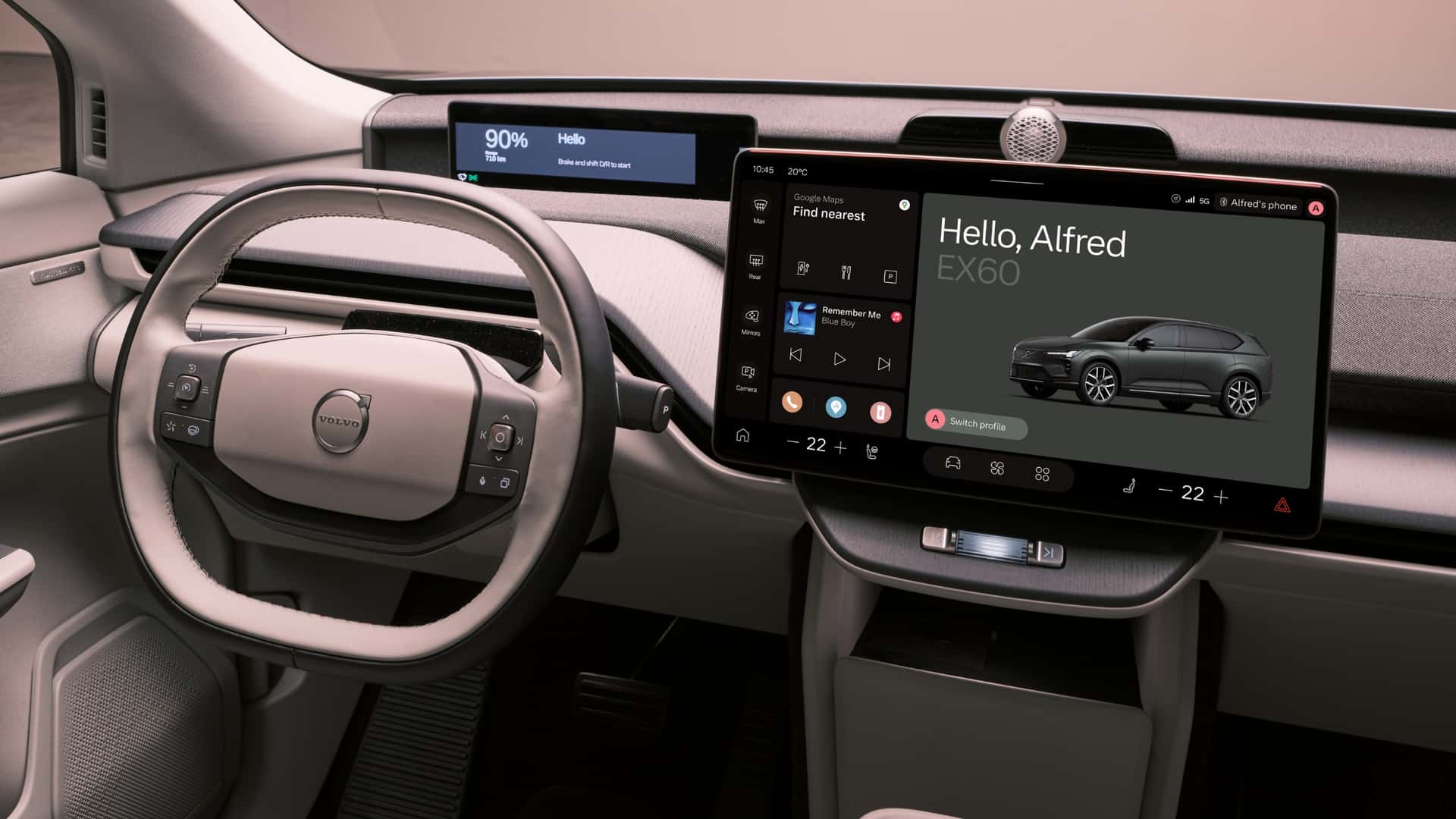
Volvo is an interesting company. Wherever you go—even among people who aren’t particularly interested in cars—there’s usually a sense of respect toward the Swedish automaker. That reputation has been earned over the years, with the company designing, engineering, and building vehicles with restraint.
For Volvo, 2026 is shaping up to be one of the most significant years in its history. Production of the new EX60 has just begun in Gothenburg—the brand’s first electric vehicle built in Sweden. This marks a major investment for the company, for Gothenburg, and for Sweden as a whole. Volvo has committed over $1 billion to introduce megacasting technology—large-scale die casting—at its Torslanda plant.
Against that backdrop, it’s a fitting moment to take stock of where Volvo—and the wider automotive industry—stands, in conversation with Eric Severinson, the company’s Chief Commercial Officer.
This story originally appeared on Motor1 Italy

Photo by: Volvo
Is The Torslanda Plant Ready For Other Models Based On The EX60 Platform?
Yes, a large part of the investment is in infrastructure. Take megacasting: the real cost isn’t the mold, but the machines, the buildings, and the whole process around it. It’s like building a road—now that it exists, you need to “fill it” with models.
We’re starting today with the EX60, but the foundation is already there for other models using the same technology, with much lower additional investment. In fact, we’re replicating the same approach in the new plant in Slovakia, which has already been designed with future models in mind.
Where Are The SPA3-Platform Batteries Made, And How Much Room Is There To Improve Software, Batteries, And Performance?
The cells come from China, supplied by Sunwoda and CATL. But the conversion into full battery packs happens in-house at Torslanda: the cells are assembled, bonded, integrated into the floor, and fitted with all the connectors. Unlike many other automakers, Volvo isn’t buying pre-built modules; a large portion of the battery pack is made in-house.
As for scalability, that’s exactly the strength of a modular platform: by keeping the interfaces between components constant, the architecture can be stretched or shortened with a high degree of flexibility. That makes it possible to cover very different segments, from compact models up to higher-end vehicles like the EX90, or even beyond.
The software is fully shared and based on a single electrical architecture: all SPA2- and SPA3-based vehicles use the same “master software,” which can be updated centrally across the lineup very quickly. The car becomes a product that continuously evolves, like a smartphone—a concept still new for many customers, but one that’s poised to reshape the industry.
Photo by: Volvo
How Do Platforms, Megacasting, And Cell-To-Body Affect Margins?
The issue is that an EV starts at a disadvantage: raw materials cost about three times as much as for an internal-combustion vehicle. So you have to make up for that with a much more efficient manufacturing process. And that’s where everything changes: an electric motor has few parts, compared with the hundreds in a combustion engine. But more importantly, you have to rethink the entire process—if you build an EV the same way you build a gas-powered car, it ends up too expensive.
That’s why solutions like megacasting and cell-to-body integration matter: no modules and no conventional battery pack—the cells become the floor structure that the seats mount to. That reduces complexity and cuts the cost of the floor structure by about 30 percent.
With megacasting, you cut another 30 percent in producing the rear floor structure. The goal is to get costs close to a plug-in hybrid—that’s the real turning point. And when prices are at parity, customers show up. People like EVs, but nobody wants to pay more just because it’s electric.
What About Concerns Over Repairability And Reliability?
The batteries are designed to last the life of the vehicle. And if you think about it, nobody really asks what happens if a combustion engine fails on a 10- to 15-year-old car—even though replacing it can be extremely expensive. Honestly, I’d be more worried about that than about a battery.
We offer a 10-year battery warranty; nobody offers similar coverage on a combustion engine. For structural components like the rear structure or floor: yes, repairs are more complex, but methods already exist to work on parts produced via megacasting. It’s more of a question for insurers, to the point that today we often see insurance premiums that are lower for EVs than for combustion vehicles.
Photo by: Volvo
Who Is The Target Customer For The New EX60?
It’s the classic primary family vehicle: customers in their early-to-mid 40s, with 2–3 kids, solid income, and homeownership. That said, early orders are also coming from different profiles—people downsizing from larger SUVs, for example, or customers without kids who are drawn to the design, software, and the audio system, which is genuinely impressive with 28 speakers, active noise cancellation, speakers in the headrests, and even passenger voice amplification.
What Sales Targets Do You Have?
I can’t get into specifics, but the objective is clear: make it a major success in its segment. Today we still sell a lot of XC60s, and this EX60 will play an important role in output at Torslanda, where we build about 285,000–290,000 vehicles per year. So yes, we’re talking about a high-volume product, and early results are very positive—we’re already exceeding our targets by a wide margin.
What Role Will Italy Play?
Italy isn’t really a single market—it’s made up of very different regions, split between North and South. That means you have to change your approach from one area to another: Sicily and Lombardy, for instance, require different strategies. And diesel still has meaningful weight there, especially for people who drive a lot, like sales reps or professionals who are constantly on the move.
With a long-range, fast-charging EV like this, we want to convince exactly those customers—people who are still skeptical but ready to make the leap. Because if you spend hours in the car every day, the comfort and quiet of an EV makes a real difference compared with even a modern diesel.
2028 Volvo EX60 Cross Country
Photo by: Volvo
How Do You See Demand For EVs Evolving Over The Next Few Years?
It depends heavily on the region. In Europe, I’m fairly confident: the path won’t be linear, but electrification will continue. You can already see it in rising energy prices after the war in Iran, growing interest in used EVs, and a sharp increase in online searches. Germany, Belgium, the Netherlands, and Scandinavia are leading the way.
In the United States, it’s more complicated: the EV market is declining, many incentives have ended, and there’s a swing back toward combustion engines, also tied to energy independence.
China will electrify, but starting from the bottom: more affordable segments and local manufacturers, with margins under increasing pressure. If we look five years out, we’ll see a world that’s much more electrified than today and, even if not everywhere, EVs will be the majority. In Europe, the real inflection point will be between 2030 and 2035.
What Role Do Dealerships Play Today?
They’re central. We’re very proud of our retail network; it’s a fundamental part of our commercial system. That said, we need to evolve: customers will be increasingly digital, more online, more oriented toward leasing, and facing ever-stronger competition.
So the challenge is to transform together with our dealers: improve the online experience, bring the customer into the showroom, and deliver a truly personalized service. The manufacturer can’t do it alone, and neither can the retail network—it has to be a shared effort.
What About Subscription Features? Are Customers Ready To Pay For Heated Seats?
If you sell a premium product, you shouldn’t nickel-and-dime customers: someone spending about $80,000 shouldn’t be asked for another $5 a month for basic functions like heated seats—especially when those features are included on much cheaper cars. That isn’t the right path.
A paid model can make sense for more comprehensive software-based services: connectivity packages or advanced driver-assistance suites, possibly bundled. As with services like Netflix or Disney+, a subscription can provide access to additional, valuable content.
But the goal remains to make the customer feel like they’re getting a premium, hassle-free experience—that’s what creates value and, in turn, profit.
17