

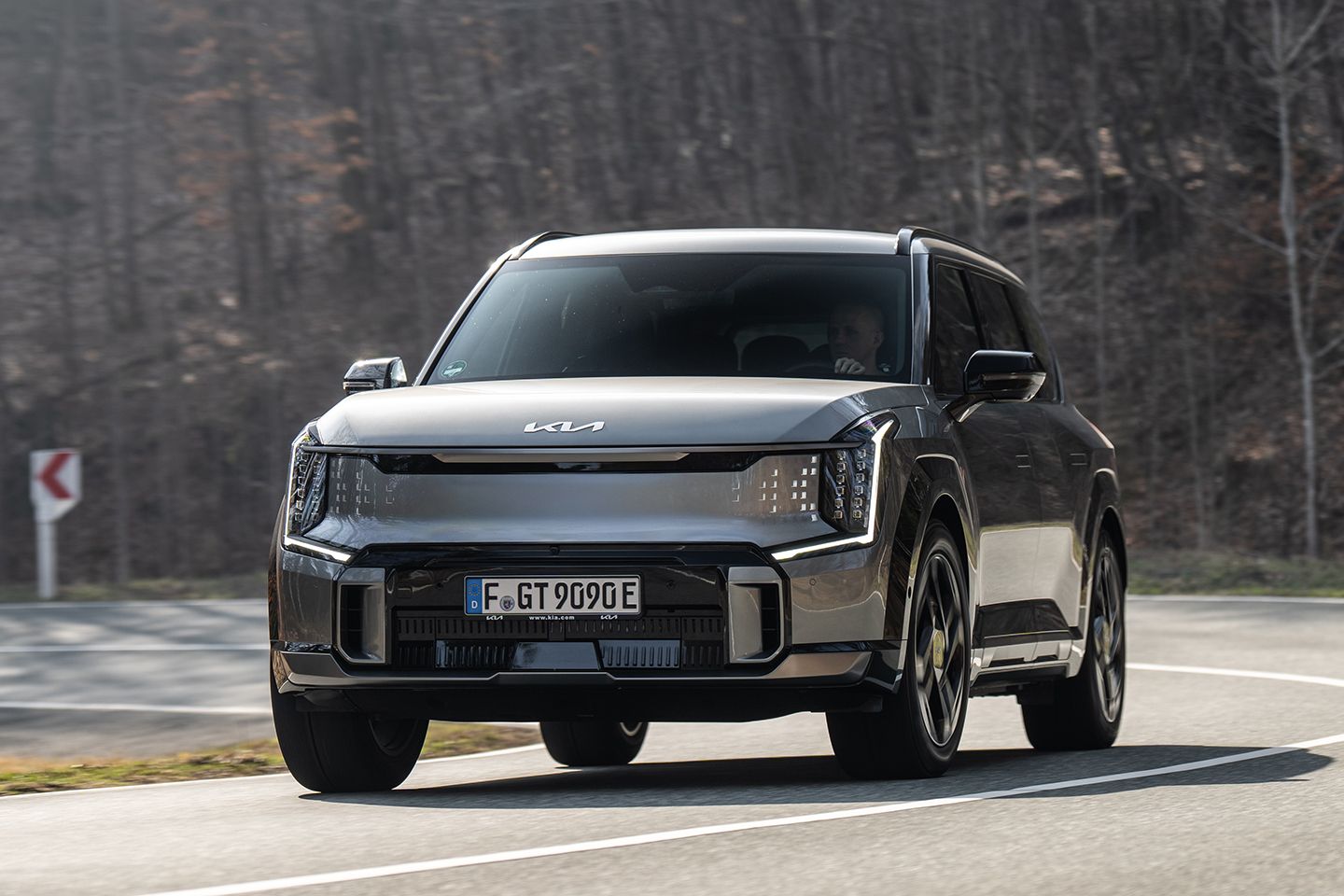
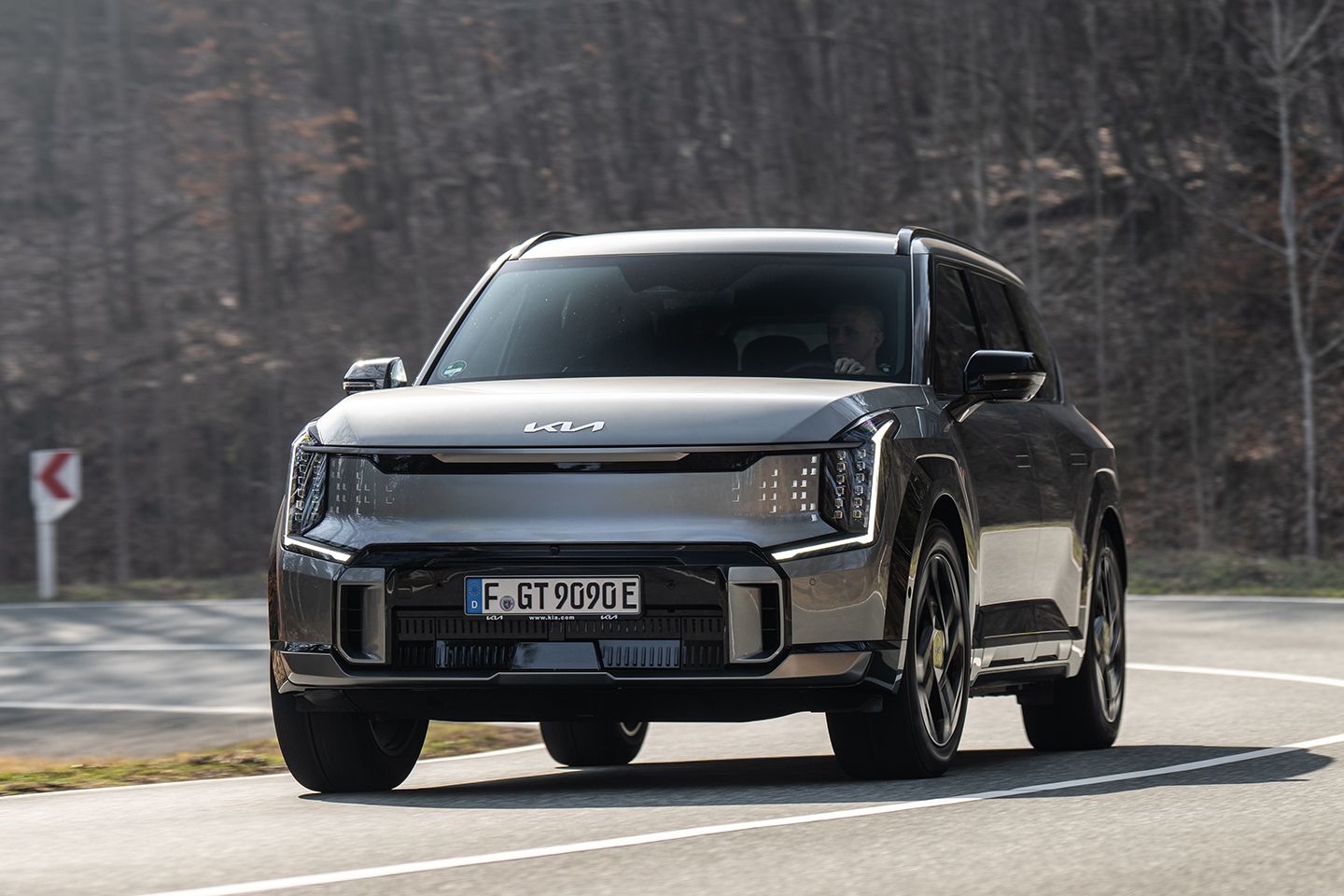
This EV9 is the first of four GTs we’ll see this year as Kia sportifies its entire EV range. I’d bet it’s the EV4 GT hot hatch we’re all most intrigued by – and most likely to consider sparing a monthly outlay for – but that remains a few months off yet. For now, the biggest of the bunch acts as a tech halo for those beneath.
Plenty of its highlights we’ve seen already, mind, most notably its Virtual Gear Shift (VGS) system, here operating through eight speeds with a 7,200rpm redline. A little feistier than the EV6 GT we’ve tried in that regard, though it’s less muscular elsewhere. Its twin e-motors – 189hp at the front, 319hp at the rear – combine for lower 508hp and 546lb ft peaks in an SUV weighing half a tonne more. Yet one that’s still good for 0-62mph in 4.6 seconds and a more than adequate 136mph top speed.
It’s four-wheel-drive then, and with a bunch of chassis developments over a stock EV9 to make it a tauter, more gratifying thing to drive. Electronically controlled suspension alters its tautness depending on drive mode, helping mitigate the roll one might expect, while brake-based torque vectoring and an electronic limited-slip differential do their bit to chip away at the 2.7-tonne weight and five-metre length of a car that “has been developed to be fun to drive,” according to the spiel. As you’d hope for a GT-badged device, of course – but this remains a leviathan SUV that seats six or seven first and foremost.

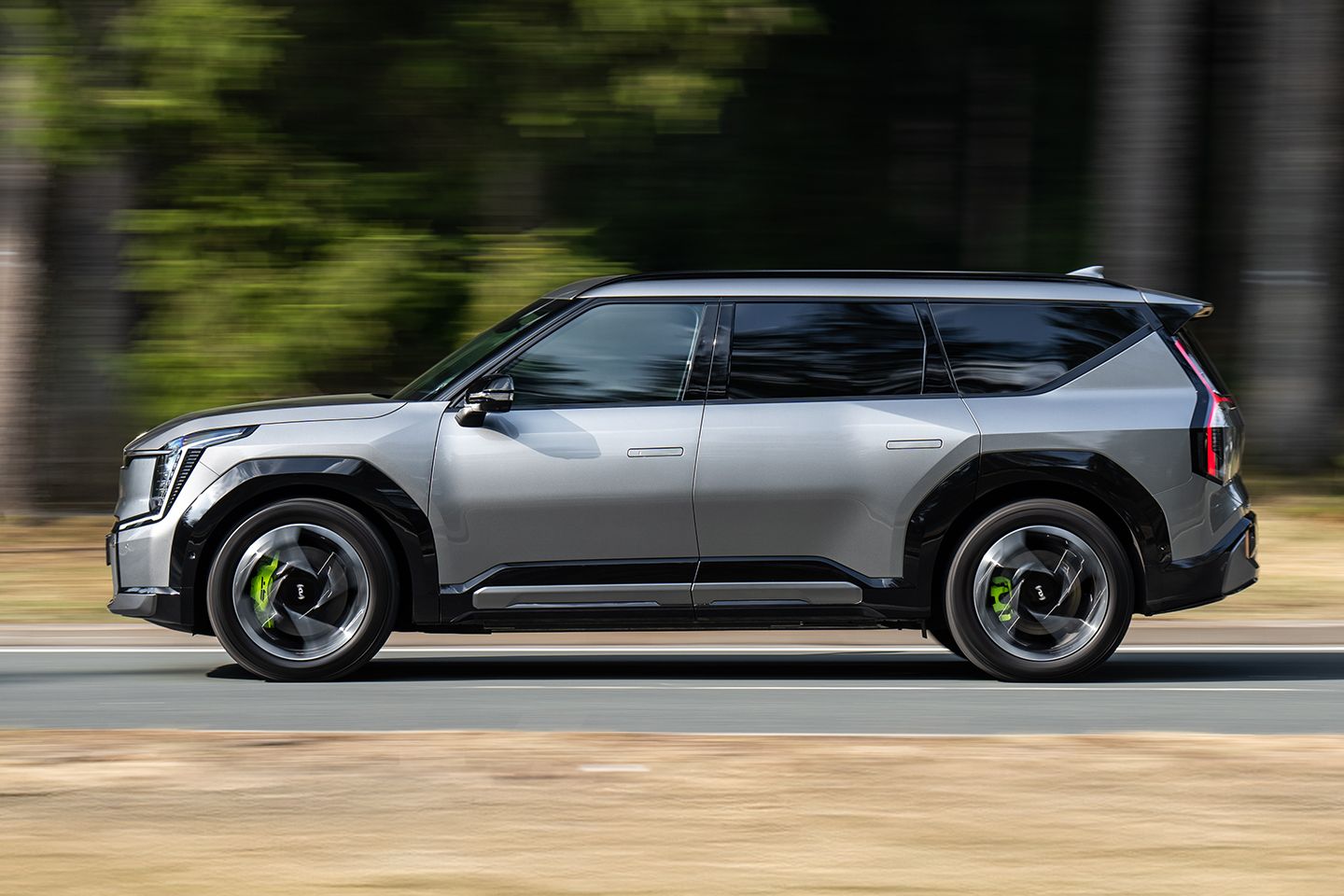
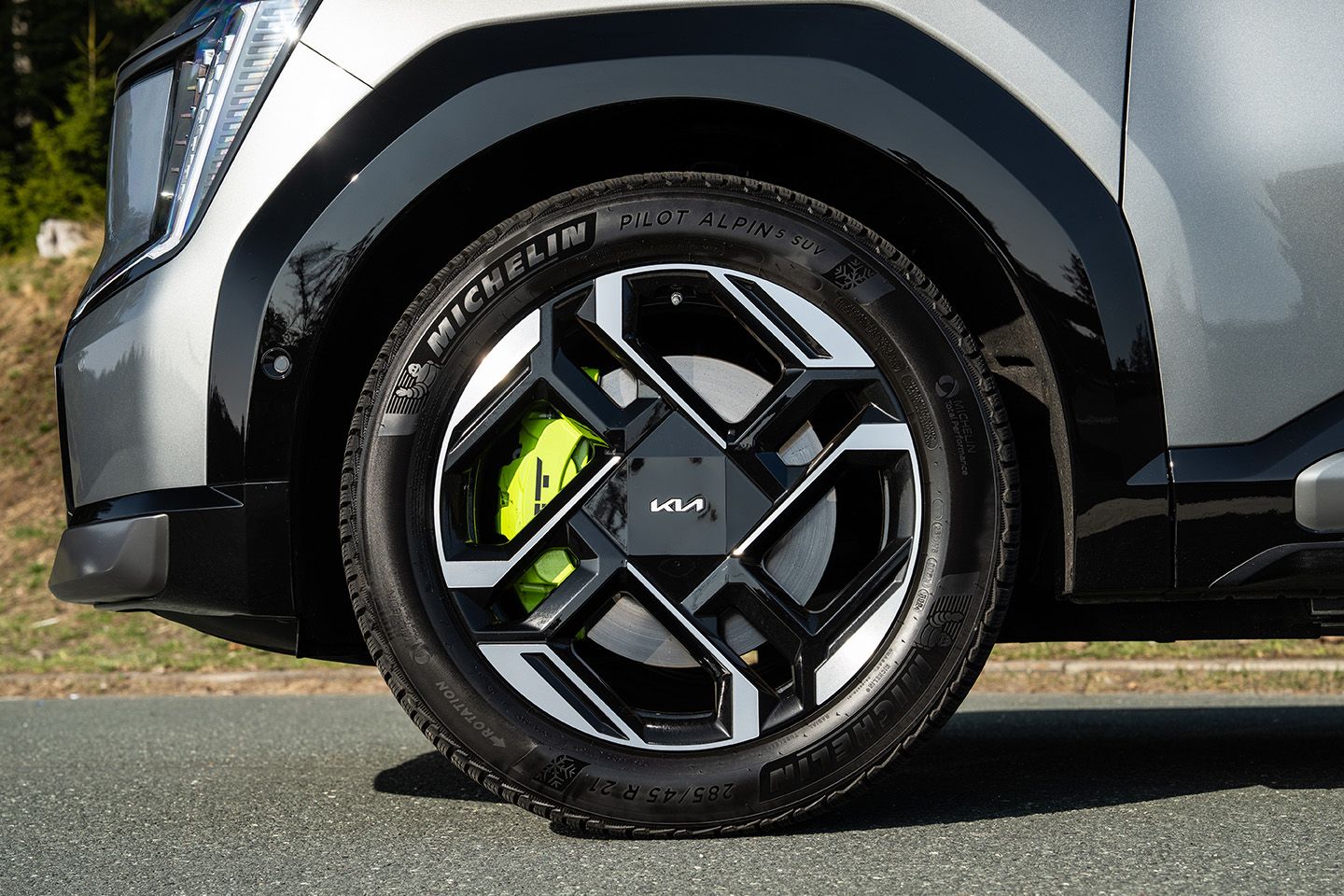
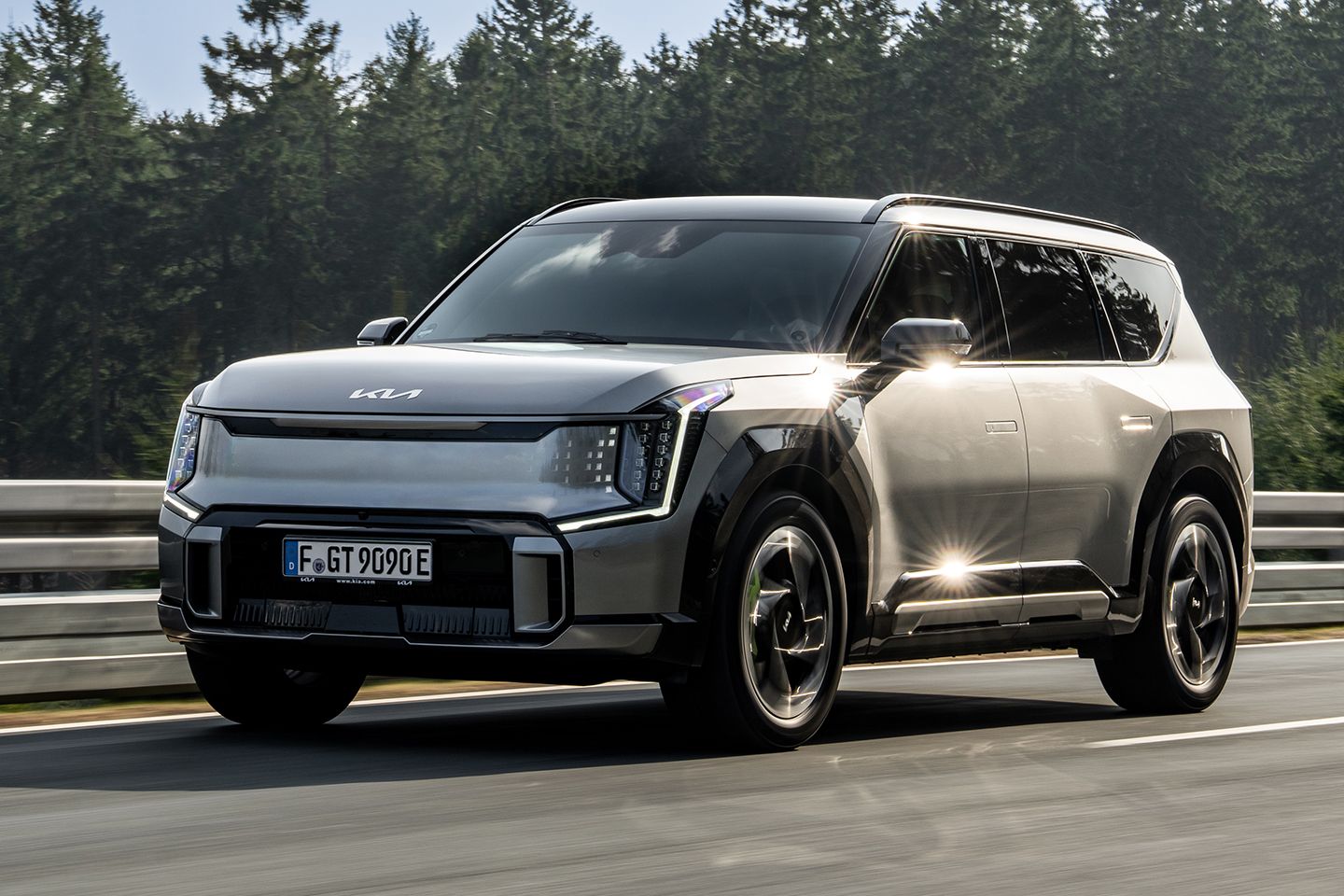
Its battery is bigger than an EV6’s too, matching the standard EV9 at 99.8kWh for a claimed range of 316 miles, 350kW max DC charging and a 10-80 per cent top up possible in 24 minutes (with a fair wind). Those wishing to tell an EV9 GT apart from its base car will need to be versed on its fancier 21-inch wheels (2kg lighter than regular 21s and wrapped as standard in Continental SportContact 6s) and lime green brake calipers, plus a new lighting signature that bleeds into the front fascia with “digital grille patterns available to purchase via the Kia Connect Store”. Sigh.
The price is… well, you can scroll down to the spec, if you really must know, because I fear it’ll steal the attention from the thorough engineering Kia has put into the thing. It also pigeonholes the car as niche, when in philosophy it really doesn’t feel far removed from sticking a supercharged V8 in a Defender 130 – it has the potential to grenade already modest efficiency, but counters with the sort of satisfying, deep reserve of power that people like us adore and which makes driving a car of this stature much easier to justify at your next cars ‘n’ coffee. And at £162 per horsepower, the GT’s output is precisely half the price of an entry EV9’s. Let’s chalk that up as some improbable PH consumer advice.
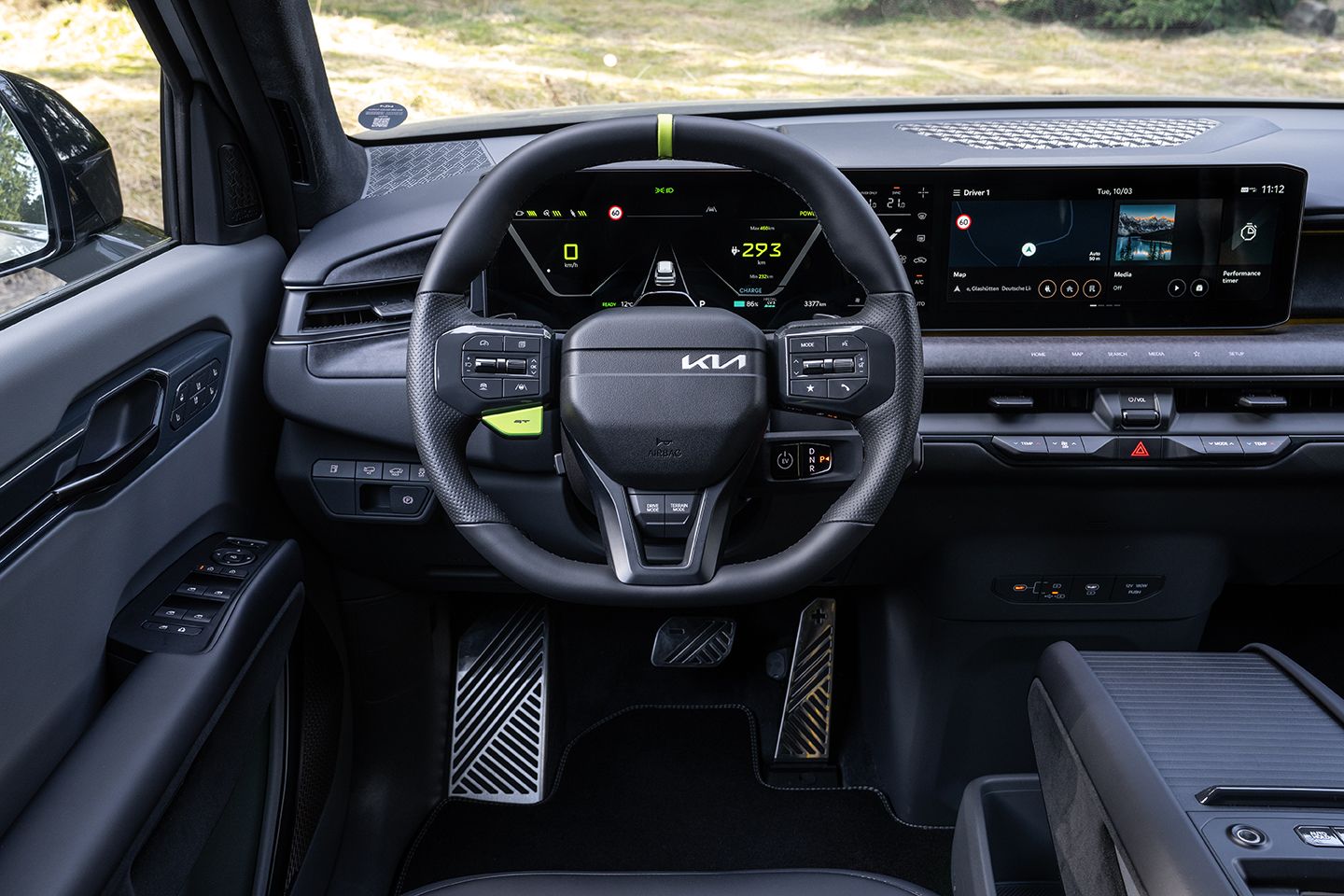
The GT exhibits a pleasing assuredness right from the off, and its enormous proportions are easier to guide out of its Frankfurt Airport car park than I’d first feared. It repeats everything that a base EV9 does well in those early kilometres, whooshing along without fuss and its ride remaining compliant. Patience isn’t a virtue of mine, so I’m quick to press the star button on the steering wheel that shortcuts its VGS into action. Even leaving it on in the background, to mimic an eight-speed auto shuffling gears of its own accord, brings some pleasing normality to progress.
You aren’t offered the OTT soundtrack options as its N Division applications, though you do get different volume levels for its reasonably gratifying electro-thrum, a weird mash-up of old ICE and modern EV sound that somehow works. Without it, VGS would seem a bit pointless. The system is a pleasure whether you’re bored pottering along in traffic or relishing a twisty, more interesting road, giving you something familiar to latch onto and evidence of a spark in a car that, on paper, isn’t core enthusiast fodder. It represents a vital sign of life.
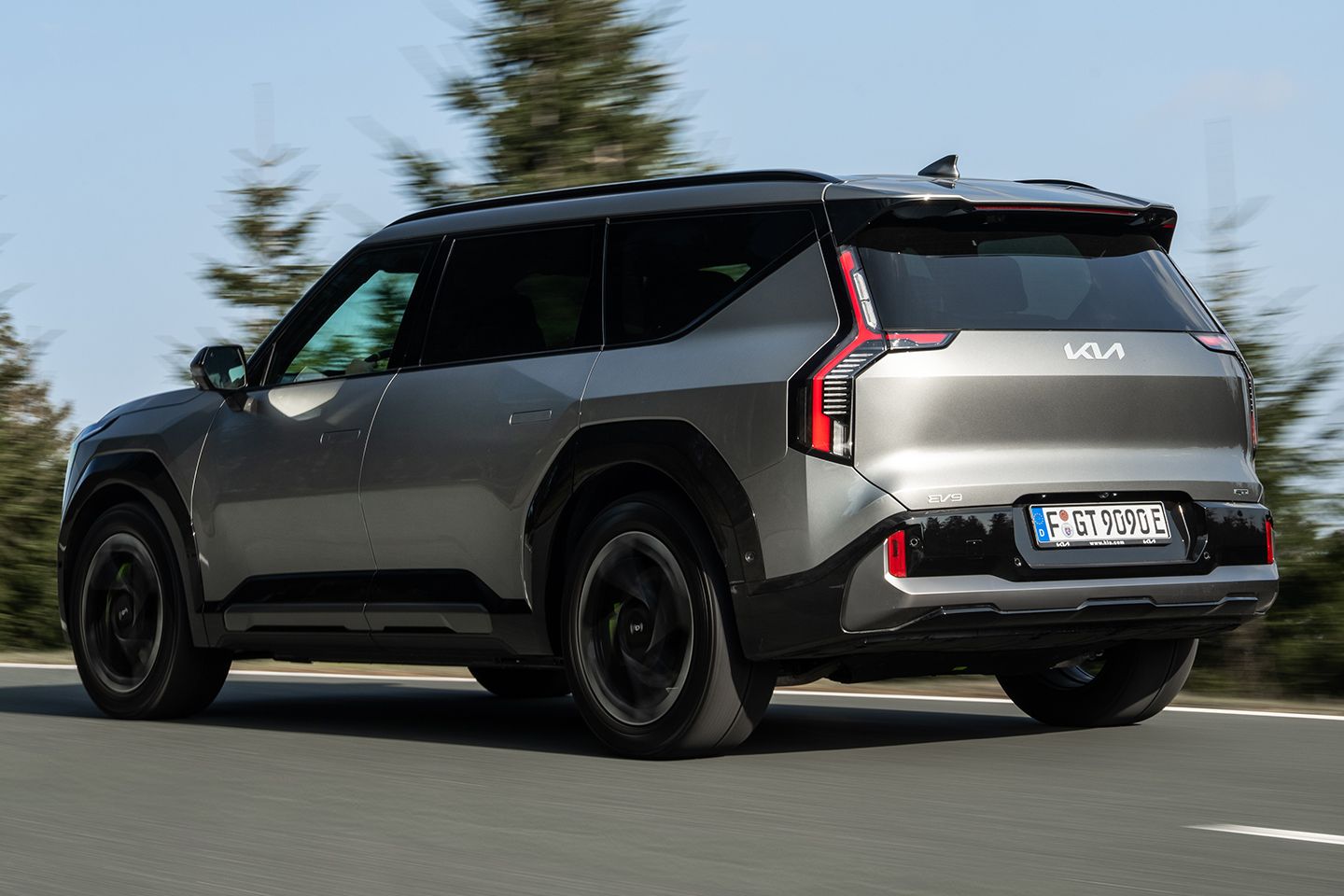
With more commitment on those twisting roads its front end is commendable, tucking nicely into corners via positive steering response, and the car resists roll well. Its size doesn’t metaphorically shrink as well as rear-steered rivals, but its considered damping and the helping hand of torque vectoring get you shuffled through turns quite efficiently. With the bias of power on its back axle, the rear tyres will happily spin up under provocation too – the damp hairpins above Frankfurt and its necessary Michelin Alpin winters only highlighting the cartoonishness if you’ve loosened the ESC – but to no one’s surprise this is a car best driven in a less boorish way. And one that should feel smarter on its proper Contis back on British tarmac.
The EV9 GT never coalesces into being a Cayenne Turbo wannabe and it’s not truly sporty by any traditional measure, but it’s pleasant nonetheless. Ramp up through its suspension parameters and not only might you suspend belief that something this tall can corner so relatively flat, but you might also forget to notch the damping back down once the fun’s over, the car feeling amenable across all its drive modes. At least on German surfaces.
Performance? It’s obviously quick, as its stats suggest, but this is an EV whose prodigious power is very easy to manage, even more so with VGS activated and its acceleration artificially stifled. A quiet stretch of mid-morning, derestricted Autobahn allows me to achieve a hushed, hurried rush to an indicated 139mph before restriction signs illuminate on the horizon. And yet the cabin retains its calm; wind and tyre roar inevitably climb, as they do in any ICE car subjected to such public performance runs, but really not by much. It’s clearly silly to cruise at triple-figure speeds in your EV on a daily basis – unless you have a sub-hundred-mile commute and cheap, easy charging at both ends of it – yet it’s highly plausible here.
Top marks for its regenerative braking, too. Like other Kias, it alters through four levels, each of which can be allied to one-pedal driving. Why does no one else do this? A one-pedal mode makes traffic a cinch but is typically too heavy-handed in its braking – here, you can enjoy a smoother, more natural stop and a taste of autonomous driving without having to truly yield control. Naturally its regen modes and VGS abilities are mutually exclusive, given they tread similar paths from a functionality point of view and occupy the same steering wheel paddles.
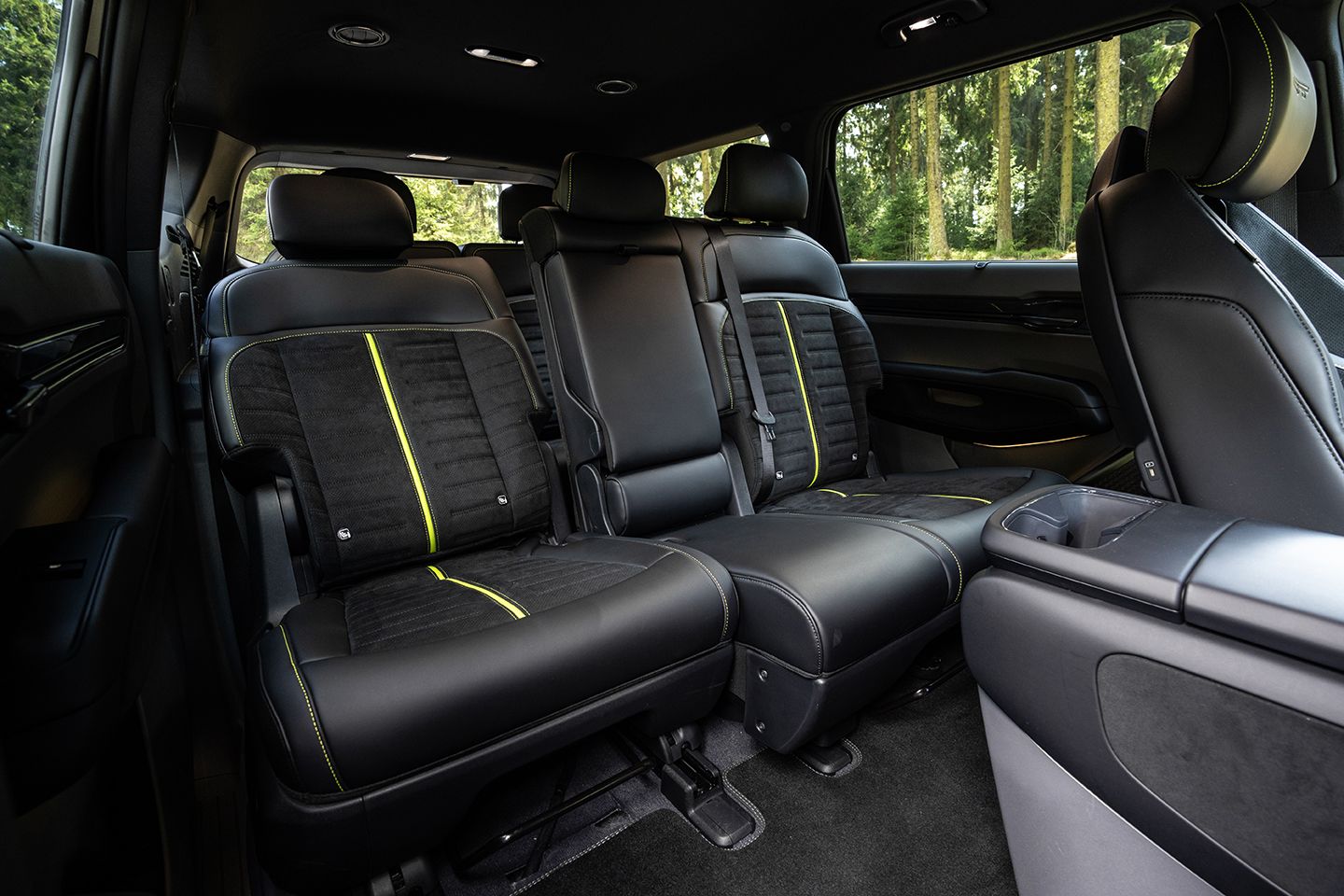
Six seats cost £1,000 more than seven (the middle row becoming captain’s chairs if you tick the box), but either way, flipping down the back row opens up 828 litres of luggage volume, while losing rows two and three gives you a stonking 2,318 litres. That’s more than a Defender 110 Commercial and comes allied to a 52-litre frunk, a ton of cubby holes and charging ports, plus vehicle-to-load capability – all underscored by a 0-62 time that shades an F355. But perhaps it’s the way the EV9 GT hustles itself along quietly, claims over 300 miles of range and charges so rapidly that will prove the triple threat most owners revel in.
All told, this is a very easy car to like, yet one that’s a lot harder to genuinely recommend given the depreciation that will almost certainly follow in its wake. You need gumption to spend this much money on a brand-new electric car of any kind, never mind a Kia. But it’s not designed to muscle the Sportage from Britain’s bestsellers list, instead being a tech showcase its engineers have evidently had fun developing – without abandoning what a big family bus truly needs to do. Folks at the group’s European R&D hub have come from McLaren, M Division and elsewhere, and their flow clearly isn’t stifled, whatever car they’re being applied to. The EV4 GT hot hatch has some level of expectation to live up to.
SPECIFICATION | 2026 KIA EV9 GT
Engine: Twin permanent magnet synchronous electric motors
Transmission: Single-speed, all-wheel drive
Power (hp): 508
Torque (lb ft): 546
0-62mph: 4.6sec
Top speed: 136mph
Weight: 2,718kg
Battery: 800V lithium-ion, 99.8kWh capacity
Efficiency/range: 2.8mi/kWh, 316 miles
Max DC charging: 350kW; 10-80% charge in 24mins
Price: £82,235