

Pitch events are often treated as performance: a founder, a deck, a room, and a moment of confidence.
But the more useful lens is diagnostic.
Early-stage pitches reveal what founders think matters, what evidence they can produce, and where the uncertainty still sits. They also surface the dynamics shaping the next phase of innovation: which problems are being prioritised, where new infrastructure is forming, and how new technologies are being translated into investable narratives.
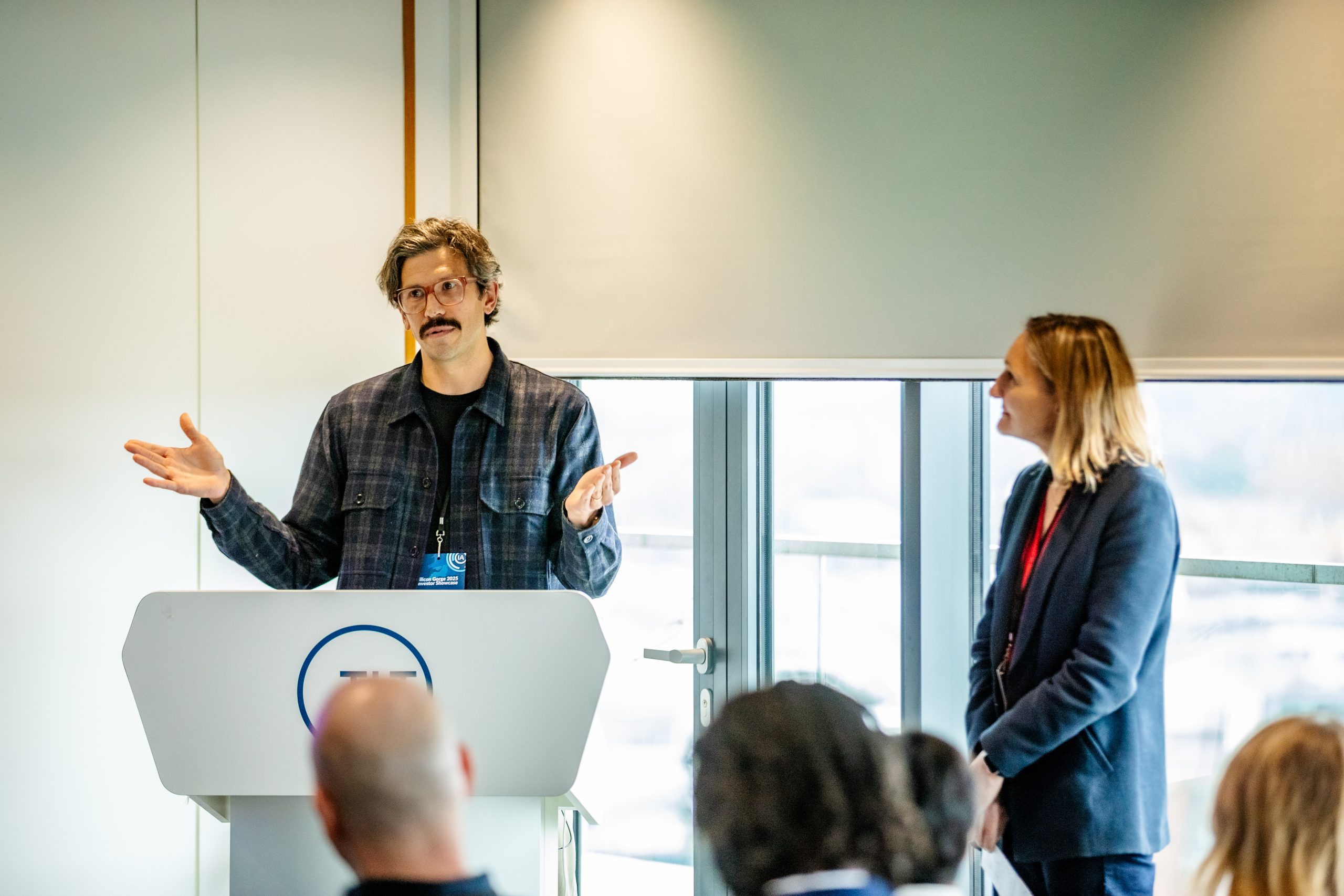
On 27 January, techSPARK hosted the first Pitch Me! session of 2026, part of the Investment Activator Programme (the feeder community for Silicon Gorge). Four founders pitched four ventures. The diversity of ideas was notable, but more importantly, so were the patterns that emerged in the feedback and questioning.
Four ventures, four different innovation logics
The most striking feature of the session was how little the pitches resembled one another. The ventures operated across entirely different domains and relied on different “innovation logics” (what makes this defensible, scalable, and worth funding).
One pitch addressed a persistent friction point in e-commerce: customers cannot easily visualise products in their environment. The proposed solution was a universal visualisation engine positioned not as a standalone feature but as enabling infrastructure for improved conversion and reduced returns.
Another pitch focused on accelerating creative production without displacing creative authorship. The technology aimed to support artists and animators with AI-driven workflow enhancement. This sits within a growing category of tools designed to augment skilled labour rather than automate it.
A third pitch argued for a rethink of how non-programmers interact with information systems. Rather than another interface layer, it positioned the opportunity as structural: enabling more people to shape and interrogate data without needing developer-level capability.
The fourth pitch focused on social connection at a time when AI companionship is increasingly normalised. The founder framed AI as a short-term solution that may intensify long-term isolation, proposing collaborative storytelling as a way to rebuild human connection.
Taken together, these pitches reflect a broader trend: innovation is no longer only about novel technology, but about designing systems that alter behaviour, reduce friction, and shift access to capability.
What the pitch process is really testing
From an investment perspective, early-stage pitching is not primarily about the product. It is about the structure of belief.
At seed and pre-seed, the core question is rarely “does it work?” but:
- does the market exist at meaningful scale?
- does adoption require behaviour change, and if so, how is it mitigated?
- is the model plausible at the unit economics level?
- what becomes true after the raise that is not true today?
- what evidence will meaningfully reduce uncertainty?
PitchMe!’s format makes these uncertainties visible quickly. This is valuable for founders, because it forces them to distinguish between what they know internally and what can be demonstrated externally.
A recurring issue: narrative misalignment
Several pitches surfaced a common failure mode in early-stage fundraising: misalignment between the product’s nature and the story being told.
In one case, the panel pointed out that the venture was highly visual, yet the deck did not visually demonstrate the product. That is not cosmetic. In product categories where understanding is visceral, the pitch itself must function as proof of value.
In another case, visuals were strong, but the “investment narrative” remained under-specified: the route to market position, defensibility, and the mechanisms through which a raise translates into momentum needed tightening.
This is one reason pitch practice matters: the quality of a pitch is often correlated with the maturity of strategic thinking. A founder who can compress a complex idea into a coherent, investable narrative is usually a founder who is already building an operating system around the business.
Why this matters: pitching as a continuous capability
Historically, pitching was treated as episodic: a fundraising activity.
That assumption no longer holds.
In a market defined by fast-moving tooling, shifting cost bases (particularly compute), and compressed cycles of customer adoption, founders are increasingly required to pitch continuously: to customers, partners, prospective hires, grant programmes, strategics, angels and accelerators.
The pitch deck becomes less a fundraising artefact and more a portable representation of strategy.
That in turn changes what effective pitch environments need to do. The role of a pitch session is not simply “exposure”, but iteration: translating hypotheses into investable claims, tightening the proof points, and reducing ambiguity.
Pitch Me! returns on 3 March.
If you are an early-stage founder preparing to raise, pitching is one of the highest leverage tools available to you, not because it wins funding on the day, but because it accelerates learning.
If you would like to pitch, message me to register interest for the next session.