

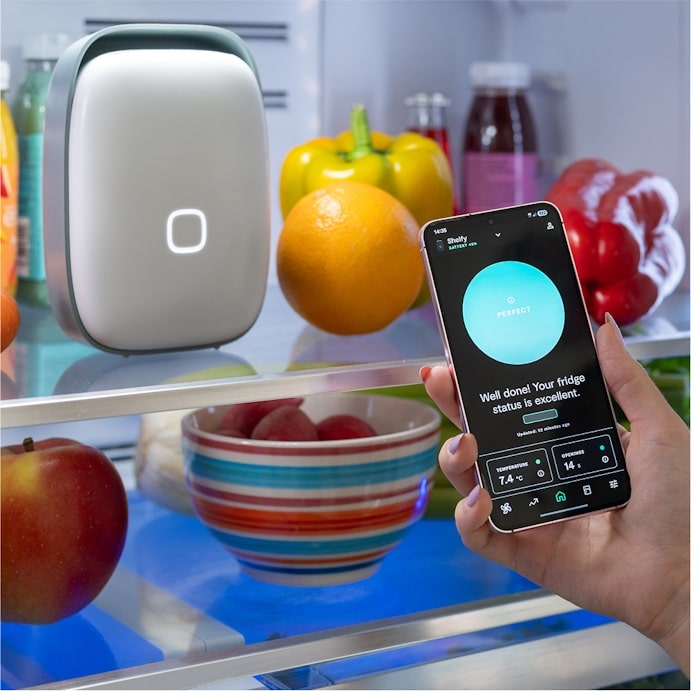
Vitesy Shelfy Smart Fridge Deodorizer for Longer-Lasting Food
Food waste starts quietly. Your refrigerator traps moisture, bacteria, and odors that shorten freshness. The Vitesy Shelfy smart fridge deodorizer targets that exact problem with active air purification inside your fridge.
Vitesy positions Shelfy as a compact, rechargeable device that preserves food naturally. It sits inside any refrigerator and works without chemicals or filters. This Spotlight delivers a full technical breakdown for leaders, founders, and smart-home buyers who want measurable value, not marketing claims.
The Real-World Problem the Vitesy Shelfy Smart Fridge Deodorizer Solves
Refrigerators circulate cold air. They do not purify it.
Odors mix. Moisture lingers. Bacteria multiply. Ethylene gas from fruits accelerates spoilage of nearby produce. The result is early food decay, flavor contamination, and unnecessary grocery spending.
That matters because households waste nearly 30 percent of purchased food globally, according to the FAO .
Traditional baking soda absorbs some odor. It does not neutralize bacteria, reduce airborne contaminants, or actively circulate air.
The Vitesy Shelfy smart fridge deodorizer introduces active purification. Instead of masking odors, it targets microorganisms and volatile organic compounds at the source.
In practice, that means:
• Produce lasts longer
• Strong smells fade faster
• Cross-contamination drops
• Fridge interiors stay fresher between deep cleans
This shifts your refrigerator from passive storage to controlled preservation.
Market Positioning and Category Context
The Vitesy Shelfy smart fridge deodorizer operates in a niche category: compact, active air purifiers built specifically for refrigerators.
Most alternatives fall into three groups. First, passive odor absorbers such as charcoal or baking soda. Second, chemical deodorizers. Third, UV-based sterilizers.
Shelfy differentiates itself through photocatalytic oxidation technology combined with active airflow. In addition, it runs on a rechargeable battery and fits inside standard refrigerator compartments without modification.
From a pricing standpoint, it sits above disposable solutions but below premium refrigerator upgrades with built-in purification. Therefore, it occupies a strategic middle ground.
It targets:
• Eco-conscious households
• Premium grocery buyers
• Families focused on reducing waste
• Smart home adopters
Here is where it stands out. The device requires no filter replacements. It uses USB-C charging. It also integrates app monitoring. As a result, it feels closer to connected lifestyle hardware than a simple kitchen accessory.
Design, Materials, and Build Quality

The Vitesy Shelfy smart fridge deodorizer uses a compact vertical design that stands upright on shelves. Consequently, it avoids blocking airflow or consuming valuable storage space.
Its dimensions remain small enough to prevent interference with food organization. That matters because fridge space carries real value in daily use.
The housing uses durable ABS plastic with a matte finish. The structure feels rigid under light pressure, and the device shows no visible flex.
Air intake vents wrap around the body to enable 360-degree circulation. Instead of relying on passive diffusion, Shelfy actively pulls air inward and pushes treated air back out.
Meanwhile, the internal fan operates quietly. Even in silent kitchens, noise remains minimal.
On the front, a subtle LED indicator communicates operating mode and battery level. The aesthetic remains minimal and unobtrusive.
Finally, the USB-C charging port sits discreetly at the base. This choice improves convenience because most households already use compatible cables.
Design serves function throughout. Nothing feels decorative or unnecessary.
Full Hardware Breakdown of the Vitesy Shelfy Smart Fridge Deodorizer
Now we move inside the unit.
The Vitesy Shelfy smart fridge deodorizer relies on three core components:
• Active fan system
• Photocatalytic reactor
• Rechargeable lithium battery

Active Fan System
Shelfy integrates a low-energy fan that pulls refrigerator air into its purification chamber. As a result, airflow increases contact between contaminated air and the purification core.
Passive purifiers depend on ambient circulation, which limits coverage speed. By contrast, active airflow accelerates air exchange cycles.
In real use, odors dissipate faster and airborne bacteria face higher exposure to treatment.
Photocatalytic Oxidation Core
This component forms the technical center of the device.
Shelfy uses photocatalytic oxidation technology, combining a catalytic surface with UV light to trigger oxidation reactions. These reactions break down:
• Bacteria
• Mold spores
• Volatile organic compounds
• Odor-causing molecules
Unlike ozone generators, properly engineered photocatalytic systems avoid harmful byproducts. Therefore, the approach focuses on molecular breakdown rather than scent masking.
Lithium Battery System
The device runs on a rechargeable lithium battery designed for multi-week operation per charge, depending on mode selection.
Because it operates wirelessly, it avoids clutter inside the refrigerator. USB-C charging further simplifies maintenance.
Energy consumption remains low, which reduces long-term operating costs.
Performance in Real Use
Specifications only matter if performance holds under daily conditions.
The Vitesy Shelfy smart fridge deodorizer runs in continuous cycles, actively circulating and treating refrigerator air.
In practice, strong odors from fish or aged cheese decline within hours. Additionally, leafy greens and berries show slower visible decay.
Cross-aroma contamination also drops. Butter maintains a neutral taste even when stored near strong foods.
Here is where it gets interesting. Ethylene gas accelerates ripening in confined spaces. By improving air movement and reducing airborne contaminants, Shelfy indirectly slows spoilage interactions.
It does not replace refrigeration. Instead, it optimizes the environment inside it. Over time, that translates into fewer discarded groceries.
Software, App, and Intelligence Layer
The Vitesy Shelfy smart fridge deodorizer includes Bluetooth connectivity and a companion mobile app.
Through the app, users can monitor battery levels, switch modes, view usage statistics, and receive maintenance alerts.
As a result, guesswork disappears. You see operating status in real time.
Most configurations include eco and boost modes. Eco mode extends battery life. Boost mode increases purification intensity after odor spikes.
Importantly, core functionality does not require cloud dependency. Therefore, the system maintains privacy while still delivering convenience.
Battery Behavior and Charging Architecture
Battery performance determines long-term usability.
The Vitesy Shelfy smart fridge deodorizer delivers multi-week runtime per charge under eco settings. However, boost mode consumes more power to increase purification speed.
USB-C charging simplifies recharging. Most users can recharge during routine fridge cleaning without disruption.
The trade-off appears over extended ownership. Lithium batteries degrade gradually, and this unit does not offer user-replaceable cells. Consequently, long-term service life may fall behind wired alternatives.
Competitive Comparison Analysis
Let us compare the Vitesy Shelfy smart fridge deodorizer against common alternatives.
Vs. Arm & Hammer Fridge Baking Soda
Price: Shelfy costs more upfront.
Performance: Baking soda absorbs odors passively. Shelfy actively purifies air.
Maintenance: Baking soda requires monthly replacement. Shelfy recharges.
Winner: Shelfy for performance and long-term sustainability. Baking soda for minimal budgets.
Vs. WISELIFE Refrigerator Deodorizer
Price: Similar mid-tier range.
Technology: Many competitors rely solely on activated carbon. Shelfy adds photocatalysis.
Power: Some use disposable batteries. Shelfy uses USB-C recharge.
Winner: Shelfy for sustainability and app integration.
Vs. UV-C Sterilizer Devices
Price: UV devices often cost more.
Coverage: Direct UV treats only exposed surfaces. Shelfy treats circulating air.
Safety: Poorly designed UV units may introduce risk.
Winner: Shelfy for balanced safety and air circulation coverage.
For ROI-focused buyers, Shelfy delivers higher upfront cost but lower recurring expense.
Ideal Use Cases for the Vitesy Shelfy Smart Fridge Deodorizer
The Vitesy Shelfy smart fridge deodorizer fits best in:
• Homes purchasing fresh produce weekly
• Families cooking strong-smelling foods
• Eco-conscious households reducing waste
• Premium grocery buyers protecting higher food investments
• Compact apartments prone to odor buildup
It also suits short-term rentals where odor neutrality improves guest experience.
Where It Falls Short
No device solves every problem.
The Vitesy Shelfy smart fridge deodorizer cannot revive spoiled food. Moreover, it does not eliminate the need for regular fridge cleaning.
Battery replacement remains non-user-serviceable. Additionally, the price may feel high for buyers accustomed to low-cost deodorizers.
Bluetooth connectivity limits remote access. Therefore, users seeking Wi-Fi integration may find the feature set restrictive.
Final Decision Matrix
Buy If:
You purchase fresh food frequently and want measurable waste reduction with minimal maintenance.
Consider If:
You value sustainability and prefer rechargeable systems over disposable odor absorbers.
Skip If:
You want a near-zero-cost solution or expect complete surface sterilization.
Executive Summary Verdict
The Vitesy Shelfy smart fridge deodorizer transforms passive refrigeration into active preservation. It reduces odor, supports longer freshness, and removes recurring filter costs. While the upfront investment exceeds baking soda solutions, the long-term value becomes clear for households serious about food quality and waste reduction. For eco-focused, tech-aware buyers, it stands as the smarter long-term solution.