

Sea-Scan strengthens naval security through greater situational awareness
Life
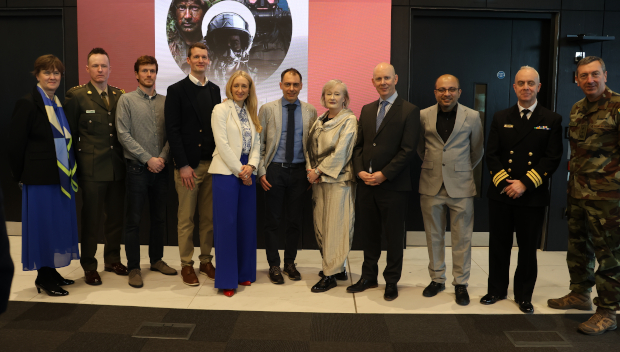
PIctured: Jaqui McCrum, Dept of Defence; Capt. Dave McKenna; Dr Kevin Roche; Dr Daniel McCrum; Dr Ruth Freeman, Prof. Marco Ruffini; Dr Rachel Iredale; Dr Diarmuid O’Brien; Koushik Nundy; Cdr Cathal Power; Lt Gen Rossa Mulcahy
More than €1.8 million has been awarded to two projects funding under the co-funded Research Ireland-Defence Innovation Challenge, a national initiative aimed at unlocking the power of research to develop enhance the capabilities of the Defence Forces.
The Challenge comprises three phases: concept, seed, and prize award. All successful teams at application will be awarded funding of up to €220,000. During the concept phase, teams will have access of up to €20,000 of this award. Up to five teams will progress to the seed phase. These finalist teams will then compete for an overall prize award of €1 million.
The 2024 programme has two streams: Challenges and Disruptive Ideas.

In the Challenges stream, four challenges were identified in collaboration with the Defence Forces and Department of Defence: Advanced Shelter Concepts, Maritime Situational Awareness, Search and Rescue and Aeromedical Emergency Dispatch.
The Disruptive Ideas stream included disruptive/radical technologies across the areas of: Medical Technologies, Disaster Relief, Peacekeeping, Climate Change and Sustainability, and Information and Communications Technologies (ICT).
The Sea-Scan team, led by Prof Marco Ruffini and Dr John Kennedy, Trinity College Dublin and Defence Forces Liaison Cdr Cathal Power, has been awarded prize funding under the Maritime Situational Awareness Challenge. The project represents an important opportunity to enhance Ireland’s ability to monitor maritime activity, including the detection of so-called ‘dark’ vessels, strengthening both national security and economic resilience. Sea-Scan will develop an AI-enhanced real-time vessel detection system to support early warning and improved situational awareness. Beyond security, the system also has potential applications in environmental monitoring, contributing to a broader national resilience.
Prof Marco Ruffini, Sea-Scan team lead, said: “Maintaining strong awareness of activity in Ireland’s maritime domain is essential, particularly given the country’s role as an island nation and a key Atlantic gateway for digital connectivity. As subsea communications and energy infrastructure continue to grow in strategic importance, so too does the need for continuous, reliable monitoring of the surrounding maritime environment.
“Over the past year, we have demonstrated the potential to detect and characterise vessel activity using existing subsea fibre infrastructure, showcasing a robust sensing capability embedded within operational communications assets and enabling effective vessel monitoring and subsea infrastructure protection. This research lays the foundation for future capabilities that can complement existing maritime surveillance systems and support both national and European resilience.”
The MASH (Mobile Adaptable SHelter) team, led by Dr Daniel McCrum and Dr Kevin Roche, University College Dublin and Defence Forces Liaison Capt. Dave McKenna, has been awarded runner-up funding. Current deployable shelters used by the Irish Defence Forces are slow to erect and require large, specialised teams. The MASH team is developing a modular, rapidly deployable, multi-purpose shelter system for defence and humanitarian needs. Their solution combines speed, safety, durability, and adaptability for global impact.
Lieutenant General Rossa Mulcahy, Chief of Staff of the Defence Forces, said: “Innovation and collaboration are central to ensuring Óglaigh na hÉireann can continue to fulfil our roles effectively in a rapidly evolving security environment. The Research Ireland – Defence Innovation Challenge demonstrates the value of close partnership between Defence Forces personnel, researchers and innovators in developing practical, mission focused solutions.
Projects such as Sea-Scan have the potential to significantly enhance the Naval Service’s maritime situational awareness, supporting our ability to monitor, protect and respond within Ireland’s maritime domain. Equally, the Mobile Adaptable SHelter project represents an important advancement in deployable infrastructure, offering flexible, rapidly deployable shelter solutions that can support Defence Forces operations at home and overseas, as well as humanitarian and emergency response tasks.
I welcome this investment in capability development and commend the research teams for working closely with the Defence Forces subject-matter experts to deliver solutions that are operationally relevant and future focused.”
Dr Diarmuid O’Brien, CEO, Research Ireland, said: “Challenge-based research funding encourages researchers to work directly with those most affected by the problems they seek to address. The teams being funded today have developed their solutions through close collaboration with Defence Forces personnel.
“The Sea-Scan team are developing a high-quality solution to a complex problem that will deliver a transformational capability for the Irish Defence Forces. The MASH team have developed an impressive and innovative solution that balances speed and quality, offering a structure that can be assembled quickly without complex tools. I congratulate both teams and look forward to seeing them deliver their solutions to issues which are of critical national importance.”
TechCentral Reporters