

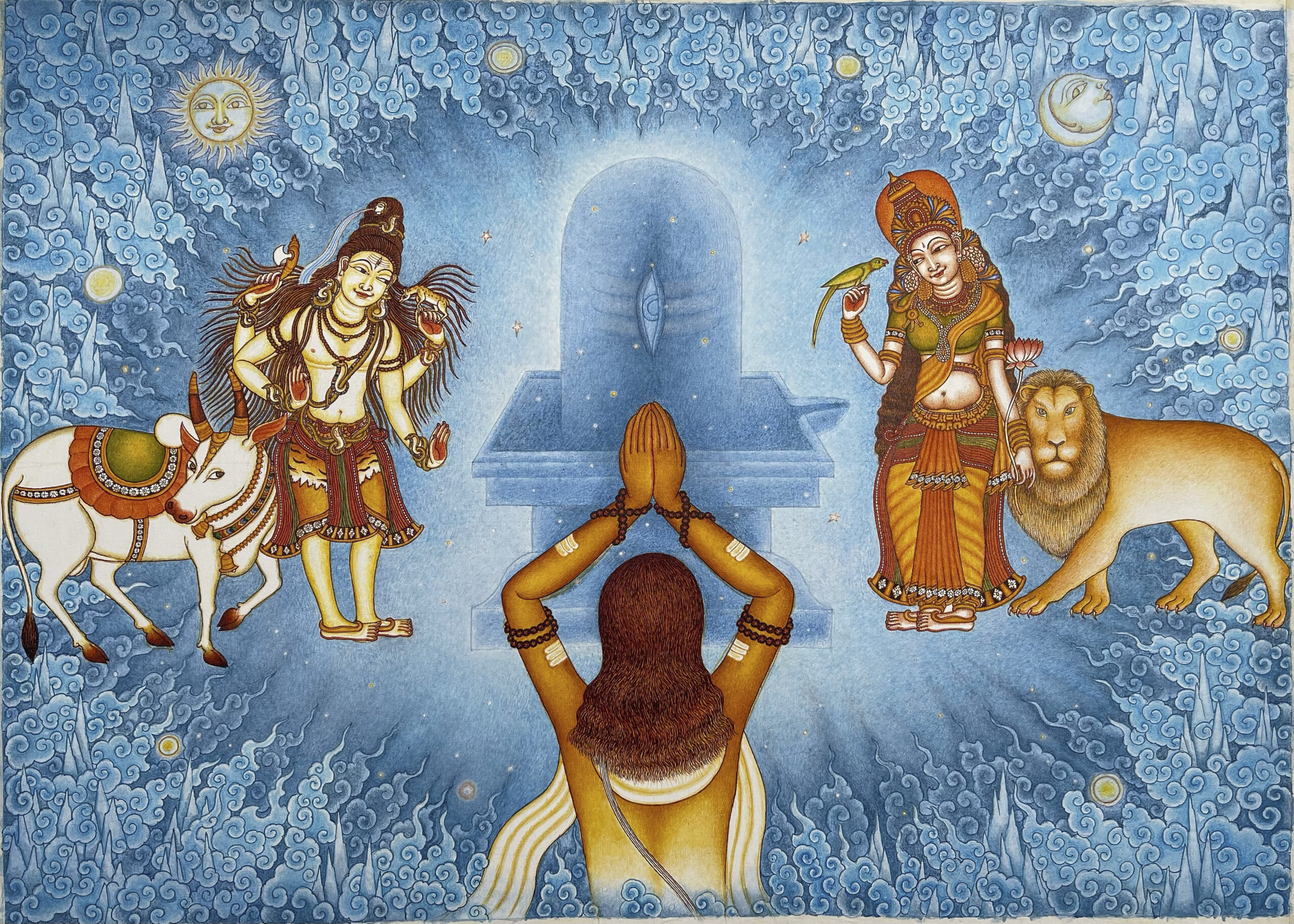
The Mystic Songs, Life and Profound Philosophy of a Tamil Sage
Main text by Dr. B. Natarajan • Art by Suresh Muthukulam
Decades ago, Satguru Sivaya Subramuniyaswami, the founder of Hinduism Today, was introduced to Dr. B. Natarajan, an economist, writer and scholar of Saiva Siddhanta, while traveling through Tamil Nadu. Dr. Natarajan had spent years translating the poems of Tayumanavarinto English. In time they grew close, and Dr. Natarajan gifted his work to the Satguru from Hawaii, knowing it would be shared with the world. For the past three years, Subramuniyaswami’s monks have been preparing an illustrated book of the saint’s 1,452 songs. That book, called Tayumanavar’s Songs to Siva, is excerpted here. We also recorded all the songs, sung by an odhuvar. (They can be listened to here: nall.ai/tayumanavarsongsaudio).
We begin with Dr. Natarajan’s first encounter with these marvelous songs.
The world was my open book, and inner quest my deep study. “Who am I in the vastness of cosmic phenomena? The mystery car of time takes me round the changeful seasons; destiny leads the play of life, blindfolding me in self-oblivion. Who am I? What am I? Whence am I? What is beyond the entry and exit in this amphitheater of existence? Who feels in the senses and thinks in the mind and dreams in my fancy?” Such were my reflections during my school days. I kept aloof from home, society and noisy crowds, taking delight in inner communion. Home and school resented my dreamy mood and crazy solitude. One day when I was treated harshly by my kith and kin, I ran for refuge to the temple and there hugged the feet of God, surrendering my life into the hands of Divine Grace. “O Grace, I take refuge at Your feet. Lead me to light from this dark vale of tears. Reveal to me the mystery of life and its mission. Keep me here to fulfill that mission, and call me back to be with You.” Sobbing in a frenzy of spontaneous fervor, I felt a warm current traversing my heart and brain and a descent from above which continues to this day. I was reborn in the Grace and could now understand the meaning of life and the language of the soul. I sat in a dark corner of the temple, forgetting body and world, when a song attracted me to the lotus tank nearby. There, in the bright moonlight, some monks were singing together a song in Tamil that touched my soul. “The Silent One possessed me in silence and poured into me a speechless word that was the seed of wisdom. That word, O friend, had a magic effect on my life. It hushed up the mind and opened my heart to the silent embrace of the Divine.” So on went the song which brought me peace and joy. I learned from the monks the song, and for the first time came to know about its author, Sage Tayumanavar. I secured a copy of his works and treasured it in my bosom. The hymns of Sage Tayumanavar became the guiding light of my life.
I still believe that Divine Grace gave a silent friend to my pilgrim soul. These hymns removed my gloom and solved my mental problems. They unraveled the riddle of existence. Each line was a message, and each message a vision of Truth. Each Truth was a spark of intuition, and each intuition had a transforming force.
The style of Tayumanavar was limpid, simple, straight, bright, profound and sweet. It flowed from the abundance of the soul’s delight in rapturous union with the Beloved. Every hymn is a gem of divinity—an enchanting flute-voice of the soul that touches all souls. The poet was the song, and the song the poet. This is the message of the Seer-Poet:

The unique One pervades all beings. All are one in That.
It is the Life of lives, the One that moves in many names and forms.
It is beyond the mental conceptions of caste, creed and religion.
Ascetic or householder, all have a right to live in its consciousness.
Come collectively to enjoy the bliss of life in the Divine Grace.
Call with deep love; the Grace shall pour itself from above.
Now let us see the evolution of Tayumanavar’s life toward divinity.
A devotional Portrait of Tayumanavar’s Life
By Dr. B. Natarajan, 1978
The Rock Temple at Trisirapuram (modern-day Tiruchirapalli) is a marvel of Indian architecture. It enshrines the image of Siva as the God of Motherly Love, Sri Tayumanavar—the poet-saint’s namesake. The temple is busy with crowds of devotees singing devotional songs and dancing in ecstasy. Among them, we see a brilliant boy, fair in color, tall in stature, with phosphorescent eyes beaming with grace and rays of knowledge. The boy contemplates upon the Divine for a while and then leaves the crowd. He quickly climbs the many steps to the topmost temple on the hill. There Ganesha stands. The boy sits self-immersed, meditates a while, and then sings:
“Rare is human birth. While yet I live on this earth, in this body, with heart and soul, I must revel in the ecstasy of Divine Grace.”
The boy seeks a spiritual teacher to initiate him in the secret of the divine art. He stands again before Lord Tayumanavar and pours out his soul’s aspirations into songs. He becomes silent in meditation, tears gushing out of his eyes in pearl drops of ecstasy.
The Pious Parents
A tall, stately man comes in haste. He looks here and there and catches hold of the boy, saying, “Come home; how long are you to be here? Come!” That is his father, Kediliappa. This saintly boy is our Tayumanavar. He was named after the Deity of the Rock Temple.
Kediliappa Pillai, a Chola Vellala, was an administrative officer of the Nayak Kingdom. He originally lived at Vedaranyam, a famous pilgrim center, where he was the trustee of the local temple. He was a learned man, high in intellect and wide in heart. His wife, Gajavalli, was a pious lady humming devotional songs while attending to housekeeping. Their home was surrounded by a divine aureole. His elder brother, Vedaranyam, a great scholar well placed in life, had not been blessed by children. Kediliappa gave his own boy, Siva Chidambaram, in adoption to the brother. The brother’s face glowed with joy and there was sunlight again in his life.
The King’s Favor
Those were days of the Nayak kings. The Pandya dynasty had declined. The Nayak chiefs of Vijayanagar ruled the Madurai Kingdom (1559-1736). Visvanatha, Tirumalai and Mangammal were noteworthy rulers of Madurai, great patrons of art and poetry. The grandson of Mangammal was Vijaya Ranga Chokkanatha. He set up his residence at Trisirapuram. He was a pious man, but not a statesman. He ruled for twenty-seven years (1704-1731). His kingdom was often attacked by the Marathas and the Mussalmans. His minister, Govindappa, one day came to Vedaranyam. Kediliappa received the august guest with temple honors and entertained him under his hospitable roof. They spoke on religion and politics. The minister said, “Kedili, you are a scholar, a devotee, an astute statesman, a clever diplomat and a keen accountant. You are just the man we are seeking. Come with me and serve the King.” Kediliappa promptly shifted his family to Trisirapuram. King Chokkanatha, pleased even at the first sight, took Kedili into his council and gave him a free hand in the management of his household. Kedili was faithful to the King, alert to his duty and timely in advising him against enemies. There was only one gloomy spot in his life; that was the absence of a child to cheer his home.
He and his wife went daily to the Rock Temple and prayed to Swami Tayumanavar for a child. They fed saints and made gifts to scholars. Kedili chanted holy songs and arranged for Vedic recitals before the sanctum of Tayumanavar. His wife Gajavalli became enceinte. Gajavalli spent her days in prayer and holy hearing. One day devotees were chanting the soul-thrilling psalms of Manikkavasagar when Gajavalli delivered the gifted child. That child was named Tayumanavar, for it was born by the grace of Tayumanavar Swami. Kedili was overjoyed at the sight of his luminous son, radiant in beauty.
Learning and Yearning
He studied the Upanishads, side-by-side with Tiruvachakam. He was a clever logician whom none could rival in discussions. But he was not satisfied with booklore. Books did not reveal the Blessed One cradled in his heart. Words did not quench his thirst. From sunrise to sunset, he was seeking for something within, for somebody who could lead him to the fount of Self-conscious bliss.
He had a rich home. He had free access to the King’s palace. He was welcomed in royal circles. But the born sage preferred solitude to company, reflection to reading and introspection to speaking. Words were loads to him, and books burdens. He went often to the Rock Temple and spent his time there in meditation and prayer. In the bosom of purified calmness, in the silent seclusion of inner peace, he sought Self-reality with all the fervor of his faith. His eyes flowed with tears of yearning. His lips throbbed with songs of spiritual melancholy. He had the sagely mind of Pattinattar, the contemplation of the Buddha, the inspiration of Vedic seers, the fervor of Manikkavasagar, the humility of Appar and the faith of Sambandar. The boy saluted and contemplated upon the Supreme. Learning yielded to yearning.
Tayumanavar saw the hatha yogins controlling breath and twisting their bodies. He saw religionists in hot discussion. He saw verbomaniacs quarrelling about the God whom they could not even imagine. He sought solace in the Unique One who is All and All in all. He invoked His grace day and night for a guiding light.

Royal Service
Kediliappa did not live to see the brilliant manhood of his son. He joined the majority while yet Tayumanavar was in his teens. His father’s death intensified the son’s yearning for spiritual freedom. “With this body, I must attain liberation.” This was his resolution. But the King would not leave him to himself. “Dear Tayumanavar, serve me in your father’s place,” he decreed. Tayumanavar had to obey the King. He became the Chancellor of Exchequer of the Nayak Kingdom. He fulfilled his state duties to the entire satisfaction of the King. People liked his gentle manners and benevolent heart. He did his duty for duty’s sake; but his heart was aloof from the distractions of state affairs. He saw what the world was and took lessons from what he saw.
Those were troubled times. Trisirapuram was a field of conflicting forces. The throne was shaken by invasions and revolutions. Political butchery, local treachery, social animosity, royal indolence and religious pretense disrupted the harmony of life everywhere. Tayumanavar saw with open eyes the danger of royal courts disrupted by flippant pleasures. Tayumanavar did not like being caught in this political turmoil. He despised the mere life of carnal desires and sex indulgence. Yoga was his deep aspiration. A master sought the seeker.
The Master
One day Tayumanavar climbed the Rock Temple for his daily worship. There he met a sage who belonged to the order of saint Tirumular. The master and the disciple discovered each other. The disciple fell at the feet of the master, shedding tears of joy and poured out his heart in sublime hymns.
The master blessed him graciously, took him alone and accepted his devotion. “Master,” said the disciple, “I shall follow you, renouncing home and royal service.” “Wait, good soul!,” admonished the teacher. “Be a householder until you beget a child. Then I shall come to initiate you in meditation. Be silent. Rest in peace; keep quiet; have faith. You will reach the supreme state of bliss.” Having said this, the master went away. Tayumanavar shed tears of joy and gratitude at the love of his gracious master who had opened his inner eye.
Liberation
Tayumanavar would make his life a song-offering to the Divine of his heart. He would live in the Divine, for the Divine. He remembered God in all the changing phases of life. He aspired for grace and never for gold.
As knowledge dawned upon the aspirant, a dynamic peace possessed him. His heart widened into a deep compassion for all. His equal vision saw one soul in the King and in the subject. His brain thought, his heart loved, his life force sought nothing but the Divine.
The invincible grace heard his heartbeat. King Chokkanatha was a devotee of Siva and lover of saints. “Tayumanavar,” said the King one day, “Your pilgrim soul seeks the inner temple. Your soul hungers after the Supreme Reality. State service is a hindrance to your aspirations. Waste not your days in politics and diplomacies. You are no more the King’s servant; the King is your servant. Come, I shall raise a peaceful ashram for you, and you can fix yourself in yoga there.”
“I am grateful to you, O King; God has heard my prayer from your heart. I am liberated. Thank you,” said the saint, who then repaired to the banks of the Kaveri River to continue his meditation. The King raised a fine hermitage on the river bank and served the saint devoutly.
A Gift for Mother
The saint was self-absorbed. Like burnt camphor, the mind was nullified in the flames of self-consciousness. Body-consciousness was lost in the infinite spirit. The saint realized the Self of all throbbing in his heart. He felt the pinch of hunger when anyone was hungry. He shivered when a poor man had no clothes for the winter.
Silence Meets Silence
The great silent sage Sadasiva Brahmendra sanctified the atmosphere of India in those days, a parama-jnani who wandered naked, steeped in samadhi. The sky was his roof and earth his home. To see him was to know the Real. His songs were already popular among the learned. On his way to Pudukottah, Sage Sadasiva met Tayumanavar. Their meeting was like the meeting of Vedanta and Siddhanta. “Silence is peace; silence is bliss; silence is knowledge,” wrote the sage. Tayumanavar, already a lover of silence, became yet more silent.

The King Perishes
The time was troubled by plots of enemy chiefs and open skirmishes. Now the Maratha cannon thundered and now the Musalman powder exploded. King Chokkanatha was a good man, but not a good ruler. He called to his help, anybody and everybody. The only true helper was the Tondaman of Pudukottah, a brave prince who guarded the Trisirapuram fort with the help of his Marava heroes. But a double-dealing Iago sent a secret spy to the saber-rattling Marathas. The Marathas had politics in their brain and courage in their heart. One night when everything seemed quiet, the fort entrance opened, the main door swung aside, trumpets were heard, guns reported, cannons boomed. The Marathas were in the heart of the city.
King Chokkanatha was choked with grief. He must either become his enemy’s prisoner or die, shedding blood in fighting an overwhelming force. Chokkanatha would do neither. He shouted aloud the name of God: “Siva, Siva, how false is the world! How dangerous sovereignty and how heavy the crown! Man has a treacherous tiger in him. How can I trust human nature? I take refuge at Your feet, Siva! Siva!” The king died of a broken heart.
The tragic scene inspired the Nayak army with new courage. Raghu Natha Raya Tondaman, the famous king of Pudukottah, took charge of the task of guarding the fort. Vigilant swords and cannons kept the Maratha hordes at bay. The Tondaman crushed the enemies whose plots were leading to a conflagration. Rani Meenakshi, the widow of Chokkanatha, assumed sovereignty (1731-1736).
The Love Noose
The first man to attract the queen was Saint Tayumanavar. “Holy sir,” implored Queen Meenakshi, “I am helpless and alone. You are the only wise man whom I can trust. Your head and heart alone can save the kingdom. Its welfare depends upon you. Come and help me, in the name of my husband who loved you so much!”
The saint took pity upon the helpless queen; he felt obliged to do his best to maintain peace and restore order in the realm. The Rani was all regard for him. But her regard carried passion into her youthful heart. Regard turned into affection, affection into love. She approached him alone one night with a pining heart, with passion-lost modesty.
Tayumanavar asked, “What has brought you here, Queen, at this hour?” The Queen replied, “My heart has brought me to you, sir. I offer myself to you in surrender. I love you.” Tayumanavar responded, “But I love none but the Divine in my heart.” She pleaded, “Sir, consider me as your wife.” To this he said, “I consider you as my mother. Mother, do not test me. I am your simple child.” The Queen continued, “My lord, I dedicate my life to you; embrace me now, or I shall embrace death.” Tayumanavar cried out, “That shall not be, mother. At last, she demanded, “My man, it is the Queen’s order. Obey me.” Tayumanavar answered with finality, “I obey only the King’s order. The King of my soul is God.” The Rani departed like storm-driven lightning.
The next day, she was determined to force him to her will. She ordered one of her ministers, Narayanappa, to bring the saint to her private apartment. The minister went, saw, came back and reported that the saint had escaped; his whereabouts were not known! She sent out spies. But before she could avenge herself, civil war raged in the kingdom; Chanda Saheb assailed her capital; conspirators and opportunists shattered her peace and the minister himself rebelled against this woman of intolerable pride and suspicious conduct.
How Did He Escape?
Where was Tayumanavar? How did he escape the guards and the spies? Silent, aloof, meditative, Tayumanavar had watched the play of the egoistic forces in the royal court since the sudden death of the King. They knew that the Queen loved him. They made her believe that Tayumanavar was an impostor.
The saint knew the nature of the worldly. He heeded not the dagger-look of jealousy, the frown of insolence, nor the nuisance of talebearers. With calm, self-gathered inner strength, he was prepared for what lay ahead. Each day, he quietly made ready to leave the capital. He had two trusted disciples. Arulayya, the first, had the gift of clairvoyance: “Master, the talebearers are working out a plot that could cost you either your sainthood or your life. So I am moving the family property to Vedaranyam. It lies under the Maratha King of Tanjore—these people cannot reach you there.” The saint nodded his assent. Arulayya quietly removed all valuables and merchandise to Vedaranyam. Everything was arranged outside the fort. That night, Tayumanavar disguised himself as a Nayak soldier and slipped past the palace guards. Arulayya was waiting with a horse. They quickly crossed the boundary of the kingdom.
Tayumanavar, now garbed as a wandering sannyasi, joined a party of monks bound for Rameswaram. In those days, the Maravas of Sivaganga and Ramnad had raised the banner of national independence against the foreign powers who had usurped the Tamil throne. Even into the late eighteenth century, the brave Maravas fought for freedom and gave refuge to political outcasts. Tayumanavar, sensing safety there, made haste to Ramnad, where the Rani’s reach could not follow. The King of Ramnad welcomed the saint with due reverence and offered him a garden retreat for his practice of yoga.

The Silent Sage
Tayumanavar went to Rameswaram and there dedicated thrilling psalms to the Universal Mother who saved him from the dangerous lust of the Rani. Now he had to guard himself from spies and traitors.
Tayumanavar remembered the words of Sadasiva Brahmendra and practiced inner silence as well as outer. The mouth would not open for words, nor his mind for thoughts. At this juncture, in 1743, he met the silent sage once again, near Mana Madurai, and received his blessings. The Brahmin wrote a famous book called Atmavilas, which pleaded for perfect silence and solitude and aloofness in utter renunciation. This book was explained to Tayumanavar, who wrote many poems in the light of Atmavilas. Sadasiva Brahmendra said in it, “Live not in the crowd of men; run away to solitude. Shun the lure of the opposite sex as if you were a eunuch. Treat sense pleasures as poison. Seek lonely places for self-reflection. Wander freely in the hall of God, sky-roofed.” Tayumanavar steeped himself in meditation and in writing his spontaneous hymns, which Arulayya copied and gave to the world. Silence opened the psychic centers, meditation absorbed cosmic energy and awakened divine knowledge so that the sage lived in tune with the Self and wove his realizations into sublime verses.
He scarcely saw the people. The few that sought him were satisfied with hearing his hymns sung by Arulayya every evening. The garden where Tayumanavar lived is marked today by a small temple where his image is adored. There, too, an offer came to him from the royal court, but he refused it. He forgot the past in self-immersion. He opened his heart to divine love. He entered inner solitude, plunged into inner silence, and settled in the deeper Self.
The Sage as a Householder
In the meantime, the political turmoil in Madurai and Trisirapuram ended in a tragedy for the Queen. Rivals joined the Nawab and brought about her downfall. Chanda Sahib ravaged her kingdom and imprisoned her. She drank poison and died. Tayumanavar saw the tragedy of selfish pride, greed, vanity, ambition and treachery that made a hell of human life. His way was now free from the Queen’s spies.
Just at this time, his elder brother, Siva Chidambaram, came to Ramnad and persuaded him to return to Vedaranyam, where he could live conveniently and carry on his yoga. Tayumanavar left with Arulayya, visited Madurai and other pilgrim centers on the way and reached Vedaranyam. The village received its sage with temple honors. Tayumanavar entered his ancestral home. A bride awaited his arrival. His relatives entreated him to marry her and to show the world how one can be yogin and a householder at the same time. There was the word of his master, too. The brahmacharya life of Tayumanavar was so disciplined, he was physically and spiritually so strong that he could live in communion with God, wherever he might be. So, the saint married the chosen bride, the fair and chaste Mattuvarkuzhali, meaning “lady of flowing fragrant tresses.” The two lived together like life and body. She bore a child whom they named Kanakasabhapati. After the birth, Tayumanavar initiated his wife in yoga and meditation. Together, they lived a life of sensual purity and meditation. He read to her ancient books of wisdom. He dedicated song flowers to the Divine every day and explained them to his companion in life. They lived a simple life and gave liberally to the needy. Tayumanavar, like his father, supervised the local temple. He made it thrill with the songs of saints and Vedic hymns.
Unfortunately, Tayumanavar’s wife passed away, saying, “Lord, renounce the world after educating my boy and placing him well in life and not before. Let my soul rest in you!” The sage Tayumanavar was faithful to his duty as a father. He educated his son, placed him with his elder brother and waited for the next command from his master.
Thus Spake the Master
Having attained freedom of the soul, Tayumanavar lived apart from all domestic entanglements. He gave away a part of his wealth to his son, another part to charitable endeavors and a third part to the temple, keeping for himself the wealth of divine grace. The time was ripe; Maunaguru came one day when he was meditating before the vast sea near Vedaranyam. Tayumanavar fell at his feet, crying: “Master, by your grace, I am free to follow you. Bless me with your grace. Let me enter the high plane of superconscious trance. Let my being thrill with the nectar of immortality.”
The words uttered by the Master were woven into hymns and became the philosophy of the silent sage. “My darling, your psychic being is ripe enough to receive that yoga. My son, hear from me the ancient wisdom taught by Tirumular and Satyadarshi and sing it to humanity.”
Tayumanavar was steeped in trance for a month or two at Chidambaram and then went on a pilgrimage to Arunagiri, Kanchipuram, Tiruvotriyur, Tiruvarur, Madurai and other places before he finally reached Rameswaram.

Final Beatitude
The world’s life depends upon rain. Rains failed and famine raged fearfully. Tayumanavar meditated before Lord Ramanatha at Rameswaram for the good of the land. He looked up and prayed. “Pour down, O Blessed heavens, if it is true that God is one and His blissful path is the path.”
Heavens heard his prayer. The clouds gathered, lightning flashed, thunder roared, and rains poured and poured until the tanks were full, the fields were green and famine was no more.
Tayumanavar rejected all royal honors and preferred to spend his life in a garden hut in Lakshmipuram, where he entered into deep trance. From that highest state of divinity, he poured out his spiritual intuitions in sublime verses, writing them on palm leaves. His disciples Arulayya and Kodikkarai Jnani copied and sang them to the public. The songs spread like wildfire.
The sage did not like publicity. He wrote in silence, lived in silence and steeped himself in Divine Silence. His mission was fulfilled. The purpose of his embodiment was over. He had prayed for a strong body only for Self Realization. He was now in perfect union with the Divine, immersed in That-Consciousness.
The body was dead to him. So he willed to shed it off. tHe entered his samadhi room and closed the door. The disciples meditated outside. Later, Arulayya gently called, but there was no answer. He went inside. The body lay there; the face was smiling as usual; but the soul that was the real sage had flown away like a bird from its cage.
It was on a full moon day in the month of January 1742, at age thirty-seven, that Tayumanavar entered the final beatitude. January 15 is observed each year as the saint’s day. The disciples, the Raja and the local worthies adorned the body, took it in procession, paid their last honors and buried it, singing his hymns. Tayumanavar—his spirit—still endures and shall ever live in his soul-thrilling hymns.
The Sage’s Message
The hymns of Tayumanavar bring high solace to life; to hear them is to elevate life and soul. To live them is to enjoy the highest bliss in spiritual consciousness. They are dynamic song-thrills that spark out of the bliss-center. Even a song a day will do to elevate human life towards Divine transcendence. Tayumanavar is an out-and-out scripture for saints and yogins. It covers the entire field of yoga and jnana. It brings high solace to householders, purifying their mind and heart. It feeds the flames of inner communion in real yogins. There is not a single Tamilian who does not sing Tayumanavar and find joy in it. Every home cherishes it. Every mother puts her child to bed with its sweet symphony. The hymns of Tayumanavar are sublime music of the soul, the song of the inner spirits and sparks of divine essence. It is very difficult to render them into another language. Despite this, I have ventured to do it during my silent hours of inner communion with the immortal spirit of the saint. Now readers, imagine that the saint is sitting in your heart while reading these rhythmic lines in deep ingathered tranquility. They will exalt your thoughts and emotions to supernal heights of peace and bliss.
Dr. B. Natarajan, Chennai, India, 1978
Editors’ Historical Context and Dating
Tayumanavar’s life is not preserved in a formal historical record in the modern sense. The earliest Tamil accounts are brief devotional notices, capturing only a small core of biographical information concerning his realization, his guru, Maunaguru, his pilgrimages and his hymns. Much of what is known arises from the poet’s own songs, which contain personal and geographical allusions that later generations naturally read in biographical terms. As a result, later narratives weave together autobiographical hints, oral tradition, temple histories and hagiographic elaboration.
Dr. B. Natarajan’s biography follows this devotional stream. Born of a profound personal encounter with Tayumanavar’s hymns, which he regarded as a saving grace in his own life, it presents a poetically expressive portrait of the saint’s inner journey. His account places Tayumanavar in the era of Vijaya Ranga Chokkanatha Nayak (1704–1731), dating his life approximately from 1705 to 1742. This dating, widely cited in modern editions, rests primarily on literary references, royal associations and later devotional tradition.
Father Thomas Manninezhath’s 1989 master’s thesis and subsequent book include a brief biography that approaches the subject from a different angle. Drawing on South Indian monastic sources, including palm-leaf records associated with the Dharmapuram Aadheenam and the Maunaguru Matha tradition, as well as early disciple traditions, his study proposes an earlier chronology, placing Tayumanavar between 1602 and 1662. Within this framework, Tayumanavar is presented not only as a realized mystic and poet but also as a historically situated figure within the Maunaguru lineage, eventually revered as Maunaguru’s spiritual successor and, according to tradition, head of the Maunaguru Matha at Trisirapuram from 1644-1662.
Despite these timeline differences, the two biographies converge strikingly on the essential contours of Tayumanavar’s life: his birth into a devout Saiva household at Vedaranyam, his mastery of Tamil and Sanskrit learning, his administrative service in the Nayak court (under a different ruler in the two accounts), his profound encounter with Maunaguru, his periods of renunciation and pilgrimage, his marriage and household life undertaken in obedience to his guru’s instruction, his later ascetic withdrawal and his lifelong immersion in silence, yoga and song. Both accounts recognize his deep rootedness in the Tirumular lineage, his synthesis of Vedanta and Saiva Siddhanta and his transmission of realized wisdom through hymns rather than formal treatises.

A Summary of Tayumanavar’s Teachings
Key excerpts from Tayumanavar’s Songs to Siva, The Devotional Outpourings of a Tamil Mystic, translated by Dr B. Natarajan
1. Ultimate Reality
Eternal, pure, groundless, untouched by birth and death, pervasive, ever immaculate, distant, near, the enveloping effulgence of void, the support of all, the fullness of bliss, the spirit beyond thought and speech, that which thus stood, the expanse vast that engenders bliss—let us contemplate. (Canto 3, song 1)
As the thought behind whatever thought the mind thinks, filling all things in undifferentiated accord as their Life of life, gushing forth the ambrosial waters of divine bliss for devotees true, revealing itself by giving itself as formless and attributeless, that great Siddhanta light that is the benevolent Paraparam—let us contemplate. (Canto 3, song 2)
The maya into which the elements subside is the origin of all, so some say. The substance into which the sense organs merge is the reality, so some say. Where the cognitive organs, the karanas, end, is the ultimate reality, so some say. Where the gunas find their home is the ultimate reality, so some say. Nadam it is, some say. Bindu it is, others say. The self it is, yet others say. Formed it is, some say. Formless it is, if you search deeper, so some say. The state where jiva merges, losing identity in full, is the reality, so some say. Divine grace is the ultimate reality, so some say. The void that has neither beginning nor end is the final reality, so some say. And thus and thus, yet other things they say. Sorely troubled by all of these, my mind is in turmoil. Will I ever attain the bliss of transcendental samadhi? O You who fills all visible space in unbroken continuity! You, the bliss that is perfectly full! (Canto 3, song 6)
2. The Human Condition
This body that lives by food decays even as it stands. Sickness comes without warning. Death waits not for old age. Seeing this, my heart trembles. My Lord, when will Your grace ripen in me? (Canto 4, song 5)
Wandering in delusion, I sought the senses’ pleasures and was bound fast. My mind, like a drunken horse, plunged me again and again into suffering. When will I taste the peace that comes from knowing You? (Canto 10, song 2)
Through countless births I roamed, knowing not my own nature. I gathered the fruits of karma, I suffered, I rejoiced, I fell again. My Lord, when will the day come that I wake from this long dream? (Canto 20, song 1)
3. The Path of Yoga
Grant me the strength to conquer the senses, restrain the mind, and stand firm in the path of yoga. Your grace alone can make the wandering mind turn inward to its source. (Canto 4, song 10)
I strive again and again, yet the mind slips away. Only by holding fast to Your feet does the mind become steady, like a lamp in a windless place. (Canto 4, song 11)
The mind wanders like a restless monkey. It grasps this, drops that, and grasps again. You alone can steady it. You alone can make it turn inward to its own source. (Canto 24, song 3)
4. Summa Iru: Sacred Silence
When the mind subsides and all its movements cease, when thought dissolves and the senses fall silent, when the Self alone stands revealed within—this is the perfect stillness I seek. Grant me that state, O Lord of silentness. (Canto 4, song 8)
As waves subside into the sea, as camphor melts in fire, so let my mind dissolve in You. Let me know that stillness where knowing and knower are one. (Canto 4, song 9)
When Your grace brought me into the ocean of silent bliss, the mind vanished, the senses vanished, the world vanished. Only the One remained. (Canto 30, song 5)
In that state where even the sense of ‘I’ does not arise, where no thought stirs, where bliss wells up without cause, I saw the truth directly. What words can describe it? (Canto 7, song 1)
5. God as Guru
You raised me as a jnana elephant of towering presence! O Mantra Guru! O Yoga Tantra Guru! Maunaguru who comes in the line of Tirumular! (Canto 5, song 1)
‘Seek not the position I or You, but be inbetween. That is the position true, true’—thus with Your gesture, as Maunaguru, You taught me. And yet my I-ness sprouted again, and my mind began to wander at will. (Canto 31, song 32)
Bounty, tapas, jnana and indescribable siddhi and mukti—all, all will appear by the one word the silent guru spoke. Be calm, O heart! Why are you still in doubt? (Canto 31, song 70)

6. Siva’s Grace
O Father! You who are sweetness itself, You who made me Yours by Your grace, You who removed all my faults and bestowed on me the bliss of liberation—how shall I ever forget You? (Canto 4, song 1)
By Your grace, my Lord, the bonds of past deeds are cut away; the sufferings born of delusion vanish; the cloud of ignorance is dispelled. You have made me taste the nectar of silentness. (Canto 4, song 2)
Grace is the light that shines even when the mind fails. Grace is the hand that lifts me from the abyss. Grace is the fire that burns away impurity. Grace is the fullness that fills my heart. (Canto 9, song 1)
7. The Play of Maya and Ego
This ego that rises as ‘I’—subtle, ancient, hard as diamond—this is the impurity anava. So long as it stands, who can see the truth? The moment it dies, the Supreme stands revealed. (Canto 8, song 1)
Maya spreads its net of forms; karma tightens its cords; anava stands as the knot within. These three together have made me wander without knowing my own nature. (Canto 8, song 2)
The stains of egoism, lust and delusion cling to embodied beings. Bound by the fruits of good and evil, they wander… As husk encloses rice, as dirt dulls copper, as salt abides in sea water, so the three stains inhere in the soul. (Canto 4, song 3)
8. Samarasam: Truth Transcending Distinctions
In the state of oneness, there is no high or low, no two, no division at all. The mind that sees difference has disappeared. What remains is the silent fullness beyond all thought. (Canto 31, song 1)
Seeing all as one, seeing the One as all, seeing difference nowhere—this is samarasam. In that vision, the heart rests without movement. (Canto 31, song 5)
When the mind became level, steady, unshaken by anything, when all opposites balanced and vanished, I entered the equality that is samarasam. (Canto 31, song 12)
9. Final Realization and the State of Perfect Silence
When the mind subsides and all its movements cease, when thought dissolves and the senses fall silent, when the Self alone stands revealed within—this is the perfect stillness I seek. Grant me that state, O Lord of silentness. (Canto 4, song 8)
In that state where even the sense of ‘I’ does not arise, where no thought stirs, where bliss wells up without cause, I saw the truth directly. What words can describe it? (Canto 7, song 1)
In a moment of perfect silentness, He appeared within me as all-pervading light. Seeing Him, I became still; becoming still, I became Him. (Canto 26, song 1)
10. The Essential Teachings of Maunaguru
With meeting and parting none, with attachment none, with contracting and expanding none, with attributes none, with coming and going none, with permanent form none, with malas none, with seeking none, with divisions none, with bindu and nada none, with diversity none, of the elements five none, with knowledge none, with knower none, never withering, with one and two none, with searching none—having drunk deep in the sea of bliss of perfection fullness, that state indeed is the state eternal. Thus You taught me, O Mauni! O primal source of Siddhanta mukti! O Chinmayananda Guru! O Dakshinamurti, seated high on the Sivagiri hilltop!
O Mauni, You granted me the Grace rare. You showed me loving compassion, as would a mother. You planted Your feet on my head—my knowing not that the samadhi devoid of consciousness is the permanent, exalted state, thinking not the mantras sacred, speaking not that the states of mukti are one and two, knowing not that it is light, void, form and nada sound. To envision thus, seeing and not seeing, this alone will lead to the infinite grace that has neither cause nor effect—this You taught me! Grant me Your grace to be like Your devotees on whom grace descended of itself. O Father! O primal source of Siddhanta mukti! O Chinmayananda Guru! O Dakshinamurti, seated high on the Sivagiri hilltop! (Canto 4, songs 8-9)

The ten themes in the next five sidebars outline Tayumanavar’s contribution to Tamil mysticism: a path of silence, surrender, grace and synthesis, grounded in direct experience and universal compassion. These are interpretive syntheses drawn from the ideas and themes articulated by Father Thomas Manninezhath, CMI, in his book, Harmony of Religions: Vedanta Siddhanta Samarasam of Tayumanavar (Motilal Banarsidass, 1993—available on Amazon).
1. The Guru as a Silent Presence
In contrast to traditions where the guru instructs through speech or scripture, Tayumanavar venerates the silent presence of the realized teacher. His verses speak of the guru, whose mere glance or presence dissolves the mind’s turbulence and awakens the soul’s innate knowledge. The relationship with the guru is a silent communion of hearts. For our poet, the highest form of teaching is beyond words, resonating instead in the stillness shared by teacher and disciple.
2. Grace: Agent of Liberation
Tayumanavar repeatedly insists that no amount of personal effort, ritual precision, or intellectual understanding can by itself lead to liberation. Rather, it is arul, divine grace, that is the true liberator. Tayumanavar emphasizes surrender over striving. Grace is not earned, but received when one lays down the burden of ego and surrenders completely to God. This teaching radically democratizes spiritual awakening, making it accessible to the humble and sincere over the learned and powerful. In Tayumanavar’s verses, grace flows like rain, touching all, but pooling in the hearts prepared by surrender.

3. Samarasa: The Synthesis of Vedanta and Siddhanta
Tayumanavar’s spiritual genius lies in his experiential reconciliation of Saiva Siddhanta, which affirms a real distinction between God and soul in devotion and practice until grace ripens, and Advaita Vedanta, which also proclaims non-duality as the ultimate truth. Tayumanavar does not choose sides in this historic philosophical tension but realizes samarasa—a state of harmonious blending. In his realization, the soul worships as distinct, yet awakens through divine grace to perfect identity with Siva. He expresses this synthesis through lyrical poetry as a mystical knowing born of direct experience.
4. The Universal Accessibility of the Divine Path
Tayumanavar speaks not just to scholars and monks but to householders, women, laborers and seekers of all walks of life. He affirms that the Divine is not confined to caste, gender, education or social status. What matters is longing, sincerity and surrender. This universality aligns him with Tamil bhakti saints, yet Tayumanavar couples it with profound advaitic insight, making his songs intimate and philosophical. He opens the gates of realization to all hearts tuned to love and silence. In his songs he expresses the real moods of every seeker: love, disappointment, doubt, gratitude, peacefulness, confusion, depression, joy, uncertainty, fulfillment, surrender. He is, in himself, all of us.

5. The Limits of Language & the Power of Intuition
Again and again, Tayumanavar confesses the failure of words to capture the Divine, stating truth is not found in dialectics or scriptural debate but in anubhava (direct perception). Language, for him, is a finger pointing at the moon—useful, but not the moon itself. He urges the seeker to move beyond the intellect to the intuitive core where silence speaks and knowing dawns. His poetry, while exquisite, ultimately serves to escort the reader beyond poetry into the stillness where God alone is.
6. Symbolism and Inner Imagery
Tayumanavar’s verses are rich in symbols and inner imagery: oceans, lotuses, skies, mirrors, fire, wind and light. These are not decorative flourishes but integral to the poet’s spiritual instruction. The image of a clear mirror represents the purified mind reflecting the Divine, while the boundless sky symbolizes the unconditioned Self. These metaphors act as gateways for meditation, helping the seeker to internalize abstract truths through vivid inner pictures. Tayumanavar’s symbolic language is both aesthetic and instructive, bridging the gap between the expressible and the ineffable. He makes many references that are part of Tamil culture, the green parrot as God’s messenger and the ocean of bliss to express the vastness of the joys of the soul.

7. Annihilation of the Ego
At the heart of Tayumanavar’s path lies the need to refine our nature, especially to uproot the ego (ahankara), which he sees as the veil separating the soul from the Divine. He uses striking metaphors to describe the ego: a thief in the temple, a shadow that hides the light, a ripple disturbing the ocean of stillness. Yet, he also acknowledges that ego can take subtle forms, even masquerading as piety or wisdom. The annihilation of ego is not a one-time event, but an ongoing inner battle. Only when the last trace of self-will dissolves can the soul merge with the Supreme. He notes that realization flowers naturally as humility, compassion, freedom from pride and caste consciousness, and a tender responsiveness to the suffering of all beings.
8. Mystical Experience Over Ritual Formalism
Though born into a deeply ritualistic Saiva culture, Tayumanavar does not reject ritual outright but critiques its empty repetition without inner transformation. He calls seekers to move from the outer to the inner, from mechanical performance to living experience. He warns against being caught in temple routines while forgetting the temple within. Mystical experience—the direct encounter with the Divine—is the true goal of all religious effort. For him, realization is not escape from the world but transformation of one’s way of being within it.

9. The Role of Devotion and Surrender
Tayumanavar’s path is deeply emotional, marked by yearning, tears, gratitude and devotion. Bhakti is not a lesser path compared to knowledge (jnana) but its twin. Tayumanavar weeps before the Divine, not from weakness, but from the soul’s deep recognition of its source. He sings with abandon, praises with joy, and surrenders with trust. His fusion of bhakti and jnana reflects his broader integration of seemingly opposite paths—logic and love, silence and song, knowing and feeling.
10. The Voice of Saiva Siddhanta
Tayumanavar’s hymns do not arise from abstract speculation or private reverie. Taken as a whole, they constitute a coherent summary of Saiva Siddhanta teaching, expressed in poetic form. As court official, renunciate and disciple within an established Saiva community, the poet absorbed the doctrines of God, soul, bondage, grace, initiation and liberation as taught in the lineage of Tirumular. His verses give voice to what he had absorbed from scripture, guru and tradition, while also bearing the stamp of direct realization. His hymns function as both testimony and transmission—preserving the philosophical framework of Saiva Siddhanta while revealing its truths through personal experience. Tayumanavar is not inventing a system; he is embodying one, affirming Tirumular’s philosophy in a more accessible form.

His Life and Travels
Born in the coastal pilgrim center of Vedaranyam to a pious Saiva family, Tayumanavar was named after Siva as the “God of Motherly Love” at the Trisirapuram Rock Temple. As a youth in the capital, he was a brilliant boy who sought the solitude of the hilltop temple over the crowds of the city. Following his father’s passing, he was thrust into statecraft, serving as Chancellor of the Exchequer for King Chokkanatha Nayak (reigned 1704–1731). Though a gifted administrator, his heart remained aloof from royal distractions.
While in royal service, he encountered his master, Maunaguru, who recognized his spiritual ripeness but instructed him to remain a householder for a time. Following the King’s death, Queen Meenakshi romantically pursued the saintly official. Steadfast in his devotion, he viewed her only as a mother and eventually fled the capital disguised as a soldier. Seeking safety in Ramnad, he encountered the naked sage Sadasiva Brahmendra.
Obeying Maunaguru’s earlier command, Tayumanavar returned to Vedaranyam to marry and raise a son, proving spiritual purity is possible within family life. Following the sudden passing of his mother and wife, he gave his son’s care over to his elder brother’s family and renounced the world, receiving final initiation from Maunaguru. He spent his final 10 to 15 years as a sannyasi, leaving a trail of “song-flowers” at shrines in Chidambaram, Kanchipuram and Madurai. After performing a “rain miracle” in Rameswaram, he retreated to a simple hut in Lakshmipuram and after a time entered mahasamadhi.

Ramana’s Esteem for Our Poet
Perhaps the most prominent among those influenced by Tayumanavar is Sri Ramana Maharshi (1879–1950), the sage of Arunachala, whose own teaching of mauna (silence) and Self-inquiry echoes many of Tayumanavar’s core themes. Ramana frequently quoted Tayumanavar’s verses to visitors and devotees. In particular, he admired Tayumanavar’s ability to balance profound metaphysical insight with simplicity of expression. One of Ramana’s favorite verses was:
“ There is a state where words cease.
Where the mind dissolves,
And the self, no longer seeking,
Is found to be That.”
Ramana would point to this as the distilled essence of his own path. In Tayumanavar, he saw not a theologian, but a rishi—a seer who had known the formless directly and returned to speak of it with compassion.
Another admirer was Swami Sivananda Saraswati of Rishikesh, founder of the Divine Life Society. In his lectures and writings, Sivananda praised Tayumanavar for his synthesis of bhakti and jnana, urging students of Vedanta to read his verses to awaken the heart alongside the intellect.
Yogaswami of Jaffna, the 20th-century Saivite sage of Sri Lanka, saw him as part of his own spiritual lineage. Yogaswami’s insistence on “Summa iru” (Be still)—his most repeated instruction—was a direct inheritance from Tayumanavar’s encounter with Maunaguru. In fact, the phrase became a mantra in Yogaswami’s movement, carried forward by his disciple, Satguru Sivaya Subramuniyaswami of Kauai Aadheenam in Hawaii.
Post Views: 20