


Cross-sector leaders identify peer-to-peer knowledge sharing as the missing link in organisational learning systems
Pro
Image: Slick Plus
In association with Slick Plus
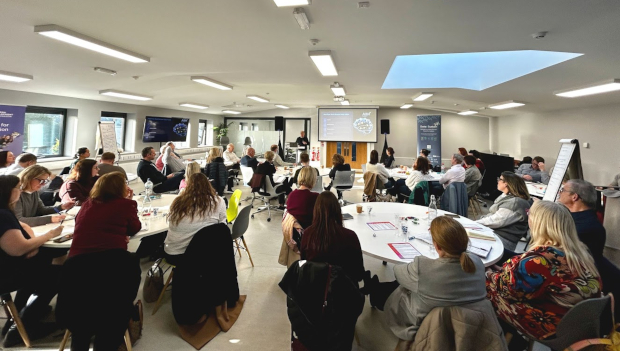
Leaders from engineering, medtech, logistics, public service, higher education and technology sectors gathered in the AIM Centre, Sligo for the Workplace Learning Summit 2025, where participants identified a striking challenge: approximately 90% of workplace knowledge never makes it into organisational systems.
The cross-sector event organised by Sligo-based HR Tech company Slick Plus, brought together professionals grappling with similar obstacles despite working in vastly different industries. Discussions centred on what one participant described as operating in a “BANI world” – brittle, anxious, non-linear and incomprehensible – where traditional approaches to knowledge management are failing.

Systemic failures
Summit participants identified four recurring problems blocking effective knowledge transfer:
Knowledge trapped in silos. Critical expertise often resides only in the minds of experienced staff approaching retirement, or scattered across isolated spreadsheets and local drives. “There is no single front door,” noted one attendee.
Ineffective onboarding. New employees face overwhelming documentation – one organisation reported 130 standard operating procedures of 30 pages each – while remote and hybrid working makes informal learning difficult. Several participants reported staff departures within 6-9 months.
Technology friction. Multiple platforms including learning management systems, SharePoint, Teams, Slack and enterprise resource planning systems fragment the learning experience. “We don’t have a knowledge problem. We have a findability and sharing problem,” one participant observed.
Failure to implement lessons learned. Retrospective documents and post-project reviews are written but rarely consulted, with ideas disappearing without visible follow-through.
Social learning as a core capability
Keynote speaker Dr Nigel Paine, a global leader in workplace learning, argued that organisations must treat social learning as a fundamental capability rather than an optional extra. “When you bring people together to share insights, something special happens that no course or content library can replicate,” Paine said.
The summit itself modelled this approach through rotating table conversations and peer discussion rather than traditional presentations.
Deskless workforce challenges
InPost, a logistics company where over 80% of staff work without desk access, shared their experience moving to mobile-first learning. Mary Kearney from InPost described the shift: “For our deskless teams, being able to pull out a phone at four in the morning, search the problem they’re having and watch a short video is a complete game changer.”
The company reported positive engagement from staff who signed up to create short instructional videos for colleagues.
Platform development directions
Discussions throughout the day pointed to several priorities for workplace learning platforms: better support for deskless workers, improved tools for peer-to-peer problem-solving, and human-centred artificial intelligence features including semantic search and prompts to capture tacit knowledge.
Slick Plus, who hosted the summit, was frequently cited by participants as addressing many of the identified challenges. Co-founder Linda Hegarty described their approach: “Slick gives organisations a simple way to capture the in-house know-how you’ll never find on Google and make internal experts visible.
“However, participants noted that technology alone doesn’t solve the underlying issues. Janine van Someren, who works on team performance, emphasised the human element: “High-performing teams depend on communication and trust. Slick Plus captures the communication side beautifully – it makes it easier to ask, answer and stay connected.”
This was the second year of the Workplace Learning Summit in Sligo and it is generously supported by partners including Western Development Commission, Data2Sustain, Sligo County Council, Sligo Chambers Skillnet, Atlantic Technological University, and the Northern and Western Regional Assembly.