

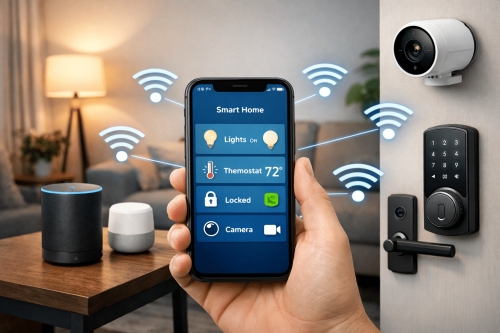
Smart Home Compatibility Is Improving
Smart home buyers waste less money today than they did five years ago. Devices now work together more often. That shift saves time, reduces returns, and lowers upgrade risk for millions of households.
Smart home standards finally align across brands and platforms. Companies that once locked users into closed systems now share technical rules. These shared rules let lights, locks, cameras, and speakers communicate without custom bridges or brand-specific hubs.
This change matters now because smart homes reached mainstream adoption. More renters and homeowners install connected devices every year. As adoption grows, frustration grows too. Buyers expect devices to work together out of the box. They no longer accept ecosystem lock-in as the price of convenience.
Smart home standards affect everyday decisions. Shoppers choose devices based on price, design, and reliability instead of brand loyalty. That shift pressures companies to compete on quality rather than control.
The biggest trade-off still exists. Shared standards reduce differentiation. Companies lose some leverage over users. Yet consumers gain flexibility, which explains why momentum continues to build.
Fewer Walled Gardens
For years, smart home platforms acted like gated communities. Apple, Google, Amazon, and Samsung each pushed proprietary systems. Devices worked best inside their own ecosystems. Mixing brands often broke features or required extra hardware.
Smart home standards now chip away at those walls. Industry groups and major companies agreed on common communication layers. These layers define how devices identify themselves, share data, and respond to commands.
The Matter protocol drives much of this progress. Matter runs over IP and supports Wi-Fi, Ethernet, and Thread. Devices that support Matter can connect across platforms without custom integrations. A smart bulb can pair with multiple ecosystems using the same firmware.
This shift reduces friction in measurable ways. Setup times drop. Support calls decline. Developers spend less time building duplicate integrations. Consumers spend less money replacing incompatible gear.
Companies still maintain platform features on top of shared standards. Voice assistants, automation tools, and app interfaces remain competitive battlegrounds. Yet the core device communication now follows shared rules.
This balance explains why smart home standards gained traction. Companies protect differentiation while solving a common pain point. Users win without forcing brands to abandon their platforms.
How Shared Standards Actually Work
Smart home standards define how devices talk, not what they say. They specify message formats, security methods, and discovery processes. They do not control user interfaces or cloud features.
Matter, Zigbee, Z-Wave, and Thread each play roles in the ecosystem. Matter focuses on application-level compatibility. Thread handles low-power mesh networking. Wi-Fi supports high-bandwidth devices like cameras. Ethernet anchors hubs and bridges.
Security remains central. Shared standards require device authentication, encrypted communication, and local control options. Devices must prove identity before joining a network. Commands travel encrypted end to end.
Local control marks a key improvement. Many devices now function without constant cloud access. Lights turn on even when the internet drops. That reliability builds trust and improves user experience.
Smart home standards also reduce latency. Local processing responds faster than cloud-based commands. Voice actions feel instant. Automations trigger without delay.
These improvements translate into measurable gains. Setup times drop from minutes to seconds. Failure rates decline. Battery-powered devices last longer due to efficient networking.
Why This Changes Buying Behavior
Shared standards change how people shop. Buyers no longer fear future incompatibility. They know devices will work across platforms even if they switch phones or voice assistants.
Flexibility reduces risk. Renters can move devices between homes. Homeowners can upgrade platforms without replacing hardware. Families can mix ecosystems without conflict.
This confidence drives higher spending. Consumers invest in better devices when they trust longevity. They choose quality over brand lock-in. That shift benefits manufacturers that focus on reliability and design.
Retailers also benefit. Return rates drop when compatibility issues fade. Support costs decline. Product reviews improve as frustration decreases.
Smart home standards also help late adopters. People who avoided smart homes due to complexity now feel more comfortable. Simpler setup and clearer labeling lower the entry barrier.
This trend mirrors earlier tech shifts. USB standardized peripherals. Wi-Fi replaced proprietary networking. Shared standards expanded markets rather than shrinking them.
Limitations and Real Concerns
Smart home standards do not solve everything. Compatibility still varies by device category. Advanced features often remain platform-specific. Cameras, security systems, and energy devices lag behind simpler accessories.
Firmware updates also matter. Devices need ongoing support to maintain compatibility. Cheap hardware may ship with standards support but lose updates over time.
Privacy remains a concern. Shared standards enable local control, but many devices still rely on cloud services. Data handling varies by brand. Consumers must still read policies and settings carefully.
Certification also adds cost. Smaller manufacturers face higher barriers to entry. Some may avoid compliance, which fragments the market again.
Interoperability testing takes time. Early implementations sometimes break. Consumers may encounter bugs during the transition phase.
Regulation adds another layer. Governments increasingly scrutinize connected devices. Security requirements may tighten, which could slow adoption or raise prices.
Despite these concerns, momentum favors alignment. The benefits outweigh the drawbacks for most users.
Market and Cultural Impact
Smart home standards reshape competition. Hardware margins shrink as differentiation shifts to software and services. Companies invest more in user experience, automation, and AI features.
Retail strategies change too. Stores highlight compatibility badges rather than platform exclusivity. Online listings emphasize standards support alongside price and reviews.
Developers benefit from a larger addressable market. One integration reaches more users. Innovation speeds up as barriers fall.
Culturally, smart homes feel less intimidating. Devices fade into the background. Technology serves daily routines instead of demanding attention.
This shift aligns with broader tech trends. Consumers prefer tools that work quietly and reliably. They value control and choice over novelty.
For deeper technical background on Matter and interoperability, readers can explore the Connectivity Standards Alliance, the group behind Matter standards, at .
Practical Takeaways for Readers
Check standards support before buying. Look for Matter, Thread, Zigbee, or Z-Wave labels.
Prioritize local control features. They improve speed and reliability.
Avoid overcommitting to one platform. Flexibility protects future upgrades.
Update firmware regularly. Standards evolve, and updates maintain compatibility.
Buy from brands with long-term support records. Longevity matters more than launch features.
For readers planning a broader home setup, GadgetGram’s guide on choosing a smart home hub explains platform trade-offs and setup basics clearly.
Smart home standards finally align, and that alignment changes everything. Devices work together more often. Buyers face less risk. Competition shifts toward quality. The smart home now feels less like a gamble and more like a tool that simply works.