

CEO sets out vision of talent development including supports for thousands of PhD researchers
Life
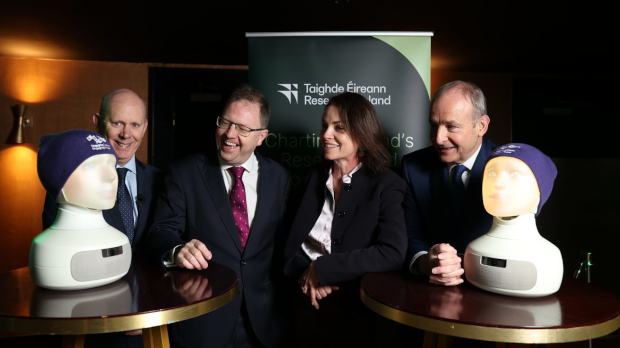
Pictured: Dr Diarmuid O’Brien, Research Ireland; Minister James Lawless; Olivia Waters, Adapt; and Taoiseach Micheál Martin
Research Ireland launched its inaugural five-year strategy at an event in the Mansion House, Dublin.
Entitled Curiosity, Capability, Competitiveness – Charting Ireland’s Research and Innovation Future 2026–2030, the strategy aims to build a research and innovation system with a focus on developing research talent.
The strategy is based on three pillars: Talent (creating a pipeline of researchers), Economy (strengthening competitiveness) and Society (finding solutions for ongoing challenges).

Under the Talent pillar, Research Ireland set a target to deliver 3,500 PhDs and 2,000 postdoctoral fellows; support 1,000 investigator-led grants; and partner with higher education institutions and research bodies to ensure the effective transition of research talent to address economic and civic needs.
The Economy pillar consists of ongoing support for 14 Research Centres; a target of 50 spin-out companies founded by Research Ireland-funded researchers; and increased enterprise co-investment, targeting 36% of co-funding from MNCs and 16% from SMEs.
Under the Society pillar €650 million will be invested in multidisciplinary research, and collaboration with enterprise, NGOs, national cultural institutions, and the arts and culture sector will be strengthened.
Addressing the event this morning Dr Diarmuid O’Brien, CEO, Research Ireland, said: “Research Ireland’s new strategy sets out a clear ambition – to support all disciplines towards building an internationally-renowned research and innovation system that delivers real outcomes for people, communities and enterprise.
“Over the coming five years, we will focus on strengthening the talent pipeline, supporting FDI investment and indigenous capability, and fostering greater innovation-driven collaboration, all of which underpins our future competitiveness and societal wellbeing. Acting as a leader, partner and connector across the research and innovation ecosystem, our measure of success is impact: a stronger, more resilient Ireland, and an innovation system that earns its place among the best in the world.”
Speaking exclusively with TechCentral.ie Dr O’Brien explained: “What we’re trying to do is move away from being seen as a funding agency to be seen as a development agency. For Ireland to succeed from a research innovation perspective, we need to build an internationally credible research and innovation capability. That’s not just about funding research, but it’s about how we connect all of that together. That’s how we build relationships with key stakeholders across the university sector, in industry and into government. I would say the big focus for us now is how do we bridge our research ecosystem and our Innovation ecosystem. If we can connect those two things together. That’s where we leverage the value and create the impact.”
That development process extends all the way back to primary and second level, where the value of curiosity is first recognised. Dr O’Brien was optimisic about the organisations current efforts to promote STEM through initiatives such as Science Week and RTE programming.
“We have actually done well in attracting our secondary school students into engineering and science disciplines within the university system,” he said “I think the challenge we have now is to make it attractive for those undergraduates post-graduation to see a PhD and a research career as one that’s going to be of value for them.
“The real opportunity there is for them to take a step back and recognise that there’s not just a pathway into an academic pathway or into academic career. It’s about a pathway into a very broad array of opportunities, including working in industry or working within government or public policy environments… one of the big challenges for us now is to really open up that excitement and enthusiasm about that fourth level investment in PhD training.”
Niall Kitson