

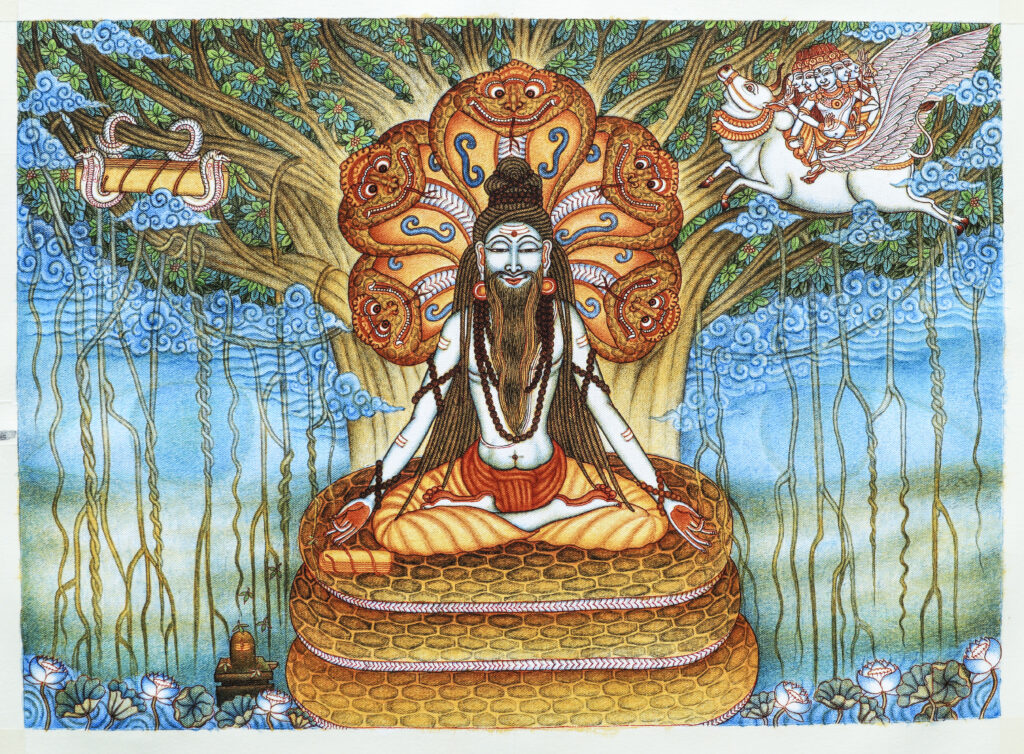
Rishi Patanjali Explains How the Mind Is Restrained and Awareness Revealed
The following excerpt is drawn from Satguru Bodhinatha Veylanswami’s recently released translation of Patanjali’s Yoga Sutras, Chapter One, verses 1-29.
1.1 Now, the exposition of yoga.
1.2 Yoga is the restraint of mental activities.
1.3 Then awareness abides in its essential nature.
1.4 Otherwise, awareness identifies with the mental activities.
1.5 The mind’s activities are of five types and can be detrimental or non-detrimental.
1.6 They are valid cognition, misapprehension, conceptualization, sleep and memory.
1.7 Valid cognition arises from direct perception, inference and authoritative testimony.
1.8 Misapprehension, having no basis in an object’s nature, is false knowledge.
1.9 Conceptualization arises from verbal knowledge and lacks an actual object.
1.10 Sleep is the mental activity based on the awareness of absence.
1.11 Remembering is the retention of things experienced.
1.12 Through practice and dispassion, these are restrained.
1.13 Practice is exertion to achieve steadiness in that.
1.14 This indeed becomes firmly grounded when cultivated with devotion for a long time without interruption.
1.15 Dispassion is the masterful consciousness of one who is free of desire for objects, whether perceived or heard about.
1.16 The supreme state of that is the non-craving for the guṇas arising from the realization of puruṣa.
1.17 Differentiated samādhi involves cogitation, subtle reflection, bliss or I-am-ness.
1.18 The other is preceded by the practice of focusing on cessation and leaves only saṁskāras.
1.19 Those who are unembodied and those who are absorbed in prakṛti remain focused on becoming.
1.20 For others, it is preceded by faith, energy, mindfulness, samādhi and mystical insight.
1.21 Samādhi is near for the intensely ardent.
1.22 Even among these, there is differentiation in degrees of ardor, whether mild, moderate or extreme.
1.23 Or, this is gained through devotion to Īśvara.
1.24 Īśvara is a special puruṣa, untouched by afflictions and karma, with its results and residue.
1.25 In Him is the peerless source of omniscience.
1.26 Unbounded by time, He is also the guru of the ancients.
1.27 “Aum” is His signifying sound.
1.28 Repeat it while contemplating its meaning.
1.29 Then follows the attainment of inner consciousness and also the elimination of obstacles.
The post Part 1: What Is Yoga? appeared first on Hinduism Today.