

Share

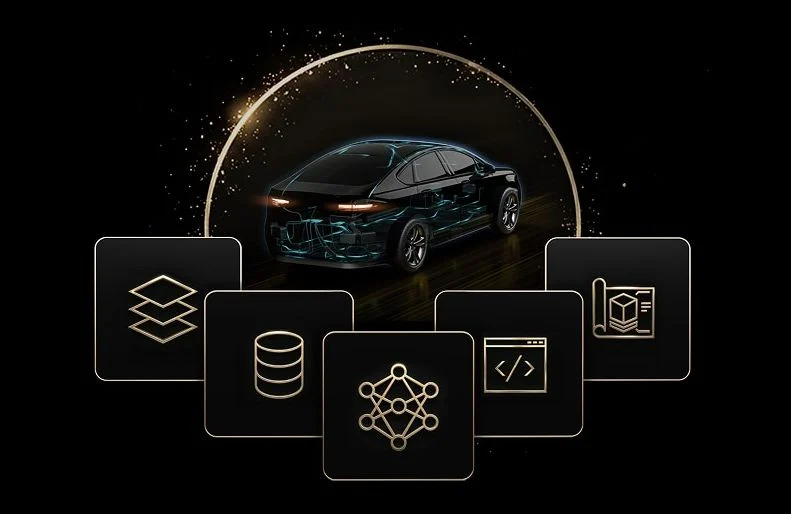
Nvidia CEO Jensen Huang took centre stage at the annual CES technology conference to unveil “Alpamayo,” a groundbreaking AI platform aimed at bringing human-like reasoning to self-driving cars.
The announcement marks a strategic pivot for the world’s most valuable company as it seeks to move beyond software chatbots and dominate the burgeoning field of “physical AI.”
Wearing his signature black leather jacket, Huang told a packed audience that the Alpamayo system represents the “ChatGPT moment” for robotics.
Unlike traditional autonomous systems that rely on pattern recognition, Alpamayo utilizes “chain-of-thought” reasoning. This allows vehicles to navigate complex, rare scenarios, such as sudden roadworks or erratic pedestrian behavior, and even explain the logic behind their driving decisions.
“Alpamayo allows cars to think through rare scenarios and drive safely in complex environments,” Huang said. “It is the foundation for safe, scalable autonomy.”
To demonstrate the tech’s real-world readiness, Nvidia showcased a video of an AI-powered Mercedes-Benz CLA navigating the streets of San Francisco. The vehicle, developed in partnership with the German automaker, is slated for a US release in the coming months before rolling out across Europe and Asia.
Huang noted that the system “drives naturally” because it learned directly from human demonstrators.
In a move to accelerate industry-wide adoption, Nvidia has made Alpamayo open-source, releasing the underlying code on the machine-learning platform Hugging Face for researchers to access and retrain.
The announcement quickly drew a sharp response from Tesla CEO Elon Musk. Posting on social media, Musk argued that while reaching 99% autonomy is “easy,” solving the “long tail” of rare road distributions is “super hard.” Despite the critique, analysts view Alpamayo as a profound shift for Nvidia, moving from a chip provider to a full platform provider for physical AI ecosystems.
Beyond automotive tech, Huang revealed that Nvidia’s next generation of hardware, the “Vera Rubin” platform, is now in full production. Scheduled for release later this year, these chips are expected to deliver five times the computing power of current models while significantly improving energy efficiency.
With a market capitalization of roughly $4.5 trillion, Nvidia remains the world’s most valuable publicly traded company. While concerns about AI over-hype have caused recent market fluctuations, Huang’s presentation at CES signalled that the company is doubling down on the integration of AI into physical hardware, from trucks to robotaxis.
Related Posts
Discover more from Tech Digest
Subscribe to get the latest posts sent to your email.