


Grassroots research key to find ways to reduce carbon footprints
Life
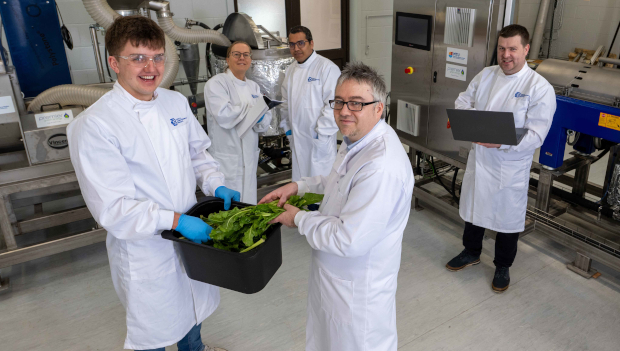
Pictured: Adam Mulcahy, Joanna Przyborksa, Jagdeep Kumar Nayak, James Gaffey, and Paddy Fitzgerald
Munster Technological University (MTU) has launched a new pilot green biorefinery at its Kerry Campus, marking an important milestone in Ireland’s move towards sustainable agriculture and a circular bioeconomy. The facility will develop technologies that convert the country’s richest resource, which is its grasslands, into a range of valuable products, including high quality animal feeds, human-grade protein, prebiotics, flavours and bioenergy.
The grass biorefinery plant funded by Enterprise Ireland in collaboration with the Centre for Applied BioSciences Research (CABR) Technology Gateway, builds on MTU’s ongoing research in projects such as Rural BioReFarmeries and Biorefinery Glas led by the Circular Bioeconomy Research Group (CircBio), which showed that protein can be extracted from grass, clover and green leaves to feed cattle and pigs while producing additional high value products.
The results that have been proven include the use of grass biorefinery press cake as a suitable forage for cows and the co-production of high-quality protein concentrates for pigs and poultry. MTU’s new Kerry Campus facility will allow the University to take this innovation to the next level ahead of a 2026 launch of a demonstration-scale green biorefinery and anaerobic digestion facility at Farm Zero C, Shinagh Farm, Bandon, Co. Cork, which MTU is developing in partnership with University College Dublin and Carbery Group.

James Gaffey, principal investigator for Green Biorefinery Research at MTU, said: “As the only country in Europe with more than 50% grassland, Ireland is uniquely positioned to play a leading role in the development of green biorefining. By extracting food and feed-grade proteins and value-added co-products from grass we can reduce costly imports and lower our carbon footprint, while increasing local resilience and strengthening the competitiveness of our farming and agri-food industries. This new pilot facility is the first of its kind in Ireland, and complements our excellent track record of research in this space. It offers a great platform for us to scale this research and test these innovation opportunities with industry”.
Ireland imports some 3 million tonnes of animal feed concentrates every year, including almost 1 million tonnes of soybean meal, mostly from South America. However, production in that region has been linked to Amazon deforestation, along with long distance transport emissions. MTU research also showed that grass protein concentrate can have up to five times lower climate impact than soybean meal. This innovation offers farmers a locally produced alternative at a time when agricultural inputs such as feed, fertiliser, and energy have increased by around 75% over the past seven years, mostly driven by the Covid-19 pandemic.
MTU has also secured significant recent research funding to expand capacity and scale operations, including coordination of the €8.7 million EU-wide CBE-JU-funded Rural BioReFarmeries project, collaboration with UCD, Carbery and other partners on the €6.1 million Horizon Europe EMBEDED project, and funding through MTU’s TU RISE programme for the green biorefinery scale-up project Dot.Green. These initiatives will drive innovation in grass processing across both sites and position Ireland at the forefront of Europe’s green biorefinery movement.
Hugh McGlynn, VP of Research, MTU, said: “This scale-up of MTU’s green biorefinery research activity is a landmark moment for MTU and for Ireland. It shows our commitment to working with partners across the country and Europe to find solutions that genuinely benefit farmers, the environment and the community. By turning our grasslands into new opportunities, we are helping rural Ireland prosper into the future.”
TechCentral Reporters