

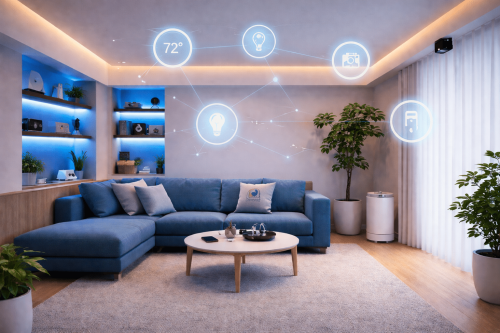
The real impact hits your daily life first
Invisible smart home tech now shapes how people live at home every day. As a result, this shift affects comfort, noise, reliability, and long-term satisfaction more than flashy features ever did. Buyers no longer chase screens, voice commands, or dashboards. Instead, they want homes that feel calmer and easier to run.
This change matters now because smart homes have finally reached a tipping point. Over time, too many devices added friction instead of removing it. Eventually, consumers noticed.
Invisible smart home tech focuses on reducing effort rather than adding controls. In practice, devices fade into the background, running quietly, connecting reliably, and demanding less attention. That trade-off sacrifices novelty but delivers livability. For many households, that exchange feels worth it.
Why invisible smart home tech matters right now
The early smart home era rewarded experimentation. At the time, people bought gadgets simply to try them. Today, however, people buy devices expecting them to last for years. Invisible smart home tech aligns with that more mature mindset.
Rising prices also push this shift. Now, a $2,000 appliance must justify itself every day. Buyers want fewer failures and fewer updates that disrupt routines. Above all, they want products that keep working during power outages, network drops, and software hiccups.
Privacy concerns further shape this moment. Always-listening devices raised alarms, while cameras inside homes sparked ongoing debate. In response, invisible smart home tech often limits data collection. It relies more on local processing and automation rather than constant cloud connections. Because of this, the approach lowers risk and builds trust.
What changed in smart home design
Design priorities have flipped. Instead of novelty and visibility, engineers now optimize for reliability, noise reduction, and physical integration.
Older smart devices demanded attention. They blinked, beeped, and interrupted. By contrast, newer devices aim for silence. Robot vacuums clean at lower decibel levels. Smart thermostats adjust gradually to avoid noticeable temperature swings. Lighting systems fade instead of snapping on.
Invisible smart home tech also hides complexity. Once setup is complete, daily use requires little or no input. Automation replaces commands. Sensors trigger actions based on behavior patterns rather than spoken requests.
This design philosophy values subtraction. Each removed step improves usability. Each eliminated alert reduces stress. Over time, those small changes add up.
Examples of invisible smart home tech in 2026
Several product categories clearly show how this shift is already playing out.
Appliances that optimize quietly
Modern dishwashers adjust cycles based on load sensors without user input. Washing machines choose water levels automatically. Refrigerators manage defrost cycles more efficiently to reduce both noise and energy use.
These appliances still connect to apps. However, owners rarely open them. In this case, that lack of interaction marks success.
Smart lighting that disappears
Lighting systems increasingly blend into walls and ceilings. Motion sensors replace switches in many rooms. Meanwhile, circadian lighting adjusts color temperature throughout the day without manual schedules.
Invisible smart home tech shines here. Eventually, people stop thinking about lighting entirely.
Climate systems that feel natural
New HVAC controllers focus on micro-adjustments. They prevent hot and cold swings. They reduce fan noise. In addition, they learn occupancy patterns locally instead of uploading constant data.
As a result, this approach improves comfort while lowering energy bills.
How invisible smart home tech actually works
The technology still relies on sensors, processors, and software. The difference lies in where decisions happen and how often devices interrupt users.
Local processing plays a key role. Many systems now analyze sensor data directly on the device. This reduces latency and dependence on cloud services. Consequently, faster response times make automation feel natural rather than reactive.
Event-based logic replaces command-based interaction. Motion triggers lights. Humidity triggers ventilation. Time and presence trigger heating changes. In everyday use, these systems act without asking for permission.
Invisible smart home tech also benefits from better hardware. Quieter motors, improved insulation, and more efficient power supplies reduce physical disruption. Over time, those hardware gains matter just as much as software improvements.
Limitations and concerns to watch
This trend does not eliminate risk.
Invisible systems can feel opaque. When something breaks, users may struggle to diagnose the problem. Fewer controls sometimes mean fewer override options, which can frustrate experienced users.
Cost also remains a barrier. In many cases, premium components and local processing raise prices. Entry-level products, by comparison, still rely on louder motors and cloud-based services.
Interoperability presents another concern. As ecosystems tighten, some invisible smart home tech locks users into proprietary platforms. Repairs and replacements can become harder over time.
Regulation may also catch up. Although local data processing reduces privacy risk, not all manufacturers follow best practices. For that reason, buyers still need to evaluate policies carefully.
How this trend compares to earlier smart home waves
Early smart homes emphasized control. Dashboards, routines, and voice commands dominated marketing. At the time, success meant offering more features.
Invisible smart home tech flips that model. Today, success means fewer interactions.
This shift mirrors broader trends in consumer technology. Smartphones removed buttons. Cars reduced physical controls while improving safety systems. As software matured, it moved into the background.
Smart homes now follow the same arc.
Market and cultural implications
Manufacturers that embrace invisible smart home tech tend to earn long-term loyalty. Devices that fade into daily life stay installed longer. That stability, in turn, creates recurring revenue through services, upgrades, and accessories.
Retail marketing also changes. Spec sheets matter less. Instead, demonstrations focus on experience rather than features. Showrooms emphasize silence, smooth motion, and seamless integration.
Culturally, this trend signals maturity. Smart homes no longer feel experimental. They feel expected.
Practical takeaways for buyers
If you plan upgrades, evaluate products differently.
Ask how often you must interact with the device. Check noise levels and local control options. Look for products that function well even without constant app use.
Invisible smart home tech rewards patience. Read long-term reviews. Focus on reliability metrics rather than feature counts.
For deeper buying guidance, see our related coverage on smart home upgrades that age well. For independent testing data, Consumer Reports continues to evaluate appliance reliability and noise performance in detail. Their methodology offers a strong baseline for comparison.
The future of invisible smart home tech
This shift will continue. Voice control will not disappear, but it will recede. Screens will matter less. Automation will feel increasingly intuitive.
Invisible smart home tech will define the next decade of home design. The best devices will not demand praise. Instead, they will earn silence.
That outcome represents real progress.