

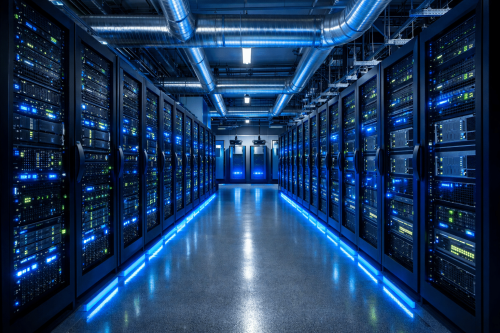
Businesses, workers, and everyday internet users will feel the effects of a $650 billion AI infrastructure investment in 2026. Big tech companies plan to pour that money into data centers, chips, memory, and power systems that run artificial intelligence tools worldwide. This $650 billion AI infrastructure investment will shape how fast AI tools improve, how much they cost, and how much energy and water they consume.
The scale stands out. Several major technology giants, including Meta, Microsoft, Google, Amazon, and chipmakers like NVIDIA and SK Hynix, outlined aggressive spending plans across earnings calls and investor briefings. They aim to expand AI capacity at record speed in 2026.
What happened
Big tech leaders announced plans to collectively invest about $650 billion in AI infrastructure in 2026. They shared these figures during earnings calls, developer conferences, and regulatory filings. The spend targets new data centers, faster networking, bigger power capacity, and more AI chips.
Meta confirmed it secured millions of NVIDIA GPUs to scale its AI systems. Microsoft and Google signaled expanded spending on AI-ready data centers. Amazon ramped up AWS AI capacity. Meanwhile, SK Hynix announced a major boost in AI memory output to meet demand for high-bandwidth memory and DDR5 modules.
Together, these moves form the backbone of the $650 billion AI infrastructure investment. The money will fund new AI data centers, advanced NVIDIA GPUs, high-bandwidth memory chips, networking systems, and cooling and power upgrades.
Why it matters now
AI models have grown larger and more complex. Training one advanced model can require tens of thousands of GPUs running for weeks. That demand forces companies to build bigger computing clusters and faster data pipelines.
The $650 billion AI infrastructure investment arrives as companies compete to train faster models and roll out AI agents that handle real-world tasks. Whoever builds the strongest infrastructure gains a speed advantage, and speed often decides who ships the best features first.
- Faster training cuts development time.
- More compute can improve accuracy and stability.
- Bigger clusters support more users at once.
- Stronger infrastructure attracts enterprise contracts.
However, this race also creates risks. When only a few companies control most AI infrastructure, market power concentrates. Smaller firms may struggle to compete due to high chip costs and limited GPU supply.
How it works
AI infrastructure includes several layers. GPUs handle the math behind training and serving models. High-bandwidth memory feeds data fast enough to keep GPUs busy. Data centers house thousands of servers, while networking gear moves data between machines. Finally, power and cooling keep everything stable around the clock.
AI servers consume huge electricity loads, and they create intense heat. Cooling systems often use water or liquid cooling to maintain safe temperatures. Those requirements shape where companies build and how they operate.
Limitations and concerns
The $650 billion AI infrastructure investment could accelerate AI progress, but it can also raise energy demand and strain local resources. It may push up costs for startups that rent GPU time. It may also trigger tighter scrutiny on privacy, safety, and competition.
Energy use remains a key pressure point. According to the U.S. Department of Energy, data center electricity demand continues rising as AI workloads expand. That trend forces utilities and communities to plan for heavier loads.
Practical takeaways
- Watch GPU and memory supply trends, since hardware availability can change cloud pricing.
- Expect more AI features bundled into everyday products, but also expect new subscription tiers.
- Track local and national policy moves tied to energy, water, and AI regulation.
The $650 billion AI infrastructure investment marks a turning point in global technology spending. In 2026, AI will not improve only because of smarter software. It will improve because companies built the physical systems that power it.