

Bedi Lakshmi: The Sacred Grain-Filled Form of Bengal’s Goddess of Abundance
In the verdant landscapes of Bengal, where rivers meet rice fields and nature’s bounty shapes daily life, a unique and profoundly symbolic form of Goddess Lakshmi worship has flourished for centuries. Known as Bedi Lakshmi or Beri Lakshmi, this traditional practice transforms simple natural materials into a sacred representation of the goddess of wealth, prosperity, and abundance. This form of worship embodies the deep connection between agricultural prosperity, feminine divinity, and the cycle of sustenance that sustains human civilization.
The Sacred Construction: Nature as Divine Medium
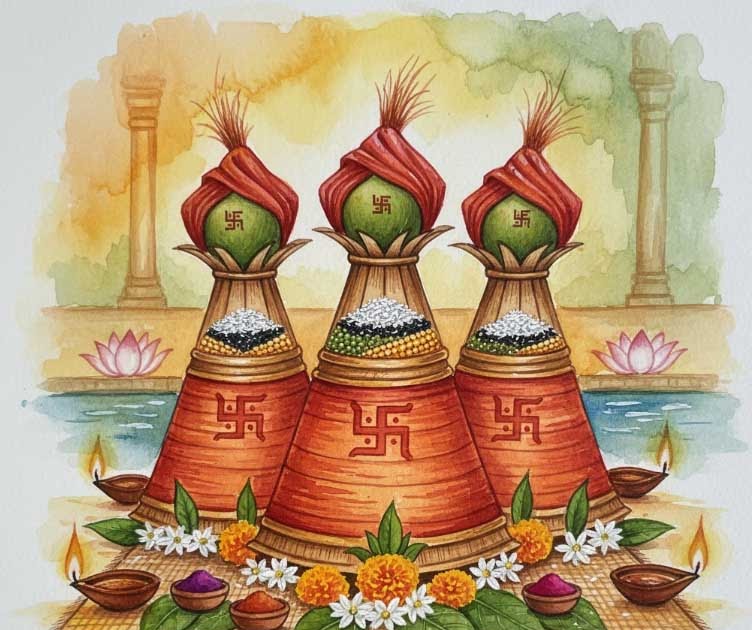
The creation of Bedi Lakshmi begins with materials drawn directly from nature’s abundance. Bark from banana trees—themselves symbols of fertility and prosperity in Hindu tradition—is carefully rolled into cylindrical shapes and secured with coconut sticks to form conical structures. These cones, called Beri or Bedi, are then adorned with vermilion swastika symbols, ancient marks of auspiciousness and the sun’s life-giving energy.
The construction itself reflects the Hindu principle that divinity pervades all of creation. By using banana bark, coconut, and grains, devotees acknowledge that the goddess resides not in distant heavens alone but manifests through the very elements that sustain life. The banana plant, which gives fruit only once before dying and regenerating through its offshoot, symbolizes the cycle of creation, sustenance, and renewal—core principles associated with Lakshmi.

The Sacred Number and Arrangement
Traditionally, nine Bedi structures are arranged on a wooden or clay platform, though regional variations employ five or seven. These numbers carry deep significance in Hindu cosmology:
- Nine (Nava): Represents completeness and the nine forms of Goddess Durga (Navadurga), connecting Lakshmi worship to the broader Shakti tradition
- Five (Pancha): Symbolizes the five elements (panchabhutas) and the five senses, representing the totality of manifest creation
- Seven (Sapta): Represents the seven sacred rivers, the seven chakras, and completeness in spiritual attainment
The platform itself serves as the symbolic foundation—the earth from which all prosperity arises and to which all returns, reflecting the cyclical understanding of wealth and abundance in Hindu thought.
The Grain-Filled Heart: Panchashasya Symbolism
Each Bedi is filled with panchashasya—five kinds of grains representing agricultural abundance and the diversity of nourishment. This practice connects directly to the Vedic understanding of annam (food) as brahman, as stated in the Taittiriya Upanishad: “Annam Brahma” (food is divine). The five grains typically include:
- Rice: The primary sustenance grain, representing basic nourishment
- Wheat: Symbolizing strength and vitality
- Lentils: Representing protein and balance in diet
- Sesame: Associated with ancestral offerings and continuity
- Barley: Connected to Vedic rituals and ancient traditions
The grain-filled Bedi becomes a living granary, a physical manifestation of the prayer “May our stores always be full.” This symbolism resonates with Lakshmi’s essential nature as Dhanya Lakshmi—the giver of grain wealth, one of her eight primary forms (Ashtalakshmi).
The Bridal Crown: Tender Coconut as Divine Presence
Atop each grain-filled Bedi sits a tender coconut with its stalk intact, covered with a red cloth. This arrangement transforms the structure into a representation of Goddess Lakshmi as a bride—Navami (new bride)—symbolizing:
- The coconut: A complete fruit containing water (life essence), flesh (nourishment), and potential for new growth, representing the fullness of prosperity
- The red cloth: Signifying the married woman’s auspiciousness, vitality, and the goddess’s role as consort of Lord Vishnu
- The bride form: Emphasizing Lakshmi’s role in establishing and maintaining household prosperity
The bridal imagery connects to Lakshmi’s manifestation during Diwali and harvest festivals, when she is invited into homes as the honored bride bringing fortune and blessings.
Scriptural Foundations and Philosophical Depth
While specific references to Bedi Lakshmi worship may not appear in ancient texts—as regional practices evolved organically—the underlying principles are firmly rooted in Hindu scripture. The Shri Sukta, an ancient Vedic hymn to Lakshmi found in the Rigveda’s appendices, describes the goddess as:
“Hiranya-varnam harinim suvarna-rajata-srajam” (Golden-hued, who wears garlands of gold and silver)
This verse establishes Lakshmi’s connection to golden grains and the earth’s treasures. The Vishnu Purana describes her emergence from the cosmic ocean holding a lotus and showering prosperity, emphasizing her role as the source of agricultural and material abundance.
The Simplicity and Profundity of Traditional Worship
Bedi Lakshmi worship exemplifies several profound aspects of Hindu devotional practice:
- Accessibility: Requires no expensive materials or priestly mediation, allowing every household to worship with dignity
- Ecological harmony: Uses only biodegradable, natural materials that return to earth
- Community participation: Often involves women collectively preparing the structures, strengthening social bonds
- Sensory engagement: The visual beauty, the touch of natural materials, and the fragrance of fresh vegetation create a complete devotional experience
- Living symbolism: The actual grains, living coconuts, and fresh vegetation make the worship dynamic rather than static
- Feminine wisdom: Primarily maintained by women, preserving feminine spiritual authority and agricultural knowledge
This form of worship stands in beautiful contrast to elaborate temple rituals, demonstrating that devotion’s sincerity matters more than material grandeur.
The Agricultural-Spiritual Connection
Bengal’s agricultural identity deeply influences Bedi Lakshmi worship. The practice typically occurs during harvest festivals, particularly during Lakshmi Puja in autumn (Kojagari Lakshmi Puja). This timing connects divine worship with:
- Gratitude: Thanking the goddess for successful harvests
- Invocation: Requesting continued abundance for the coming agricultural cycle
- Recognition: Acknowledging the divine feminine as the ultimate source of fertility and productivity
- Celebration: Transforming labor’s fruits into sacred offerings
The Bhagavad Gita (Chapter 3, Verse 14) states: “Annad bhavanti bhutani” (From food, all beings come into existence), emphasizing that food sustains all life. Bedi Lakshmi worship honors this fundamental truth by elevating grain storage to a sacred act.
Present Status and Future Prospects
In contemporary times, Bedi Lakshmi worship faces both challenges and opportunities:
Challenges:
- Urbanization: Apartment living makes traditional worship difficult due to space constraints and material unavailability
- Agricultural disconnection: Urban populations lack direct relationship with harvest cycles and agricultural abundance
- Time constraints: Modern lifestyles reduce time available for elaborate traditional preparations
- Material substitution: Some practitioners use artificial materials, diluting the ecological and symbolic authenticity
- Generational gap: Younger generations may not learn traditional construction methods
Opportunities and Revival:
- Cultural preservation movements: Growing interest in traditional practices among heritage-conscious communities
- Eco-friendly appeal: The completely biodegradable nature attracts environmentally conscious practitioners
- Artistic value: Recognition of folk art and traditional crafts supports continuation
- Community centers: Cultural organizations facilitate collective worship, enabling those without space at home
- Digital documentation: Videos and tutorials help preserve and transmit knowledge across generations
Several communities have begun organizing collective Bedi Lakshmi worship in neighborhood spaces, allowing participation from apartment dwellers while maintaining traditional authenticity. This adaptation demonstrates the practice’s resilience and relevance.
Integrated Symbolism: Understanding the Complete Form
The beauty of Bedi Lakshmi lies in how each element contributes to a unified symbolic statement:
- Banana bark cylinder: The structural foundation representing the natural world’s support
- Coconut sticks: The binding force, symbolizing connection and integration
- Vermilion swastika: The divine marking, invoking auspiciousness and cosmic order
- Five grains: The diversity of nourishment and the fullness of provision
- Tender coconut: The crown of consciousness, the goddess’s living presence
- Green stalk: Continued growth and vitality, the future’s promise
- Red cloth: The sacred feminine power, the bride’s auspiciousness
- Platform foundation: The earth element, the ground of all manifestation
- Multiple structures: Community, completeness, and abundance multiplied
Together, these elements create not merely a ritual object but a philosophical statement about prosperity, sustainability, feminine divinity, and the sacred nature of agricultural abundance.
The Enduring Wisdom of Simple Devotion
Bedi Lakshmi worship preserves ancient wisdom about humanity’s relationship with nature, prosperity, and the divine feminine. In an age of increasing environmental crisis and disconnection from food sources, this practice offers profound lessons. It teaches that true wealth lies in filled granaries, that the goddess manifests through nature’s gifts, and that devotion requires not expensive materials but sincere hearts and respectful hands.
The tradition reminds us that every grain of rice is sacred, every harvest is a divine blessing, and prosperity means having enough to sustain life with dignity. As communities work to preserve this beautiful practice, they maintain not just a ritual but a worldview—one that sees divinity in daily bread and recognizes the goddess in the gift of sustenance itself.