

Running out of power now means falling behind
Battery capacity now decides whether people can work, travel, and stay productive. Laptops drain faster during video calls. Tablets replace notebooks during flights. Phones act as wallets, cameras, and hotspots all at once. When power dies, work stops.
This shift matters now because devices demand more energy every year. Software loads grow heavier. Screens refresh faster. AI features run constantly in the background. Battery capacity once faded as a selling point. It has returned as a core buying factor.
Portable power no longer counts as a convenience. It now functions as infrastructure.
Why battery capacity matters right now
Work no longer happens in one place. People work from airports, trains, hotels, and coffee shops. Power outlets remain scarce and unreliable. Battery capacity fills that gap.
A laptop with strong battery capacity survives long flights. A tablet with extended endurance replaces paper without anxiety. A high capacity power bank keeps work alive when outlets disappear.
At the same time, energy demands keep rising. Devices stay connected all day. Background syncing never stops. AI tools analyze data locally instead of waiting for the cloud.
Battery capacity offsets that demand. Buyers now accept extra weight or size to avoid downtime. That trade feels practical, not indulgent.
How modern devices drain power faster
Battery efficiency improvements continue, but demand grows faster.
Laptops now operate in an always-on state. Sleep modes still consume power. File syncing, notifications, and security scans run continuously.
Tablets support external keyboards, displays, and multitasking. Each accessory pulls energy from the internal battery.
Phones manage navigation, payments, photography, streaming, and messaging at the same time. High refresh rate displays stay active all day.
Battery capacity absorbs this pressure. Without it, devices fail earlier in the day.
Why high-capacity power banks became essential
Power banks moved from backup tools to primary gear.
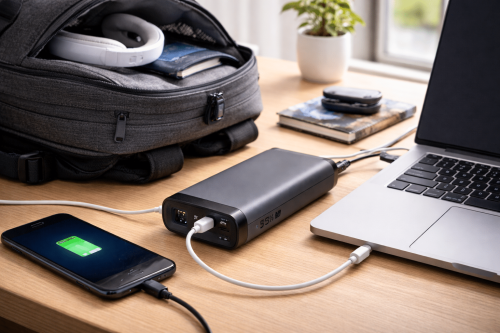
Older power banks charged phones once or twice. Modern models deliver 65 to 140 watts of output. They charge laptops, tablets, cameras, and handheld consoles.
Battery capacity matters more than speed alone. Fast charging fails without enough stored energy. A small battery empties quickly, even with high output.
High-capacity power banks support multiple devices across a full workday. Travelers now plan power the same way they plan luggage.
Battery capacity defines how long productivity lasts between outlets.
How battery capacity actually works
Most devices still rely on lithium-ion batteries. Innovation now focuses on structure, control, and delivery.
Manufacturers stack cells more efficiently. They improve heat management to sustain output under load. Power controllers regulate voltage to reduce waste.
High-capacity power banks often use multiple cells wired in parallel. This design increases total capacity while maintaining safe voltage levels.
USB-C Power Delivery allows higher wattage through a single port. One battery can now charge phones, tablets, and laptops safely.
Battery capacity alone does not guarantee performance. Stable delivery, thermal control, and efficiency matter just as much.
Limits and risks buyers should understand
Higher battery capacity introduces real drawbacks.
Weight increases quickly. A 25,000 mAh power bank adds noticeable bulk to a backpack. Frequent travelers feel that difference.
Airline limits also matter. Many airlines restrict carry-on batteries to 100 watt-hours without approval. Buyers must check capacity ratings before travel. The Federal Aviation Administration publishes clear guidance on lithium battery limits.
Cost rises with capacity. High-output power banks cost more than entry-level options.
Battery degradation also matters. Larger batteries last longer per cycle but still lose capacity over time. Poor heat control accelerates wear.
Safety remains critical. Cheap high-capacity batteries increase risk.
How brands now compete on battery capacity
Manufacturers changed their messaging.
Laptop makers highlight real-world battery life again. Tablet brands emphasize endurance during travel. Phone makers publish usage scenarios instead of idle time.
Accessory brands race to deliver higher battery capacity in smaller shells. Competition now centers on watt-hours, not just charging speed.
Battery capacity now separates premium devices from midrange options. Buyers notice these numbers again.
This shift mirrors earlier eras when battery life defined success. The difference lies in scale. Devices now demand far more energy.
How this trend compares to the past
A decade ago, efficiency gains delivered longer battery life without larger batteries. Processors improved quickly. Software demands remained lighter.
That curve flattened. Efficiency still improves, but at a slower pace. Software demands now grow faster than hardware savings.
Battery capacity fills the gap. Manufacturers accept thicker designs to deliver reliability.
This change reflects user priorities. People now value endurance over thinness during work and travel.
Market and cultural impact
Battery capacity influences design across industries.
Backpacks include dedicated power compartments. Furniture adds integrated charging. Vehicles ship with higher wattage ports.
Work culture adapts as well. Meetings assume device availability. Dead batteries signal lost productivity.
Power access now defines readiness. Battery capacity supports that expectation.
Retail messaging changes too. Packaging highlights capacity clearly. Reviews focus on endurance tests instead of features.
Practical takeaways for readers
Evaluate battery capacity alongside speed and size.
For power banks, check watt-hours instead of milliamp-hours. Confirm output wattage supports your laptop or tablet.
For laptops and tablets, read real-world battery tests. Ignore idle claims.
For travel, confirm airline limits before buying high-capacity batteries.
Portable power now supports work and travel as core infrastructure.
For more buying advice, see our guide on travel tech that actually works.
For safety rules, review guidance from the Federal Aviation Administration on lithium battery limits.
What comes next for battery capacity
Manufacturers will keep pushing capacity higher.
Solid-state batteries promise future gains, but current products rely on refinement. Expect gradual increases paired with smarter power management.
Battery capacity will remain a key differentiator as long as energy demand keeps rising.
That moment has not arrived yet.