

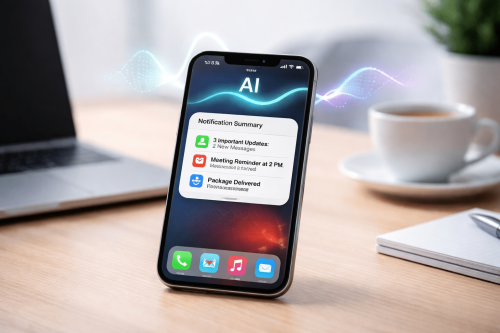
iPhone owners may soon draft messages, summarize alerts, and manage daily tasks faster without sending personal data to the cloud. Apple on-device AI expansion now touches more parts of the company’s ecosystem, and that shift could change how millions of people judge mobile AI in 2026.
Apple continues to roll out new artificial intelligence features that run directly on its devices instead of remote servers. The company highlighted these upgrades across iPhone, iPad, and Mac, building on its privacy-first strategy. Apple positions this move as a direct answer to cloud-heavy AI systems from rivals like Google and Microsoft.
This Apple on-device AI expansion affects everyday users first. It also affects developers, enterprise customers, and regulators who track data privacy. The timing matters. Consumers now question where their data goes. Lawmakers in the United States and Europe push for tighter rules on AI data use. Apple wants to show that useful AI does not require constant data transfer to distant data centers.
What Apple Announced
Apple confirmed broader deployment of on-device language models across its ecosystem. The company integrated these models deeper into system apps like Messages, Mail, Notes, and Reminders. Users can now generate suggested replies, summarize long notification stacks, and rewrite text in different tones without leaving the app.
The Apple on-device AI expansion also enhances Siri. Apple improved contextual awareness so Siri can reference recent messages, calendar events, and app activity more smoothly. Instead of pulling data into the cloud for processing, the device handles more requests locally through Apple silicon.
Apple first previewed parts of this strategy at recent developer events. Over the past year, it gradually activated features in beta releases. Now it pushes broader availability through software updates across supported devices.
Why It Matters Now
AI tools moved from novelty to expectation in less than two years. Many smartphone buyers now compare devices based on AI capabilities. Google markets Gemini integration. Samsung promotes Galaxy AI. Microsoft embeds Copilot across Windows and Office.
Apple took a slower path. Critics argued that Apple lagged in generative AI. The Apple on-device AI expansion changes that perception. Instead of chasing large cloud models with massive parameter counts, Apple focuses on speed, privacy, and tight hardware integration.
This approach carries trade-offs. Cloud AI models often handle more complex tasks because they rely on larger computing clusters. On-device models must fit within memory and battery limits. Apple bets that most daily tasks do not require extreme scale. Drafting a short email, summarizing notifications, or organizing reminders requires precision and context more than raw size.
For users, the benefit shows up in milliseconds. Local processing cuts network latency. Responses appear almost instantly. Users also avoid uploading sensitive text, photos, or voice commands to remote servers.
That privacy angle holds weight. According to the Electronic Frontier Foundation, minimizing data transfer reduces exposure to breaches and misuse. You can review EFF’s work on digital privacy here:
How It Works
Apple builds its on-device AI around custom silicon. The Neural Engine inside Apple chips handles machine learning tasks separately from the CPU and GPU. This design allows efficient parallel processing.
When a user triggers an AI feature, the request routes to a compact language model stored on the device. That model processes the prompt using quantized weights, which shrink file size and memory demands. Apple engineers optimize these models to run within tight power limits.
For example, summarizing notifications requires three main steps:
-
The system collects relevant text from recent alerts.
-
The local model identifies key points and removes repetition.
-
The device generates a short summary in natural language.
All of this occurs without uploading the text externally. The Apple on-device AI expansion also uses a hybrid method in some cases. If a task exceeds local capacity, the system can request help from Apple’s private cloud servers with user consent. Apple claims it anonymizes and encrypts those requests.
Developers gain access to updated APIs. They can call system-level AI tools for summarization, rewriting, and categorization. That means third-party apps can integrate similar features without building their own models from scratch.
Performance and Limits
On-device AI depends on hardware capability. Newer devices with advanced chips handle tasks faster and more smoothly. Older devices may support fewer features or slower performance.
Memory constraints limit model size. Large language models that operate in data centers can exceed hundreds of billions of parameters. On-device models typically use far fewer parameters to fit within a few gigabytes or less. That size difference impacts complexity.
The Apple on-device AI expansion prioritizes common tasks over deep research queries or long-form generation. You can ask it to rewrite a paragraph or draft a quick reply. You cannot expect it to generate a 10,000-word research paper offline with high accuracy.
Battery life also plays a role. Machine learning workloads consume power. Apple balances performance with energy efficiency, but heavy AI use could affect daily battery endurance.
Privacy and Security Concerns
Apple markets privacy as its main differentiator. Running AI locally reduces exposure, but it does not eliminate risk. If someone gains physical access to a device, they may access locally stored data. Strong device encryption and authentication remain critical.
There is also the question of transparency. Apple does not publish full technical details about its models. Researchers cannot easily audit them. That limits external validation of safety claims.
The Apple on-device AI expansion also raises competitive concerns. By embedding AI deeply into system apps, Apple strengthens ecosystem lock-in. Users who rely on these integrated features may find it harder to switch platforms.
Comparison to Competitors
Google’s strategy leans heavily on cloud infrastructure. Gemini processes many tasks in remote data centers, although Google also develops on-device features for Pixel devices. Samsung uses a hybrid model, mixing local processing with cloud AI.
Apple’s edge lies in hardware control. It designs chips, operating systems, and key software layers. That vertical integration allows tighter optimization. When Apple tunes a model, it can match it precisely to the Neural Engine’s capabilities.
However, cloud-based rivals often push faster updates. They can improve large models centrally without requiring device upgrades. Apple must ship updates through operating system releases or app patches.
The Apple on-device AI expansion reflects a philosophical split in the industry. One side believes scale and cloud compute drive the best AI. The other believes privacy and local speed define long-term trust.
Business and Market Impact
Apple’s services revenue continues to grow. AI features could strengthen that growth by increasing device stickiness. If users depend on local AI for productivity, they may upgrade hardware more frequently to access better performance.
Developers may also benefit. Integrated AI tools reduce development costs for startups that want smart features. Instead of paying for expensive cloud API calls, they can rely on built-in capabilities.
Enterprise customers watch closely. Many companies restrict cloud AI use due to compliance rules. On-device processing offers a safer path for sensitive communication.
The Apple on-device AI expansion could also influence regulators. Lawmakers may view local processing as a model for privacy-friendly AI deployment. That could shape future guidelines around data minimization.
Cultural Implications
AI now sits inside daily routines. When your phone summarizes your day or rewrites your message tone, it shapes communication patterns. Faster AI may encourage shorter attention spans. It may also reduce friction in busy workflows.
There is a risk of over-reliance. If users depend on automated summaries, they may miss nuance. If they use tone adjustment tools often, authentic voice could blur.
Apple frames its tools as assistive, not autonomous. The company emphasizes that users stay in control. The Apple on-device AI expansion supports that framing by keeping processing personal and contained.
Practical Takeaways
If you own a recent iPhone, iPad, or Mac, update your software to access the newest AI features. Test notification summaries and writing tools in low-risk situations first. Learn where settings allow you to disable or limit AI features.
If you care deeply about privacy, review app permissions. Even on-device AI relies on data access within your device.
If you develop apps, explore Apple’s updated APIs. Local AI integration could reduce server costs and improve response speed.
If you plan to upgrade hardware soon, compare chip generations. Newer Apple silicon handles AI workloads more efficiently.
The Bigger Picture
The Apple on-device AI expansion signals a long-term shift. Instead of treating AI as a remote supercomputer service, Apple embeds it directly into personal hardware. That choice reflects a belief that trust and speed matter more than scale alone.
The next year will test this strategy. If users value instant, private assistance over large cloud capabilities, Apple’s model could gain ground. If consumers demand more complex generative power, cloud-heavy rivals may hold the advantage.
For now, Apple pushes a clear message. AI should work for you without constantly sending your data away. That promise, if Apple delivers consistently, could redefine what people expect from everyday devices.