

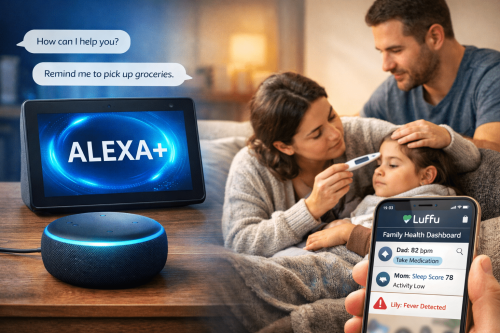
How Real Life Is Changing with Alexa+ and Family Health AI
AI assistants that understand us better and health tracking that helps families stay ahead of issues just moved from niche ideas into tools millions might use. Amazon’s Alexa+ rollout now reaches all U.S. users, bringing smarter AI into households across the country. At the same time, Fitbit’s founders launched a new family health AI platform that aims to centralize and interpret health data for entire households, not just individuals. These developments matter because they shape how we handle daily tasks and health decisions—but they also raise questions about privacy, accuracy, cost, and dependency.
What’s New With Alexa+: Smarter, More Conversational AI
Amazon has expanded the rollout of Alexa+, its generative AI-powered version of the Alexa assistant, to all U.S. users, including Prime members and non-members alike. Previously limited to early access and select devices, Alexa+ now works across Alexa-enabled devices, the Alexa app, and even a browser interface.
Alexa+ isn’t just a voice helper that sets timers or plays music anymore. It uses advanced language models to understand natural language better, carry longer conversations, and complete complex tasks on your behalf, like planning outings or managing calendars.
Prime members get Alexa+ at no extra cost, while others can access it on a limited free tier or pay a subscription for full access.
Why Alexa+ Matters Now
For years, voice assistants struggled to go beyond basic commands and simple tasks. Even though Amazon introduced Alexa back in 2014, its capabilities lagged behind how people naturally speak and what they expect from AI today.
With growing competition from AI chatbots like ChatGPT and Google Gemini, Amazon is betting that a more capable assistant will keep people engaged with its services and devices. Making Alexa+ widely available could change how people interact with smart homes, turning passive devices into active helpers that can clarify questions, plan activities, and respond like a conversational partner.
How Alexa+ Actually Works
Amazon rebuilt Alexa+ around generative AI models, including its own Nova models and others like Anthropic’s Claude. These models help Alexa+ move beyond keyword triggers into real back-and-forth language understanding.
Instead of a static set of commands, Alexa+ can interpret context across multiple steps. Users can speak normally, asking follow-ups or expanding topics without reciting rigid phrases. Alexa+ also suggests actions proactively—like reminders or ideas—based on patterns in your conversation or past behavior.
The integration goes beyond voice. Alexa+ works through typed chat on web and mobile, making it behave more like a full-blown AI assistant rather than only a voice interface.
Trade-Offs: Privacy, Cost, and Dependency
As Alexa+ gets smarter, it also gets deeper access to user context, schedules, and routines. That raises privacy questions about how much personal data the assistant stores and processes. Amazon says it aims to protect user data, but users should still review privacy settings and permissions.
Adding AI features also means more reliance on internet connectivity and subscription models. While Prime users get access included, non-Prime subscriptions can add costs that some consumers may find steep if they already pay for multiple services.
Finally, as AI assistants make decisions or recommendations for us, we risk becoming too dependent on automated advice rather than building our own problem-solving skills.
Family Health AI: Luffu’s Mission to Support Caregivers
On another front, Fitbit co-founders James Park and Eric Friedman launched a new AI-driven platform called Luffu, designed to help families manage health information collectively.
Unlike most health apps that focus on individual users and isolated metrics, Luffu gathers health information from multiple sources—wearables, apps, user input, and more—and organizes it to give families a clearer picture of their collective wellbeing.
Instead of acting as a chatty bot, Luffu works quietly in the background, learning what’s normal for each household and alerting caregivers to meaningful changes or potential concerns. The founders describe the platform as a “guardian,” not a constant monitor, putting control of data sharing firmly in users’ hands.
Why Family Health AI Matters
Family caregiving is a reality for tens of millions of adults. Across the U.S., a large share of people juggle caring for children, aging parents, spouses, and even pets—all while balancing work and other responsibilities. Luffu addresses the real complexity of these roles by reducing the mental load of tracking scattered health information.
Current health data often lives in separate silos: wearable dashboards here, doctor portals there, text messages and medications elsewhere. Luffu aims to unify that information and make it meaningful in real time.
How It Works: AI That Learns Your Family
Luffu taps into connected devices like wearables and integrates data from various health apps to create a baseline for each family member’s health patterns. Over time, it learns what’s typical and flags deviations—like changes in sleep, missed medications, or unusual symptoms—without overwhelming users with noise.
Users can input information using voice, text, or photos. An example might be snapping a picture of a medication label or typing in notes about a symptom, and Luffu will interpret and organize that data into actionable insights.
The platform starts as a mobile app with plans to expand into complementary hardware, aiming to create an ecosystem that fits everyday family life.
Risks, Accessibility, and Trust
Health data is deeply personal, and the success of tools like Luffu hinges on trust. Users must feel confident that data stays secure, that sharing controls are transparent, and that insights are accurate.
AI systems can generate false positives or miss context that a human caregiver would notice. Overreliance on automated alerts could also cause unnecessary anxiety or lead to ignoring personal judgment.
There are also accessibility questions. Will Luffu cost money? Will families with limited tech access be left out? These details remain unclear until broader availability rolls out.
How These Trends Compare
Alexa+ and Luffu come from very different origins but share a theme: AI moving from novelty to everyday usefulness.
-
Alexa+ builds on decades of Amazon’s voice assistant work and AI chatbot breakthroughs. It competes with ChatGPT, Google Gemini, and others in making assistants conversational and capable of taking action beyond simple commands.
-
Luffu moves AI into caregiving, an area many health tech solutions have overlooked by focusing narrowly on individual metrics. Its family-centered model reflects broader trends in personalized and interconnected health tech.
Both initiatives illustrate how AI is becoming embedded in daily life, not just in apps we check but in how we organize tasks and make decisions.
Practical Takeaways
-
Try Alexa+: If you’re a Prime member, explore Alexa+ via your Alexa app or speaking to your device. For non-Prime users, the free tier might still offer useful features.
-
Set privacy preferences: Review Alexa+ permissions and privacy settings to control what data is used and stored.
-
Watch for Luffu availability: Join the waitlist if you’re a caregiver or family health organizer to test early versions of Luffu.
-
Balance AI and judgment: Use these tools to support decisions, not replace personal judgment or professional advice.