

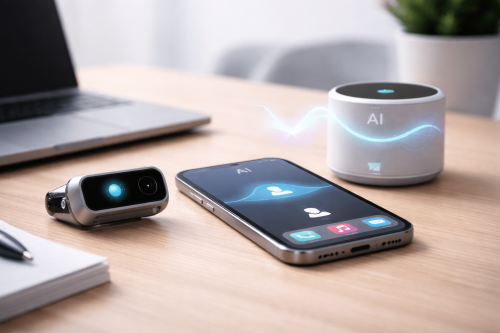
Your next AI assistant may sit on your desk or clip to your shirt instead of living inside your phone. AI hardware startups now push dedicated consumer gadgets that promise instant answers, voice control, and contextual help without opening an app.
This shift matters for buyers who already juggle smartphones, smartwatches, earbuds, and laptops. AI hardware startups argue that purpose-built devices can deliver faster responses and more natural interaction than phone-based apps. But these gadgets also raise questions about cost, battery life, privacy, and whether they solve real problems or add more clutter.
What Happened
Over the past year, several AI hardware startups doubled down on standalone devices. Instead of launching another AI app in crowded app stores, they introduced wearables, desk assistants, and portable AI companions.
Companies in this space include Humane with its AI Pin, Rabbit with the R1, and newer entrants building voice-first desk hubs. Each product centers on one idea: remove friction between you and artificial intelligence.
Most announcements came through product launch events and tech conferences in late 2025 and early 2026. Founders pitched these devices as the next wave after smartphones. They claim dedicated AI hardware can replace constant screen tapping with ambient, always-ready assistance.
AI hardware startups now compete not just with Apple, Google, and Samsung, but with the smartphone itself.
Why It Matters Now
Smartphones dominate digital life. They handle messaging, maps, payments, work, and entertainment. Adding AI through apps seems simple. So why do AI hardware startups think they can break through?
First, AI expectations changed fast. People now expect real-time transcription, contextual search, and natural language control. Phone apps often bury those features behind menus. Dedicated devices aim to surface AI instantly through voice or gesture.
Second, large tech companies control app ecosystems tightly. Startups struggle to gain visibility in app stores. By building hardware, they control the full experience.
Third, advances in compact chips make local AI processing more feasible. Smaller devices can now run trimmed language models without constant cloud access.
Still, timing cuts both ways. Consumers feel cautious about buying new gadgets after mixed results from early AI products. Many early reviews of AI pins and handheld AI devices pointed to slow responses, software bugs, and unclear value.
AI hardware startups must prove that their tools save time or reduce friction in measurable ways.
How These Devices Work
Most products from AI hardware startups rely on three core components:
-
A microphone array for voice input
-
A compact processor for local AI tasks
-
Cloud connectivity for heavier computation
When you ask a question, the device records your voice and converts it to text. A local model handles simple commands like setting reminders or summarizing recent notifications. For more complex requests, the device sends encrypted data to remote servers for processing.
Some devices include tiny projectors or minimalist screens. Others rely on audio responses only. The goal centers on reducing screen dependency.
For example, a wearable AI pin might:
-
Listen for a wake word
-
Capture your spoken query
-
Check your calendar or recent messages
-
Deliver a spoken summary in seconds
AI hardware startups often highlight hands-free interaction as their main selling point. They argue that constant phone checking disrupts focus. A wearable or desk device, in theory, blends into daily routines.
Performance and Practical Limits
Hardware constraints shape everything. Unlike smartphones with large batteries and powerful chips, small AI devices must operate within tight thermal and power limits.
Battery life often ranges from several hours to one full day, depending on usage. Continuous listening drains power quickly. That forces trade-offs between always-on features and longevity.
Processing speed also matters. Compact processors cannot match data center scale. Many AI hardware startups rely heavily on cloud support for advanced tasks. That means response times depend on network quality.
Privacy concerns follow. Even if a device runs some AI locally, voice data may still travel to remote servers. Users must trust that companies encrypt and handle data responsibly.
Price creates another barrier. Early dedicated AI devices have launched between $199 and $699, sometimes with subscription fees. Buyers compare that cost to a phone they already own.
AI hardware startups must show that their products reduce friction enough to justify the extra expense.
Do These Devices Replace Phones?
This question defines the category’s future.
So far, most dedicated AI gadgets act as companions, not replacements. Users still rely on smartphones for apps, photos, social media, and payments. AI devices often forward tasks back to the phone.
For example, you might ask a wearable to send a message. The device processes the request but uses your phone’s connection to complete it. That dependency limits independence.
AI hardware startups claim this stage mirrors early smartwatch history. Smartwatches began as phone extensions. Over time, they gained standalone capabilities.
However, smartphones pack cameras, large displays, and powerful processors. Replacing them requires more than voice queries. It requires ecosystem depth.
For now, these AI devices sit in a gray zone between accessory and primary tool.
Comparison to Past Gadget Waves
Tech history shows cycles of hardware experimentation. Netbooks, smart glasses, and portable music players each promised new computing models. Some stuck. Many faded.
Smart speakers offer a useful comparison. Amazon Echo and Google Nest created a voice-first category inside homes. Yet smartphones still handle most daily interactions.
AI hardware startups face a similar challenge. They must move beyond novelty. Consumers need clear daily use cases, not demos.
Wearables like fitness trackers succeeded because they solved a focused problem: step counting and health tracking. AI devices attempt broader goals. That breadth can dilute clarity.
Market and Investor Pressure
Venture capital continues to flow into AI-focused companies. Investors chase the next platform shift. AI hardware startups attract funding because they combine artificial intelligence with tangible products.
Hardware, however, carries higher risk than software. Manufacturing, supply chains, and returns increase complexity. Margins shrink when physical components enter the equation.
Large tech firms also watch closely. If startups prove demand, giants could integrate similar features into existing devices quickly.
This dynamic creates urgency. AI hardware startups must iterate fast before platform owners absorb their ideas.
Cultural and Behavioral Impact
If dedicated AI devices gain traction, daily behavior may shift. Voice-first computing could reduce screen time. People might rely more on spoken summaries than visual feeds.
But constant listening devices also raise social concerns. Will people feel comfortable wearing always-on microphones in public spaces? Will workplaces allow them?
Adoption depends not just on performance, but on social norms. Smart glasses struggled partly because of privacy optics. AI pins and desk companions must navigate similar perceptions.
AI hardware startups frame their products as tools for focus and productivity. The real test lies in whether users feel more efficient or more distracted.
Risks and Concerns
Several risks stand out:
-
Overpromising capabilities before software matures
-
Subscription fatigue from added monthly fees
-
Data privacy ambiguity
-
Hardware obsolescence within short cycles
-
Limited developer ecosystems
Many early devices depend on proprietary platforms. Without strong developer support, features remain narrow.
There is also the risk of fragmentation. If each startup builds its own assistant ecosystem, users may juggle incompatible systems.
AI hardware startups must balance innovation with openness.
Practical Advice for Buyers
If you consider a dedicated AI device, start with clear goals. Ask yourself:
-
Do I need hands-free assistance beyond my phone?
-
Will this device replace daily tasks or duplicate them?
-
Does it require a subscription?
-
How does it handle my data?
Read independent reviews and watch real-world demos, not launch presentations. Early adopters often tolerate glitches. Mainstream users expect polish.
If you value simplicity, wait for second-generation hardware. First releases often refine form factor and software through real feedback.
The Bigger Question
AI hardware startups represent experimentation at the edge of consumer tech. They test whether artificial intelligence deserves its own physical form.
Smartphones absorbed cameras, GPS units, and music players. They may absorb AI devices too. Or AI may evolve into a parallel layer that reshapes how we interact with technology.
Right now, practicality outweighs hype. Buyers want tools that save time, reduce friction, and respect privacy. AI hardware startups must deliver measurable value in speed, accuracy, and convenience.
The next year will reveal whether dedicated AI gadgets mark a true platform shift or a short-lived detour. Either way, this wave signals one thing clearly: the race to define how humans access artificial intelligence has moved beyond the app store.