


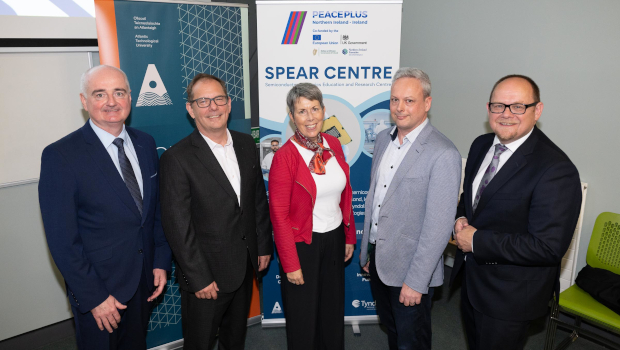
SPEAR Centre a collaboration between Atlantic Technological University, Ulster University, Tyndall National Institute
Pro
Pictured: Peter Devine, Ulster University; Dr Nick Timmons, Atlantic Technological University; Dr Orla Flynn, Atlantic Technological University; Dr Mark Gubbins, Seagate Technology; Prof William Scanlon, Tyndall National Institute
The SPEAR Centre (Semiconductor Photonics Education and Research Centre) has been launched at the Atlantic Technological University (ATU) campus in Letterkenny, Co Donegal.
This project is supported by PEACEPLUS, a programme managed by the Special EU Programmes Body (SEUPB). It will be led by Atlantic Technological University through its WiSAR Lab in partnership with Ulster University, the Tyndall National Institute at University College Cork, and Seagate Technology. It represents a total investment of €8.46 million.
SPEAR Centre has been designed to position the Northwest as a hub for semiconductor and photonics innovation. The project will align with the EU Chips Act and Ireland’s Smart Specialisation Strategy, embedding advanced technology capabilities into the regional economy and strengthening cross-border collaboration.

Over the coming years, SPEAR will deliver on three key pillars: A doctoral college will train the next generation of PhD researchers in photonics, artificial intelligence, and semiconductor technologies. An innovation fund will support research and development across at least nine regional SMEs, enabling them to integrate cutting edge technology into their operations. Lastly, a strategic engagement programme will foster collaboration between academia, industry, and policymakers while raising public awareness of the potential of advanced technologies.
SEUPB chief executive Gina McIntyre said: “This PEACEPLUS project is designed to transform the North West through cutting-edge research, innovation, and enterprise development.
“It represents an investment in technology and education and also in people, in places, and in the shared future of the cross-border region. Through cross-border collaboration – between ATU, Ulster University, and Tyndall National Institute – this will strengthen the bonds of shared progress.
“This project marks a new chapter for regional innovation, for cross-border partnership, and for this island’s place in a fast-changing technological world. Empowering SMEs and growing high-tech sectors helps give people the opportunity to stay in the Northwest and this, in turn, helps create the conditions for a sustainable, inclusive peace.”
Atlantic Technological University President Dr Orla Flynn said: “SPEAR is far more than an investment in research infrastructure; it is a commitment to regional transformation. By embedding deep technology expertise into the Northwest, SPEAR will support enterprise growth, create high-value jobs, and build resilience in the face of global challenges.”
SPEAR will act as a catalyst for sustainable economic growth, enterprise development, workforce upskilling, and peacebuilding across border regions. By leveraging the combined expertise of its partners and the investment provided through PEACEPLUS, the initiative will not only advance research and innovation but also ensure that these advances bring tangible benefits to the region’s economy and society.
PEACEPLUS is managed by the Special EU Programmes Body (SEUPB) and represents a funding partnership between the European Union, the Government of the United Kingdom of Great Britain and Northern Ireland, the Government of Ireland, and the Northern Ireland Executive.
TechCentral Reporters