


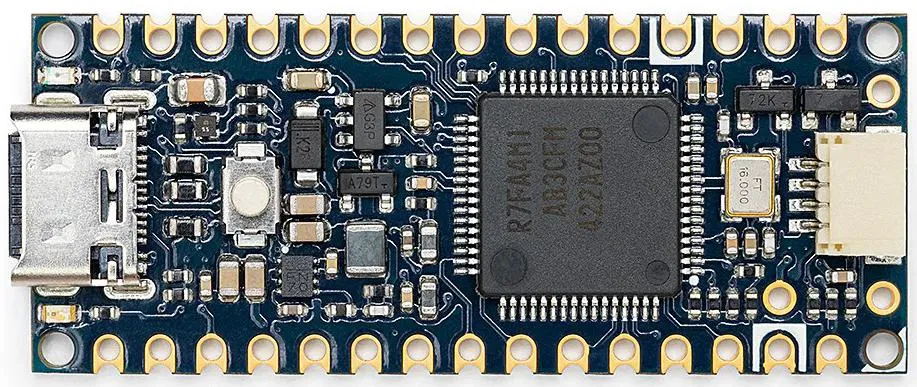
Powered by a Renesas RA4M1 microcontroller (Arm Cortex-M4), it is described as a “tiny-yet-mighty module”.
It is aimed at UNO R4 users for compatibility (the board is also based on the RA4M1), with minimal code changes. And it should find its place in connected devices, smart home units, or generally space-constrained projects. We’re talking a tiny footprint of 4.3 x 1.7 cm…
Nano R4
Arduino writes:
“With pre-soldered headers, the Nano R4 is ready out of the box for breadboarding, connecting to Modulino nodes, and jumping into experimentation without additional assembly. It maintains the same pinout as other boards in the Nano family and features an on-board Qwiic connector for rapid sensor and peripheral expansion, as well as a programmable RGB LED for intuitive system feedback.”
“Its single-sided component design makes it ideal for space-constrained products, ensuring a seamless transition from classroom or lab testing to real-world deployment.”
Spec
Sensors and peripherals are connected by one of two I2C ports. There’s a 3.3V I2C interface via a Qwiic/Stemma QT connector, and another 5V I2C port.
In terms of pins, there are 21 digital I/O Pins (all the exposed I/O can be used as digital I/O pins). And there are 8 analog input pins, 1 DAC, and 6 PWM pins. External interrupts are on pins 2 and 3.
In terms of memory, the RA4M1 has 256kB of Flash, 32kB of RAM, and 8kB EEPROM.
Pricing
The module priced at $13.30 on the Arduino store. And note, there is also a version with pre-installed header pins.
You can see what our technology editor thought in his news piece on the release. He writes, for example, on the Nano Connector Carrier board:
“If header pins are installed in the Nano, further expansion for sensors is available through Arduino’s 28x43mm Nano Connector Carrier board, which adds one more I2C ‘Qwiic’/’Stemma QT’ connector and three ‘Grove’ style connectors for: UART, yet another I2C, and both analogue and digital IO. A Micro SD card slot is also included and the IO can be switched between 3.3V and 5V.”
And you can find out more on the Arduino website.
It certainly seems to be already popular. It is currently sold out!
See also: