

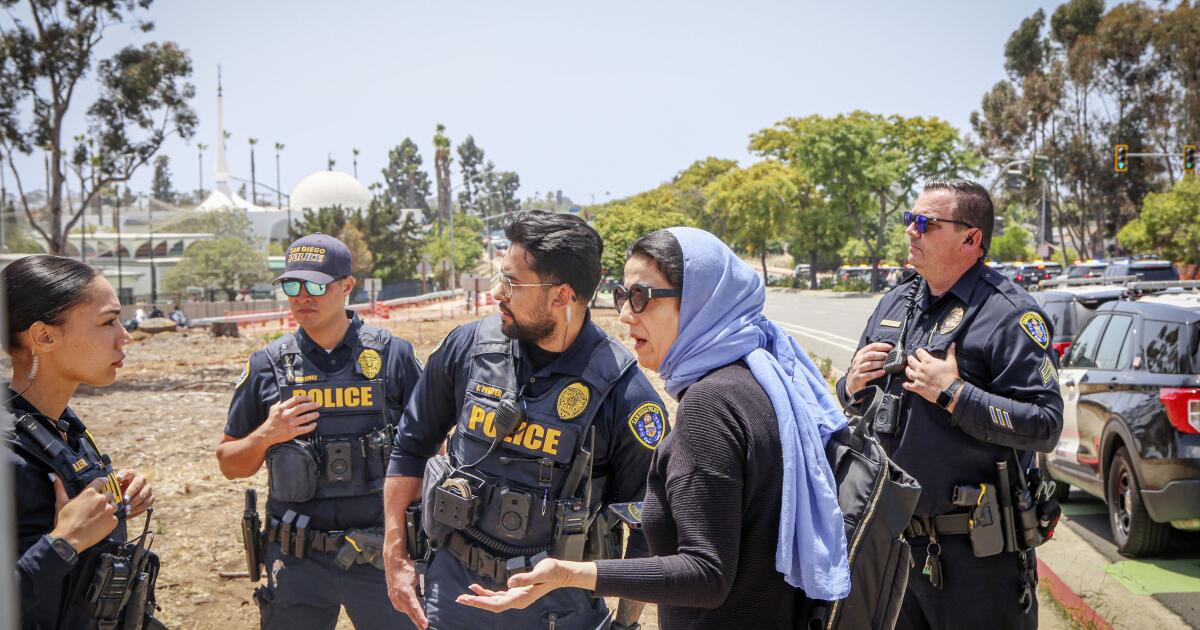
Many Muslim Americans are fearful following a shooting at the Islamic Center of San Diego on Monday that left three people dead, in addition to the two gunmen. Investigators reportedly found hate speech and anti-Islamic writing inside the vehicle of the shooters, who apparently killed themselves soon after the attack.
The director of the Islamic Center, Taha Hassane, condemned the attack while also encouraging individuals to respond with tolerance and love. “All of us are responsible for spreading the culture of tolerance, the culture of love,” he said, while lamenting the conditions that had led to such violence.
The attack comes after escalating tensions in the Middle East and increasing anti-Islamic political rhetoric in the United States. Republicans in Congress held hearings last week titled “Sharia-Free America.” This reflects a long-standing anti-Muslim trope that portrays Muslims as invaders who want to impose sharia — Islamic religious law — on all Americans. Many Muslim Americans are concerned because the rise of anti-Muslim bigotry among politicians has been mostly met with silence.
Muslim Americans have been warning that the increased rhetoric targeting Islam and Muslims endangers their community. As a scholar who studies Islamophobia and its impact on Muslim Americans, I have observed how the war with Iran intensified anti-Muslim sentiment online. A study by the Center for the Study of Organized Hate found that in the first six days of the conflict, the average number of Islamophobic posts on X jumped from an average of 2,000 daily to 6,000.
Research consistently shows that negative portrayals of Muslims shape public attitudes toward them and can lead to increased discrimination, psychological harm and hate crimes like the shooting in San Diego.
Islamophobia in the United States tends to surge during global conflicts, political campaigns and terrorist attacks. Human Rights First, an organization that works to promote human rights in the U.S. and abroad, documented surges in Islamophobia in 2015 following the Syrian refugee crisis, when a large number of people were displaced. That same year the attacks in Paris and shooting in San Bernardino intensified public anxiety about terrorism. A surge in crimes against Muslims followed.
Islamophobic rhetoric in the U.S., in which Muslims were often framed as a security threat, intensified during Donald Trump’s 2016 presidential campaign and continued into his first presidency. Burton Speakman, a scholar of digital media, and I found an increasing acceptance of such rhetoric among the political right in social media posts from 2016 to 2019.
Social media posts and comments showed an increasing use of dehumanizing language toward Muslims. In a study I conducted in 2020, a majority of 830 Muslim Americans reported encountering the most Islamophobic content on Facebook, followed by Twitter and Instagram. This shift was also reflected in the language and coverage of Islam in right-wing media, which often portrayed Muslims as invaders wanting to impose sharia and as a drain on social welfare.
Mainstream media can also amplify negative depictions of Muslims by often discussing Islam within the context of terrorism and portraying Muslims more negatively than other racial, ethnic or religious minority groups.
Hate crimes tend to increase alongside Islamophobic rhetoric. During 2016, a period with high rates of Islamophobic rhetoric, there were 307 reported incidents — the highest recorded number since immediately following 9/11. The numbers dropped in 2017 but were followed by an increase in 2024 with the Israel-Hamas war. That year, 288 anti-Muslim hate crimes were reported.
A 2025 poll found that 63% of American Muslims reported experiencing religious discrimination, with many reporting at least one such incident every year since 2016.
The cumulative effects of Islamophobia have an impact on American Muslims’ mental health and access to care.
Numerous studies since 9/11 link the high rates of discrimination experienced by the Muslim American community to higher rates of depression. Experiences of discrimination also lead some Muslim Americans to believe they are not viewed as being American. In addition, many Muslims reported feeling discouraged from seeking both physical and psychological treatment from non-Muslim providers. This leads Muslim Americans to significantly underutilize available services compared to other ethnic and religious minority groups.
The war with Iran has fueled an increase in anti-Muslim rhetoric that has increasingly spilled into political discourse. In February, for example, Rep. Randy Fine (R-Fla.) posted on X that “the choice between dogs and Muslims is not a difficult one.” In another post he wrote, “We need more Islamophobia, not less.” Similarly, Rep. Brandon Gill (R-Texas) called for stopping the entry of “Muslims immigrating to America.”
The shooting at the Islamic Center of San Diego has deepened fear of harassment and violence among an already vulnerable community.
Muslim Americans can often feel powerless in the face of such hostility. Greater public awareness, stronger advocacy and efforts to address the mental health impacts of anti-Muslim hatred are critical for a community that already feels vulnerable.
Anisah Bagasra is an associate professor of psychology at Kennesaw State University. This article was produced in collaboration with the Conversation.
Insights
L.A. Times Insights delivers AI-generated analysis on Voices content to offer all points of view. Insights does not appear on any news articles.
Viewpoint
Perspectives
The following AI-generated content is powered by Perplexity. The Los Angeles Times editorial staff does not create or edit the content.
Ideas expressed in the piece
- The article links the San Diego mosque shooting to a broader climate of Islamophobia in the United States, noting that investigators found hate speech and anti-Islamic writings connected to the suspects and that police are treating the case as a possible hate crime[1][2].
- It argues that the attack has intensified fear among Muslim Americans, many of whom already feel vulnerable to harassment and violence in the wake of global conflicts and domestic political tensions.
- The piece contends that recent events — including congressional hearings branded “Sharia-Free America” — revive long-standing tropes that portray Muslims as invaders bent on imposing Islamic law on the country, thereby normalizing anti-Muslim suspicion in mainstream politics.
- It maintains that such rhetoric has not been meaningfully challenged by many political leaders, and that this silence signals tacit acceptance of anti-Muslim bigotry.
- The article highlights research showing that Islamophobia spikes during geopolitical crises, such as the war with Iran, when online Islamophobic posts tripled in the first days of the conflict, and during earlier periods like the Syrian refugee crisis and attacks in Paris and San Bernardino.
- It argues that negative portrayals of Muslims in right-wing and, at times, mainstream media — including depictions of Muslims as security threats, social welfare burdens, or would-be enforcers of sharia — contribute to dehumanizing language and hostile public attitudes.
- The piece cites data indicating that anti-Muslim hate crimes rose sharply during periods of intense Islamophobic rhetoric, including 2016 and again in 2024 amid the Israel-Hamas war, and ties this pattern to an increasingly permissive environment for bias-motivated violence.
- It emphasizes the psychological toll on Muslim Americans, pointing to studies that connect high levels of discrimination to elevated rates of depression and to feelings of exclusion from American identity.
- The article notes that discrimination and mistrust discourage many Muslims from seeking physical or mental healthcare, especially from non-Muslim providers, leading to underuse of services when compared with other minority groups.
- It concludes that greater public awareness of Islamophobia, stronger advocacy, and targeted efforts to address its mental health impacts are essential steps to protect Muslim communities in the United States.
Different views on the topic
- While authorities are investigating the San Diego shooting as a potential hate crime, law enforcement officials have stressed that the suspects’ writings appeared to reflect a broad spectrum of hateful ideologies rather than a singular focus on Muslims, and have cautioned that the exact motive remains under investigation[1][2].
- In public briefings, officials have framed the suspects primarily as teenagers who appeared to be suicidal and radicalized online, suggesting that the key drivers may be digital extremism, mental health crises, and easy access to firearms rather than national-level political rhetoric alone[1][2][4].
- Some officials have underscored that the suspects “did not discriminate on who they hated” and that investigators recovered numerous weapons and tactical gear from multiple locations, presenting the case as part of a broader problem of youth access to weapons and extremist content instead of focusing specifically on Islamophobic discourse[2].
- Political and civic leaders at the local level have largely emphasized unity and a universal condemnation of hate — with statements that “hate has no home” in San Diego — without publicly tying the attack to specific congressional hearings or partisan figures, thereby framing the issue as a general fight against bigotry rather than as a direct product of particular political messages[1][2].
- Community responses highlighted by officials have often centered on resilience, interfaith solidarity, and improving security at houses of worship, focusing on immediate safety and communal healing rather than on systemic Islamophobia or national political rhetoric as the primary explanation for the attack[2][4].
- Early news coverage of the shooting has focused on reconstructing events, the personal backgrounds of the suspects, and the ongoing investigation, with limited explicit linkage to specific recent political statements; this framing situates the tragedy more within patterns of targeted violence, youth radicalization, and gun access than as a direct consequence of high-profile Islamophobic rhetoric in Washington[1][3][4].