


There is a particular kind of exhaustion that happens in front of a wardrobe, that doesn’t announce itself dramatically. It’s not just the practical stress of a busy morning or the frustration of having nothing to wear on a night out – it’s the feeling of standing in front of clothes you chose, clothes you paid for, clothes that fit. And finding that none of them come together into anything that feels like you. You have pieces, but what you don’t have is complete outfits – and the difference between those two things feels enormous.
Most women I speak to describe it the same way. Not as a practical problem exactly, but as a wrongness they can’t quite locate. They reach for something, put it back. Leave the house in whatever felt least wrong and spend the rest of the day uncomfortable – not in their body, but in the version of themselves they’re presenting to the world. And almost without exception, they conclude that the problem must be their style and what’s in their wardrobe.
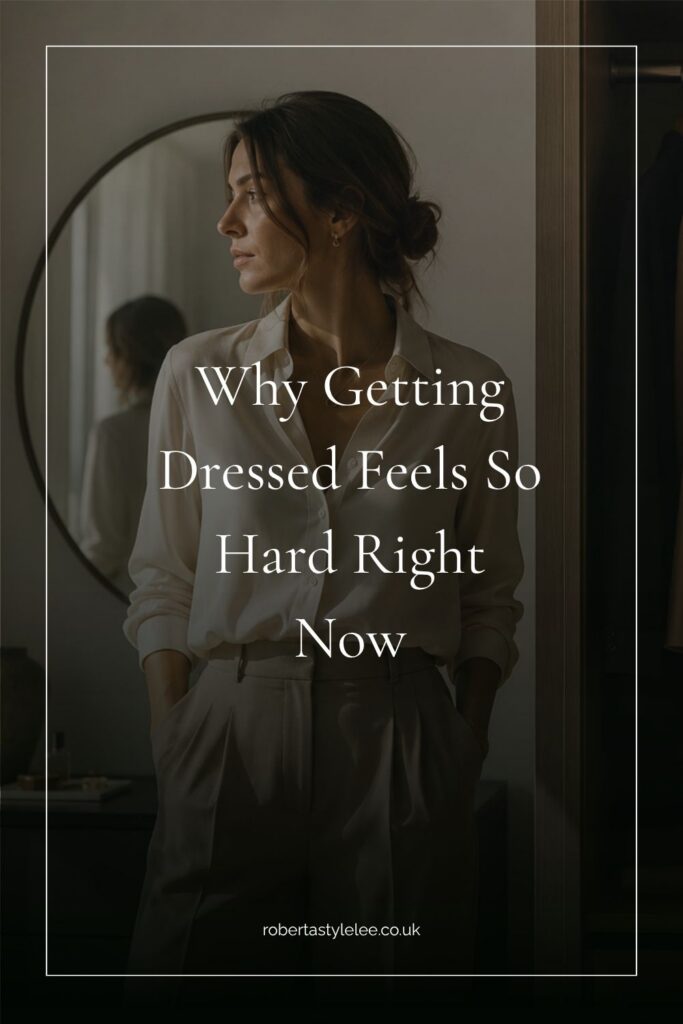
It’s a reasonable conclusion. The evidence points that way – nothing feels right, therefore something must be wrong with the clothes. The solution, logically, is to fix them. Clear things out, buy better things, start again with a wardrobe that finally makes sense. And so the cycle continues: the clear-out that doesn’t quite resolve it, the shopping trip that brings momentary relief before settling back into the same dull dissatisfaction, the carefully assembled Pinterest board that represents a woman who feels, somehow, like a stranger.
The difficulty with this logic is that it locates the problem in the wrong place. In my role I look at both style and identity as a whole – and what I see most often isn’t a wardrobe problem. It’s an identity shift that the wardrobe hasn’t caught up with yet.
When Nothing In Your Wardrobe Feels Like You Anymore
Wardrobe confidence isn’t really about the clothes. It’s about the relationship between the clothes and the woman wearing them – and whether that relationship still reflects who she actually is. When it doesn’t, the disconnection is felt immediately, even when it takes much longer to name.
What tends to happen is this. Life moves. A woman changes – in her career, in her relationships, in how she understands herself and what she wants to communicate to the world. The change is rarely sudden. It accumulates gradually, through experience and growth and the slow process of becoming someone different from who she was three or five years ago. And the wardrobe, which was assembled for that earlier version of herself, stays exactly where it is.
Your Wardrobe Records Who You Were, Not Who You Are Now
A wardrobe records decisions made at particular moments, for particular versions of a life. The blazer bought for a role that no longer reflects how you want to be seen. The dresses from a chapter you’ve left behind. The jeans that held a version of you three dress sizes ago – a reminder you are not that size anymore. The carefully assembled work wardrobe that still fits the job but has stopped you feeling like the person you are today, not last year.
When nothing feels right, it is rarely because your clothes have failed, or you lack taste – it is because you have changed, and the wardrobe hasn’t evolved with you. If this feels familiar, you’re not alone in feeling this way.
Your Wardrobe Hasn’t Failed You – You’ve Changed
That gap between who you are becoming and what you are still wearing is what generates the emotional dissonance. And the reason getting dressed feels so hard is that it asks you to make a visible statement about who you are at the precise moment you are still working that out.
There is rarely language for this when you’re in the middle of it. You know something is off. You’ve tried fixing it the obvious ways – the clear-out, the shopping trip, the new rules – and nothing quite sticks. What’s harder to see from the inside is that the wardrobe isn’t the source of the problem. It’s just where the problem shows up most visibly, every single morning.
The Emotional Cost of Dressing as a Past Version of Yourself
Naming it as an identity signal rather than a wardrobe failure changes everything. Style problems are often decision problems – and decision problems have a different solution to wardrobe problems. One sends you back to the shops. The other asks you to stop and look honestly at what’s actually changed.
The weight of presenting a version of yourself that no longer fits is genuinely tiring, even when each individual decision seems small. Getting dressed is one of the few moments in a day that requires you to make a visible statement about who you are. When that statement feels false, or simply unclear, the effort of making it accumulates in ways that are easy to underestimate. For many women, this is the moment that signals it’s time for a new style chapter.
What the Clothes Are Actually Telling You
What I notice in my work, repeatedly, is that the wardrobe tells the story before the woman does. A client arrives describing a vague dissatisfaction – nothing dramatic, just a persistent sense that things don’t feel right anymore. And when we look at what’s actually there, the emotional timeline is almost always visible.
When Your Wardrobe Was Built for a Life You’ve Outgrown
The problem rarely looks the way women expect it to. The first is the wardrobe that looks perfectly reasonable from the outside – relatively small, relatively well-used, and still completely frustrating – mostly because the pieces don’t connect to each other and none of them connect clearly to who she is now. It’s not that there are no options. She’s wearing most of what she owns. It just doesn’t feel complete – like outfits are always missing something, never quite hitting the mark.
Then there is the opposite: the wardrobe built without restraint or any real sense of style direction. Industry estimates consistently suggest women wear as little as 20% of what they own – and in the most overfull wardrobes, it shows. Access to options was never the issue – if anything, all those choices have simply added to the mental clutter and chaos. No coherence, no thread running through it, no framework to return to when the decision fatigue sets in at 7am. In this wardrobe, more has meant more overwhelm, not more confidence.
Two very different wardrobes. The same feeling every morning.
If you recognise yourself in either of these, finding your personal style without years of guesswork is a more useful starting point than another shopping trip.
Why GENERIC Style Advice Keeps Getting It Wrong
What happens over time is a gradual loss of self-trust. Those instincts that were once sharper – before Instagram, before fast-moving trends, before the relentless external noise of half-baked advice telling you what you need, how you should dress and what to buy – have been slowly crowded out. Not because your judgment was ever wrong, but because it’s been competing with so many other voices for so long that it’s become hard to hear your own.
You might be the woman who admires someone else’s effortless style and wonders why the same pieces don’t land the same way on her. Or the woman who invests in expensive items that made perfect sense in the moment and felt like a mistake within a week. Or maybe you’re the woman who keeps trying other people’s frameworks and finding that none of them quite fit – because they were never built for your life, your body, your history or where you’re actually going.
This is not a taste problem – it is what happens when you’ve been trying to answer an identity question using tools that were never designed for it. Identity-driven personal style starts from a completely different place.
And, you may be wondering what if I am all three? That’s completely normal and from experience, I can say at least 85% of my clients recognise themselves across all areas. That’s why I have developed the New Chapter Styling Experience for women who want to be expertly guided through the process (and unlearn a lot of things that haven’t been helpful) so they can trust themselves fully and start enjoying their wardrobes every day. And look forward to investing in key peices again.
Why Shopping Won’t Solve Wardrobe Overwhelm
The instinct, when nothing feels right, is to go back to the beginning – to shop her way to a wardrobe that finally makes sense. And that instinct isn’t entirely wrong. There are pieces missing from most wardrobes, and investing in the right ones does make a real difference. But shopping into confusion rarely produces clarity. At best it adds more volume to a wardrobe that already has more than enough. At worst it deepens the disconnection, because the new pieces don’t connect to what’s already there, and the underlying question – who am I dressing for now – remains completely unanswered.
Why Buying for Your Future Self Rarely Works
What I’ve also noticed is the particular exhaustion that comes from dressing for a version of yourself you’re aspiring toward rather than where you actually are. Buying the expensive piece to signal a future self, wearing it once, feeling like an imposter, and hanging it back up. Not because the piece was wrong exactly, but because it wasn’t connected to anything real yet – not to the rest of the wardrobe, not to the life she’s actually living, not to the clarity she hasn’t quite found. The purchase came before the foundation, and without the foundation, even the right piece can land wrong.
The guilt from purchases that didn’t work. The frustration of a wardrobe that keeps growing without ever feeling complete. The decision fatigue of standing in front of it every morning and still feeling like there’s nothing to wear. None of that is solved by more shopping. It’s solved by clarity – and clarity is not something the industry is designed to give you.
Wardrobe Confidence & Colour Clarity
And this has nothing to do with colour, despite what a lot of styling advice would have you believe. The idea that visibility requires it – wear brights, be remembered, add colour to command a room – is advice built for volume, not discernment. What I’ve noticed is that the women who genuinely hold attention when they walk in often do so in black, or in a single considered neutral, because what creates presence isn’t the shade – it’s the coherence. Black can be precise and completely personal. A neutral can be the most honest expression of who someone is. The issue was never the palette – it was the gap between what’s being worn and who’s actually wearing it.
Understanding how colour supports presence and identity is a very different conversation to being told which seasonal palette to follow.
Why Wardrobe Strategy Is So Hard to See From the Inside
Here is what I’ve observed consistently: the women who struggle most with this are not the ones with the least knowledge or the worst taste. They are often the most informed, the most thoughtful, the most willing to invest time and money into getting it right. The problem isn’t a lack of effort. It’s that style, particularly during a period of real transition, is extraordinarily difficult to see clearly from the inside.
Why the Most Stylish Women Still Need an Outside Perspective
We all have blind spots. Not because we’re not intelligent – the women I work with are highly capable in every other area of their lives – but because personal style is emotionally charged in ways that make objectivity almost impossible to access alone. The pieces we hold onto carry meaning we’ve stopped questioning. The things we avoid have histories we haven’t fully examined. The instincts we’ve stopped trusting were often right to begin with, but got buried under too many competing voices.
Sometimes the most useful thing isn’t more information. It’s one honest conversation with someone who can see the whole picture without the emotional weight attached to every piece. How personal style transforms confidence is rarely about the clothes themselves – it’s about finally being able to see yourself clearly.
The Inner Circle is where I share more thinking behind my work – practical, identity-led insight for women who are paying closer attention to how they present themselves and why. No trends, no generic styling tips. Just honest, considered thinking about style, identity and what it means to dress in a way that actually reflects who you are now.
[BUTTON: Join the Inner Circle] [LINK: Newsletter sign-up page]
What Clarity Actually Looks Like
The women who come to me at this point are rarely looking for someone to tell them what to wear. What they’re looking for – even if they don’t have language for it yet – is someone to help them see themselves clearly. To look honestly at what’s there, understand what it’s communicating, and identify what actually belongs to who she is now rather than who she was, or who she thought she should become.
That clarity, once established, changes everything that comes after it. The investment decisions become easier. The colour choices make more sense. The shapes, the brands, the balance between practicality and polish – all of it has a logic to it when the foundation is right. The decision fatigue that made getting dressed feel like an effort every morning starts to lift, not because the wardrobe has been overhauled overnight, but because there is finally a clear point of reference to return to.
Would a Style audit help?
This is precisely what the Style Synopsis is designed to do – not as a clear-out, not as a shopping directive, but as a structured moment of recognition. A chance to look at what’s there, understand what it’s telling her, and establish a clear foundation to build from. The women who find it most valuable are rarely the ones with chaotic wardrobes. They tend to be the ones with full, considered wardrobes that have simply stopped reflecting them – women who are closer to their own style than they realise, but who needed someone to help them see it before anything could shift.
The outcome isn’t a list of things to buy. It’s something more useful than that: a clear sense of the woman she’s dressing for now, and what that woman actually needs. From that point, every decision has a logic to it – and getting dressed stops being a problem to solve every morning and starts being something that simply works. If you want to understand what a style audit actually involves before taking that step, that’s a good place to start.
Ready to stop guessing?
If you’ve been standing in front of a full wardrobe and feeling like none of feels like you anymore, the Style Synopsis is where that conversation starts. It’s not a makeover and it’s not a shopping list. It’s clarity – about who you’re dressing for now, what your wardrobe is actually telling you, and what needs to change for getting dressed to feel like you again.
Not sure which personal styling services are right for you? See all styling services here.
Style Identity Doesn’t Change Overnight – But Clarity Does
A wardrobe can hold onto versions of ourselves long after we’ve moved on – and that isn’t a failure of the clothes, or of the woman wearing them. It’s simply what happens when life moves faster than the decisions we make about how to present ourselves, which for most women navigating real change, is most of the time.
The exhaustion of getting dressed, when it persists, is information. Not that something has gone wrong, but that something has changed. And recognising that distinction – with the right support and a clear outside perspective – is usually where everything begins to shift.
For the woman who is ready to build from that point with certainty rather than guesswork, the New Chapter Styling Experience or Bespoke Styling takes that clarity further.
SUGGESTED READING
When Clothes Don’t Feel Like Me Anymore
Entering a New Style Chapter
How to Find Your Personal Style Without Years of Guesswork