

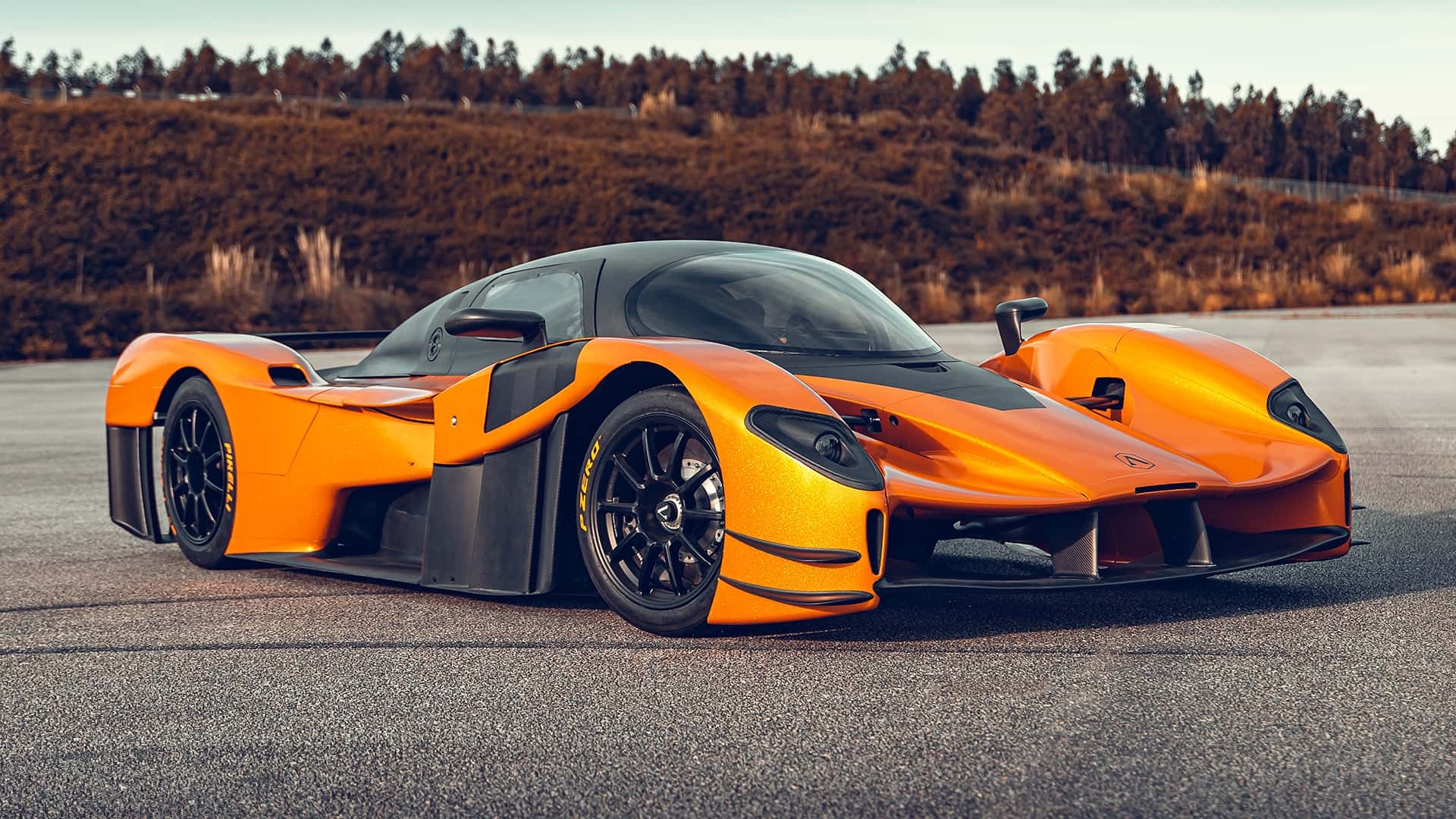
- The Adamastor Furia is a new hypercar from Portugal.
- It has a twin-turbocharged 3.5-liter V6 engine from a Ford GT making 650 horsepower.
- The car is a starting point for a 24 Hours of Le Mans program.
There’s a new name in Europe’s supercar scene—and it comes from a country that hasn’t traditionally played in this segment. It’s called the Adamastor Furia, the first model developed by Adamastor, a young Portuguese company based in Porto with the stated goal of bringing race-bred technology to the street.
This isn’t just a styling exercise. It’s the starting point for a broader program that also looks toward motorsports, with the long-term idea of aiming for the 24 Hours of Le Mans. The street-legal version starts at €1.6 million ($1.9 million at today’s exchange rate); with 22 percent VAT, that figure rises to €1.95 million ($2,3 million).
Designed Around Airflow
The Furia was developed from a clean sheet, with aerodynamics playing a central role from the earliest stages. Its bodywork, made entirely of carbon fiber, hides substantial work underneath: two Venturi channels in the underbody generate much of the downforce. That reduces the need for traditional aero add-ons, keeping the lines clean while remaining highly functional.
The proportions are typical of an extreme supercar: about 15.0 feet long, more than 7.2 feet wide, and just over 3.3 feet tall. The result is a very low, very wide car designed to maximize stability at high speed. The two-seat cockpit is integrated into a monocoque structure with an integrated roll bar—an approach taken directly from race cars.
Just Over A Ton
One of the Furia’s key attributes is its low weight: roughly 2,315 pounds dry. That number comes from extensive use of carbon fiber and a design process focused on cutting mass. The layout is a longitudinal mid-engine with rear-wheel drive, prioritizing balance and handling response.

Adamastor Furia: race-bred aerodynamics and reduced weight
Photo by: Adamastor
Fully adjustable double-wishbone suspension allows the setup to be tailored to different conditions, while the AP Racing braking system uses six-piston aluminum calipers up front and four-piston units in the rear. The transmission is also race-derived, with a Hewland sequential gearbox operated via steering-wheel paddles.
Ford Power, Track-Focused Intent
Behind the carbon-fiber bodywork sits a 3.5-liter twin-turbo V6 developed by Ford Performance for the Ford GT, producing over 650 horsepower and 421 pound-feet of torque available from low engine speeds. Claimed performance includes 0–62 miles per hour in about 3.5 seconds and a top speed of more than 186 mph in street-legal form.
Adamastor Furia, the driver’s seat to tame 650 hp
Photo by: Adamastor
The plan includes both a street-legal, homologated variant and a more extreme track configuration, with downforce figures that can reach as much as 3,968 lb at 155 mph. Numbers like that underline Adamastor’s ambition to go up against established names in the high-performance supercar segment.
From Road Car To Le Mans Aspirations
Production will be limited to around 60 units, hand-built in Portugal using a process in which each car is assembled by a dedicated team. That approach enables a high degree of personalization and direct quality oversight.
Adamastor Furia and the development team
Photo by: Adamastor
Behind the Furia is a clear vision: create a supercar that blends technology, performance, and national identity. Adamastor aims to use this platform as the basis for future developments in racing as well, including the 24 Hours of Le Mans. It’s an ambitious path—one that could eventually put the Portuguese brand up against endurance racing’s biggest names.
Motor1’s Take: It’s bold to have aspirations of building a hypercar and competing in Le Mans, and it’s not everyday that a new company decides to try both. The Furia certainly looks ready to race, and maybe we will see it on the grid very soon.