

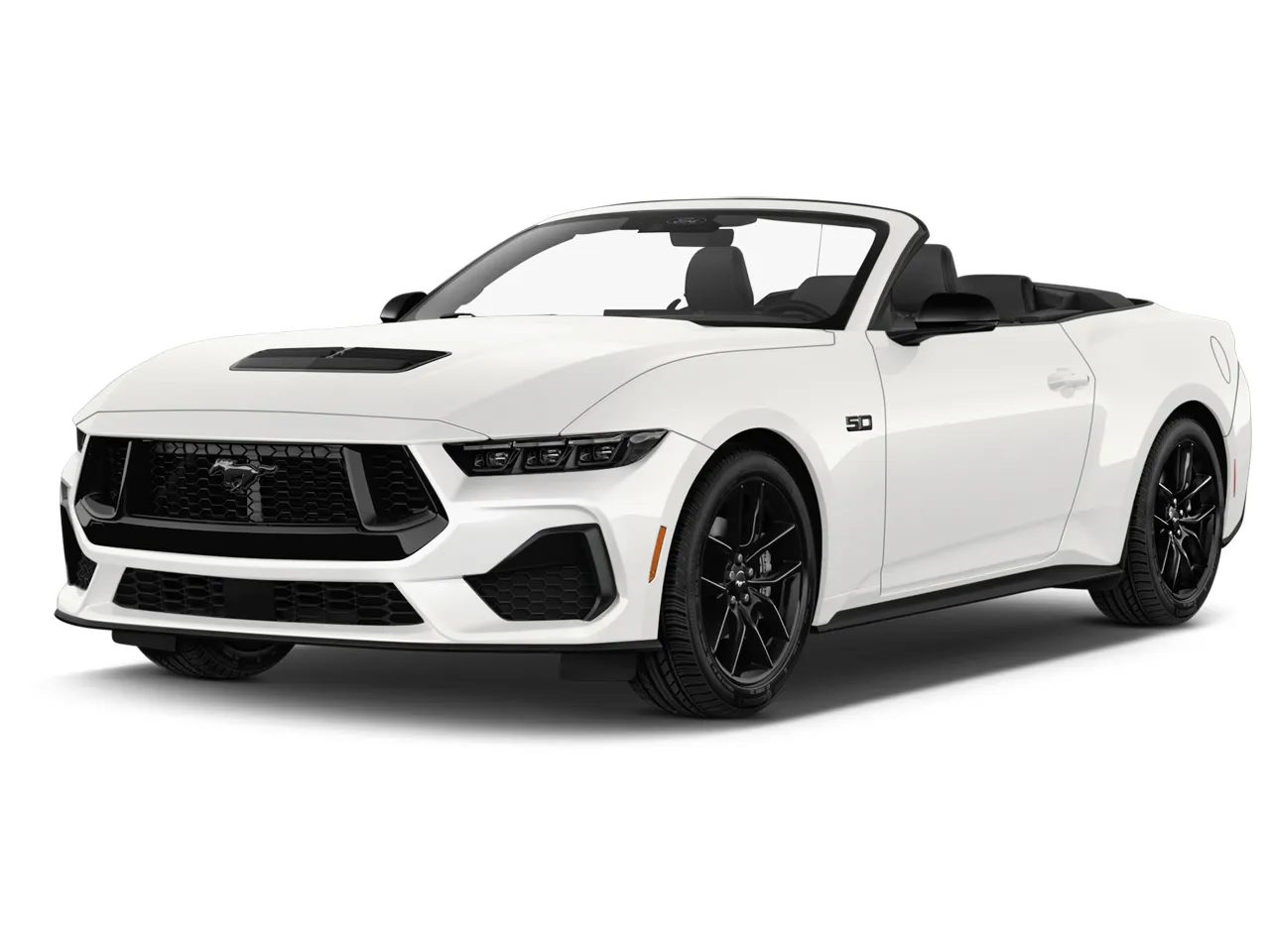
The latest Ford Mustang sticks to the formula that made it an icon. In GT form, you get a 5.0-liter V8 with up to roughly 480 to 500 horsepower depending on trim, and it feels every bit as strong as the numbers suggest. It pulls hard from low revs, spins eagerly to a high redline, and sounds like a proper muscle coupe, especially with the optional Active Valve Exhaust opened up.
The six-speed manual is one of the car’s highlights. Throws are short, light, and precise, and the clutch take-up is so forgiving that even newcomers to stick shift can drive it smoothly. Rev matching for downshifts can be turned on if you want the sound and smoothness without the extra footwork. A 10-speed automatic is available across GT, EcoBoost, and Dark Horse models for buyers who prefer two pedals.
EcoBoost versions use a 2.3-liter turbo four that makes strong power and delivers far better fuel economy than the V8 cars. In daily traffic, they feel quick enough, and the automatic snaps off rapid shifts. If you rack up highway miles or face long commutes, the four-cylinder trims will burn noticeably less fuel than the eight-cylinder Mustangs.
Ride quality is a pleasant surprise. Even on sporty setups, the Mustang has an initial softness that takes the edge off broken pavement and expansion joints. It feels more like a grand tourer than a track special, which suits drivers who want a car that can handle a long highway run as well as a back road blast. Noise levels are higher than in a typical sedan, but compared with many sports cars, the cabin is fairly calm once you dial the exhaust into its Quiet mode.
Handling is capable and confidence-inspiring if you treat the Mustang as a quick cruiser rather than a scalpel-sharp sports car. Grip is strong, body motions are controlled, and the long wheelbase gives it a stable, playful feel at the limit. With traction and stability systems relaxed, it will happily slide its tail in a predictable way that makes experienced drivers grin.
Every 2026 Mustang now comes loaded with modern active safety tech. Standard equipment includes automatic emergency braking, including cyclist and pedestrian detection, reverse automatic emergency braking, blind spot warning, rear cross traffic warning, lane departure warning, automatic high beams, and lane keeping assistance. Lane centering and adaptive cruise control are options, and even with the manual transmission, the adaptive cruise will manage speed on the highway as long as you keep the car in the right gear.
The 2026 Mustang lineup starts with EcoBoost Fastback models, which come only with the turbo four-cylinder and a 10-speed automatic. Even the base EcoBoost has decent power, a large digital gauge cluster, a 13.2-inch Sync 4 touchscreen, and the full suite of active safety features. Pricing starts at just over the mid-thirty thousand dollar mark, which is attractive for the style and performance on offer.
EcoBoost Premium Fastback and Convertible trims add everyday comforts that many buyers will want. These include upgraded interior materials, more speakers for the audio system, available heated and ventilated front seats, and extra convenience features. Convertibles cost more, yet they transform the Mustang into a relaxed open-air cruiser, especially appealing in warmer climates where the V8 rumble or turbo whistle can be enjoyed with the top down.
Step up to the GT Fastback and Convertible, and you unlock the heart of the Mustang story, the 5.0-liter V8. Power climbs significantly versus EcoBoost trims, and the car gains the option of a six-speed manual. GT Premium versions layer on dual zone climate control, a power driver seat with lumbar support, heated and cooled front seats, a heated steering wheel, upgraded audio, a wireless charging pad, and satellite radio. For many enthusiasts, a GT Premium Fastback with manual transmission is the sweet spot of the range.
The GT Performance Package is worth a hard look if you enjoy spirited driving or plan the occasional track day. It swaps in a stiffer suspension, bigger brakes, and stickier tires, which sharpen the car’s responses and improve brake performance. The tradeoff is a firmer ride and higher tire replacement costs, so it suits buyers who will actually use the extra capability rather than those who mainly commute on straight highways.
At the top of the regular lineup sits the Dark Horse Fastback. It turns the wick up further on the 5.0-liter V8, targets about 500 horsepower, and pairs it with either a six-speed manual or a 10-speed automatic. It also brings more aggressive chassis tuning, beefier cooling, and track-focused hardware. For serious track enthusiasts, the Dark Horse feels closer to a dedicated weekend toy than an everyday coupe, which is exactly what some buyers want.
The latest Mustang may be dripping with character, but it is not the most nimble car in its class. The long, wide nose and significant weight make it feel bulky on tight, twisting roads, especially compared with trimmer rivals like the Subaru BRZ or Toyota Supra. Steering effort can be adjusted, yet feedback from the front tires is still light and vague, which leaves enthusiasts wanting more connection.
Fuel economy is the other obvious tradeoff when you choose a V8 GT or Dark Horse. These versions drink far more fuel than the EcoBoost trims and trail many modern performance sedans and fast EVs. If you drive mostly in cities or push the car hard, you will spend a lot of time at the gas station. Regular fuel is acceptable in some V8 trims, but performance and efficiency are optimized with premium.
Inside, the cabin design looks modern, and the big screens grab attention, yet material quality does not always match the sticker price. Hard plastics on the doors and console, flimsy-feeling glove box hardware, and rough edges on some controls feel out of place on GT Premium and Dark Horse cars that can easily climb past the mid-fifty-thousand-dollar range. It feels fine in an entry EcoBoost, less so in a fully loaded flagship.
The move to screen-based controls also hurts day-to-day usability. Most climate functions sit in a slim bar at the bottom of the touchscreen with small icons and fiddly sliders. The system takes several seconds to wake up on startup, so you cannot quickly change temperature or fan speed as you pull away. Menu lag and confusing labeling in the MyMustang drive mode screens add another layer of frustration when you are just trying to tweak steering or exhaust settings.
Practicality remains limited. The front seats are low, and the doors are long, which makes getting in and out a chore in tight parking spaces or for anyone with mobility issues. Rear seats are best treated as an occasional child or small adult space. Headroom for grown-ups is almost nonexistent, and the process of climbing back there is awkward, not helped by front seats that do not power slide forward when you tilt the backrests.
The trunk itself can swallow luggage for two, yet the opening is small and oddly shaped, which complicates loading larger boxes or bulky gear. Cabin storage is only fair, with small door bins and cup holders doing most of the work. If you need true four-seat practicality or frequent cargo flexibility, a sporty sedan or hatchback will serve you better.
Our Take
The 2026 Ford Mustang feels like a car aimed squarely at drivers who still care about sound, feel, and drama more than spec sheet bragging rights. In V8 form, it is not the sharpest or the most efficient choice, and the tech interface can be annoying. Yet the combination of big power, classic styling, decent comfort, and strong safety tech makes it a deeply appealing coupe for the right buyer. If you want a modern car that still delivers an old-school pony car experience, this Mustang should be near the top of your list, with the GT Premium Fastback and Dark Horse serving very different but equally tempting roles.