

PROS:
- AstroRinse station eliminates the worst part of pool robot ownership
- AI Quick Mode cuts cleaning time in half without missing debris
- Five-zone coverage handles floors, walls, waterline, surface, and shelves
- 3-year full replacement warranty beats the industry standard by a year
- 30-minute setup from unboxing to first clean
CONS:
- Station rinse does not reach the top of the basket or lid
- At $4,250, the price puts it out of reach for many pool owners
EDITOR’S QUOTE:
The AstroRinse station finally makes pool robot ownership truly hands-off.

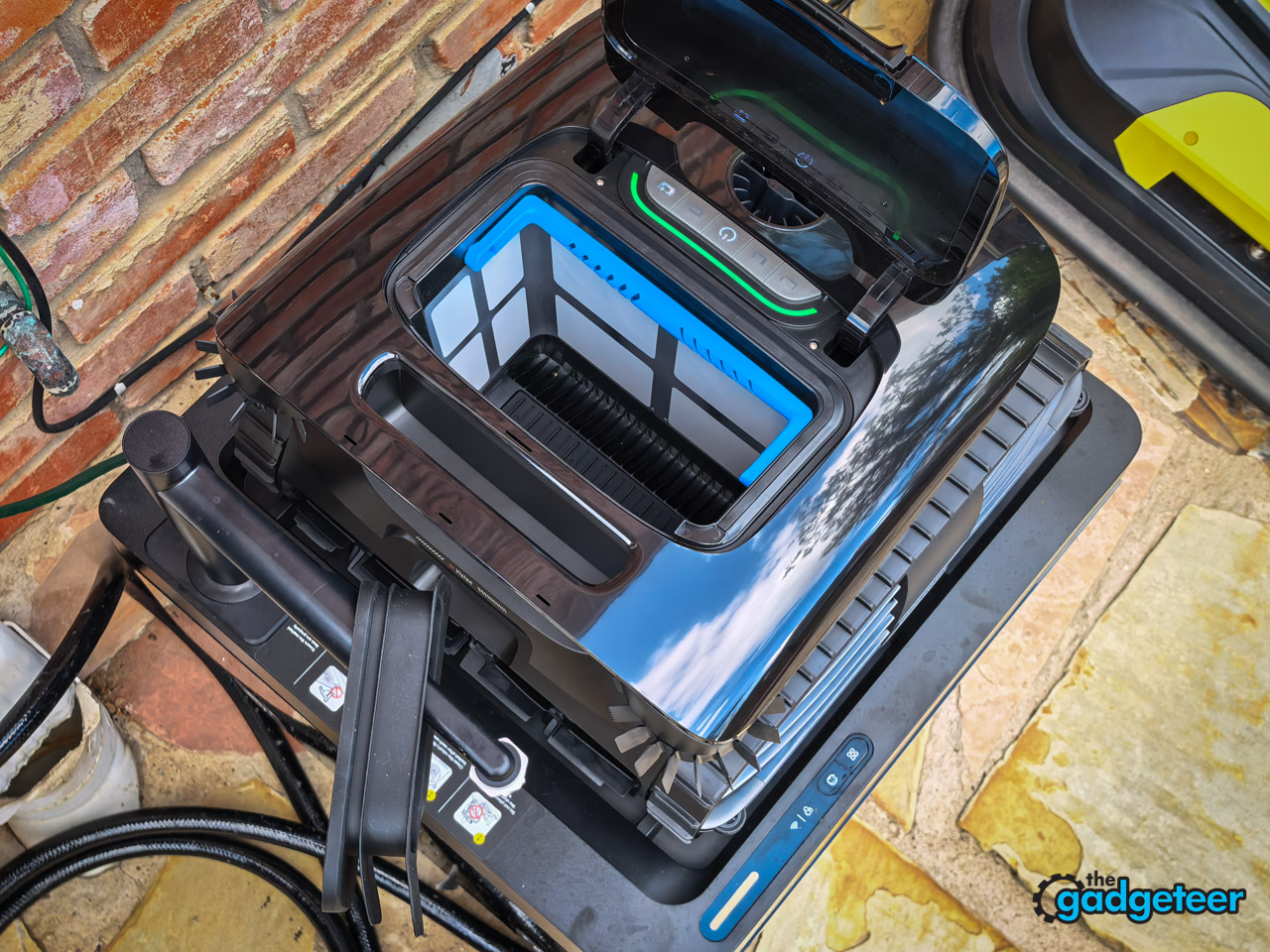
The AstroRinse station is the reason the Beatbot AquaSense X exists. It’s the first automatic filter-cleaning station built for a pool robot, and The Gadgeteer is among the first publications to put it through real-world testing. The robot docks, the station rinses its filter, empties its debris bin, and three minutes later everything is clean and charging for the next run. No hose-downs, no pulling filters by hand, no contact with the collected grime.
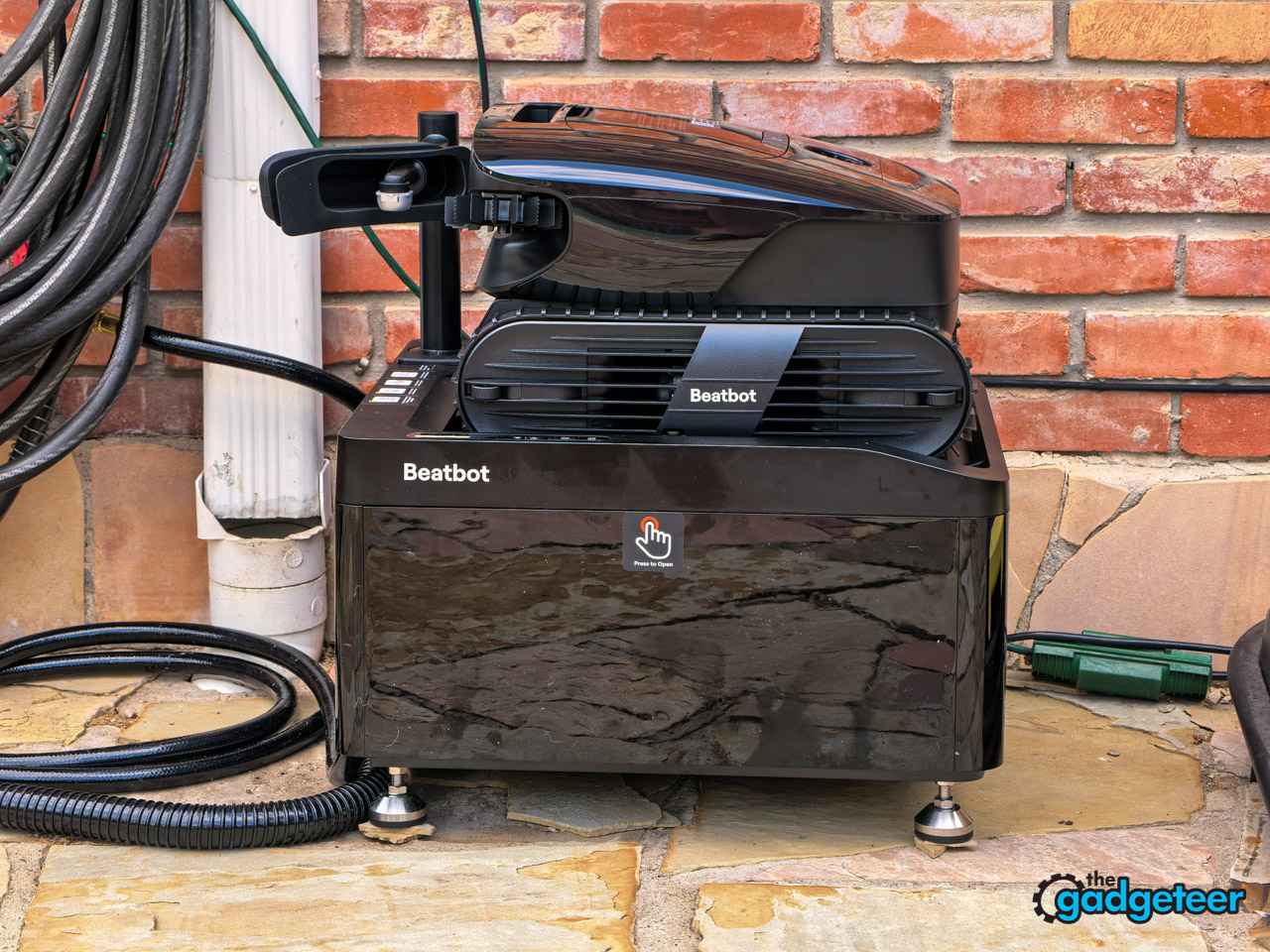
To understand why this matters, you need to see what pool robot ownership actually looks like during peak season. I’m testing the AquaSense X in April in North Texas, which means oak pollen, post-storm leaf dumps, and fine sediment that settles overnight no matter how balanced your chemistry is. Every pool robot on the market collects this stuff. The difference is what happens next.
Price: $4,250
Where to buy: Beatbot.com
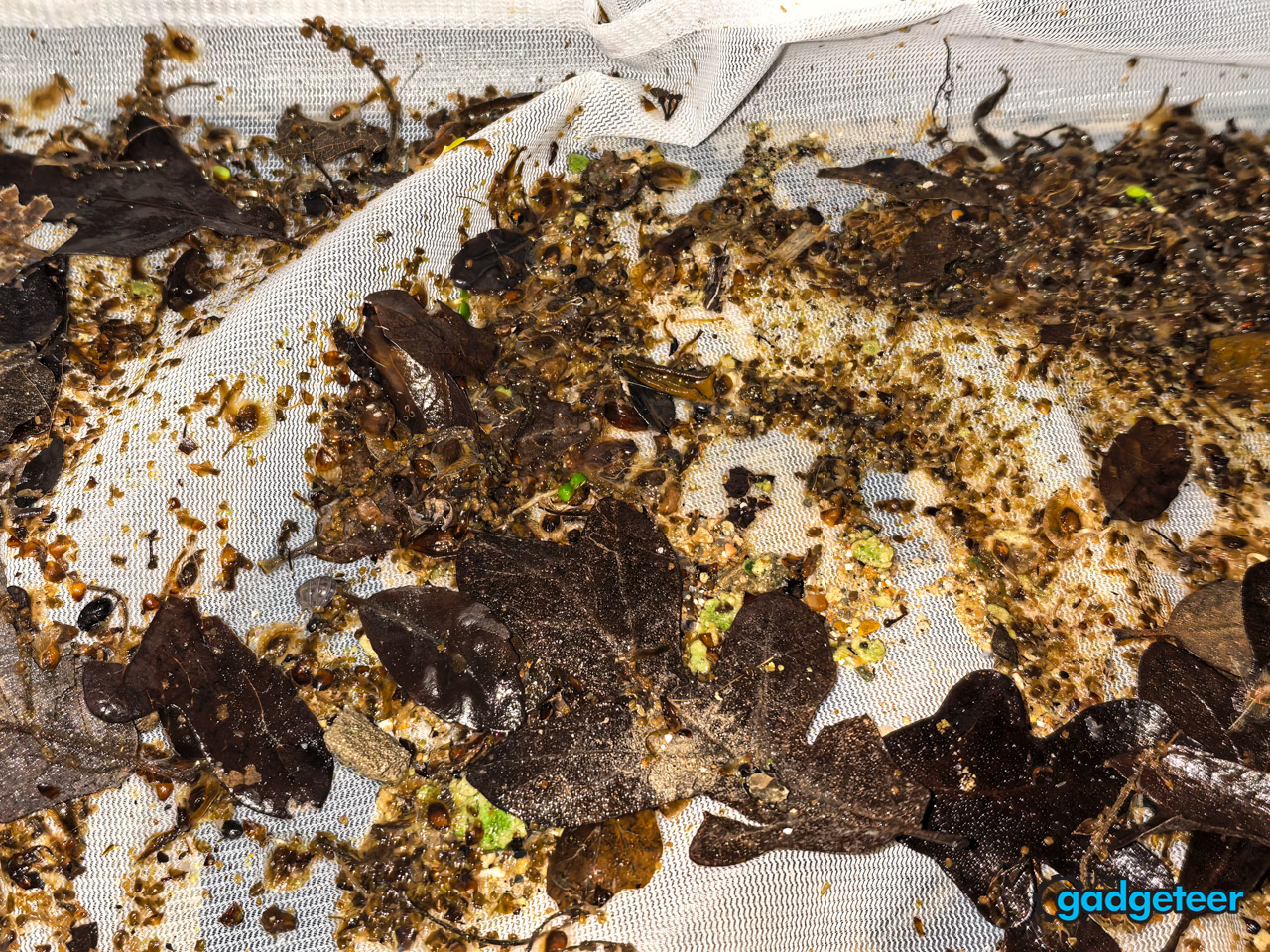
Open the onboard filter compartment on any cordless pool robot after a single cleaning cycle right now and you’ll find a compacted mass of waterlogged oak leaves, sandy grit, and enough organic sludge that it looks like something pulled from a storm drain. The filter mesh is buried under it. The housing walls are coated in a film of fine sediment. If you catch it right away and rinse everything with a garden hose, it takes about five minutes and a fair amount of scrubbing. If you forget, even for a single day, the wet debris bakes in the sun and hardens into a crust that bonds to the mesh. At that point, you’re picking leaf fragments out of the filter with your fingers, or worse, dragging out the pressure washer and plugging in the Giraffe unit like you’re prepping for a driveway restoration project. I’ve done this more times than I’d like to admit with other pool robots. When cleaning the thing that cleans your pool requires its own power tools, something has gone wrong.
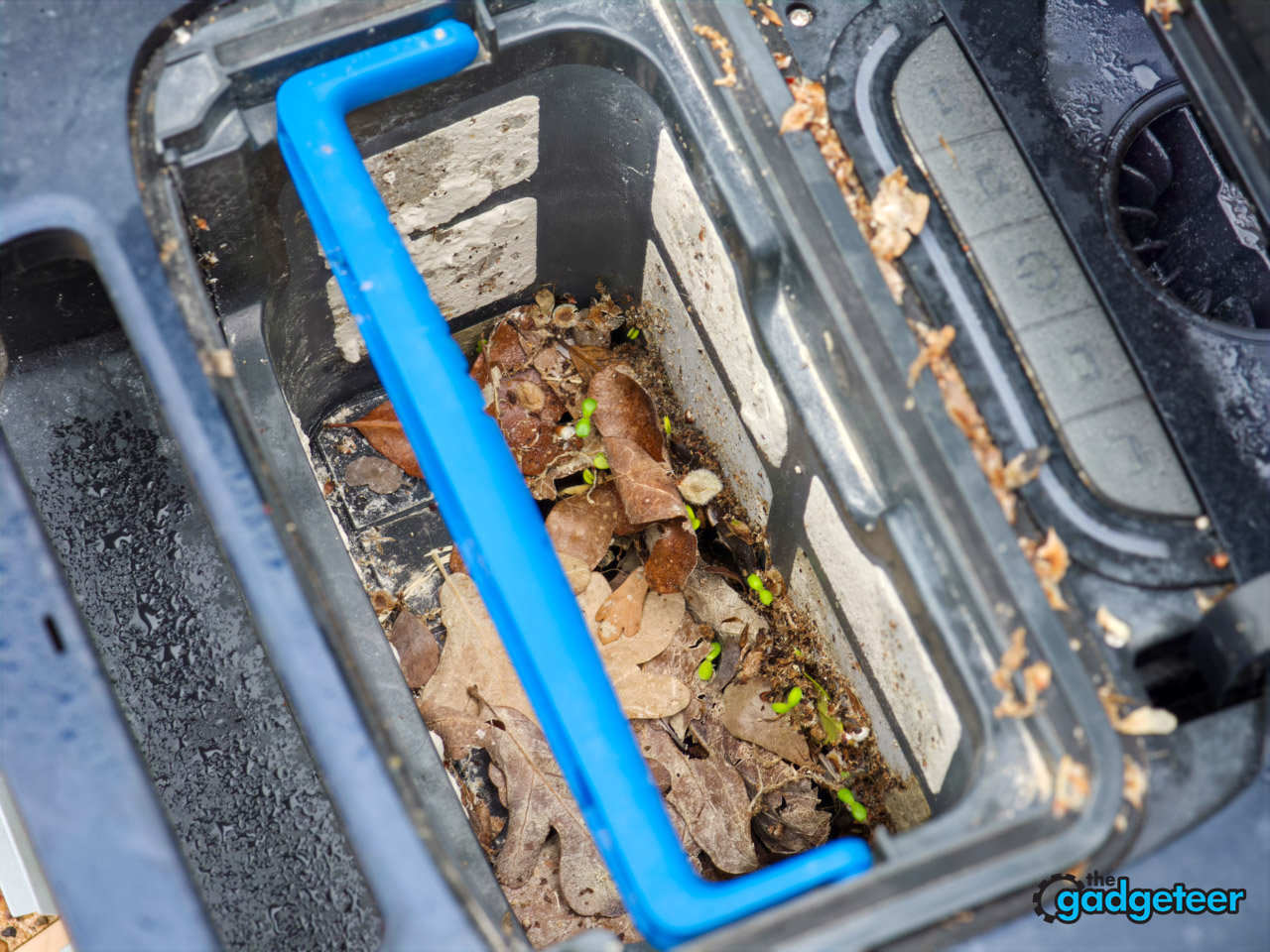
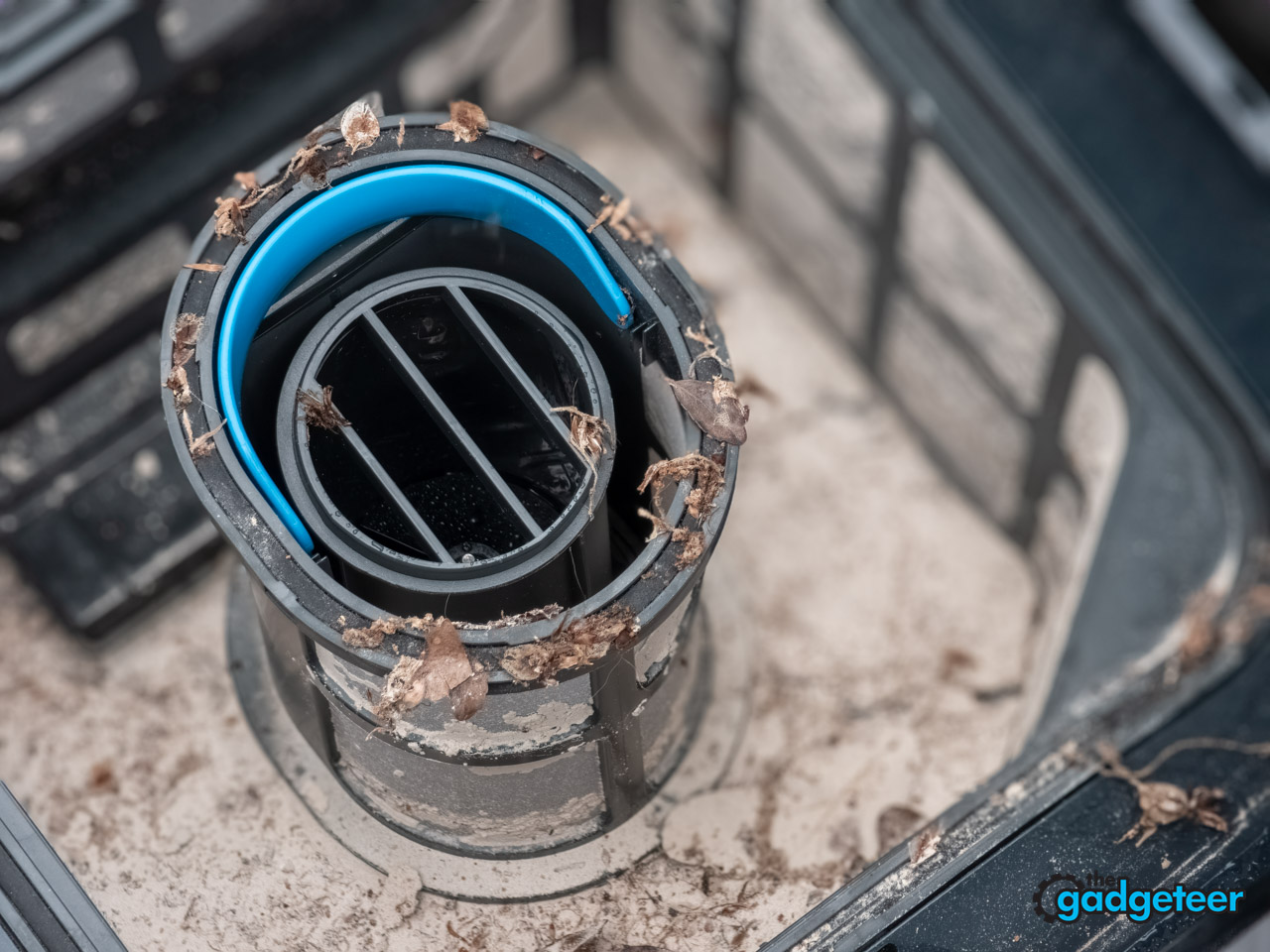
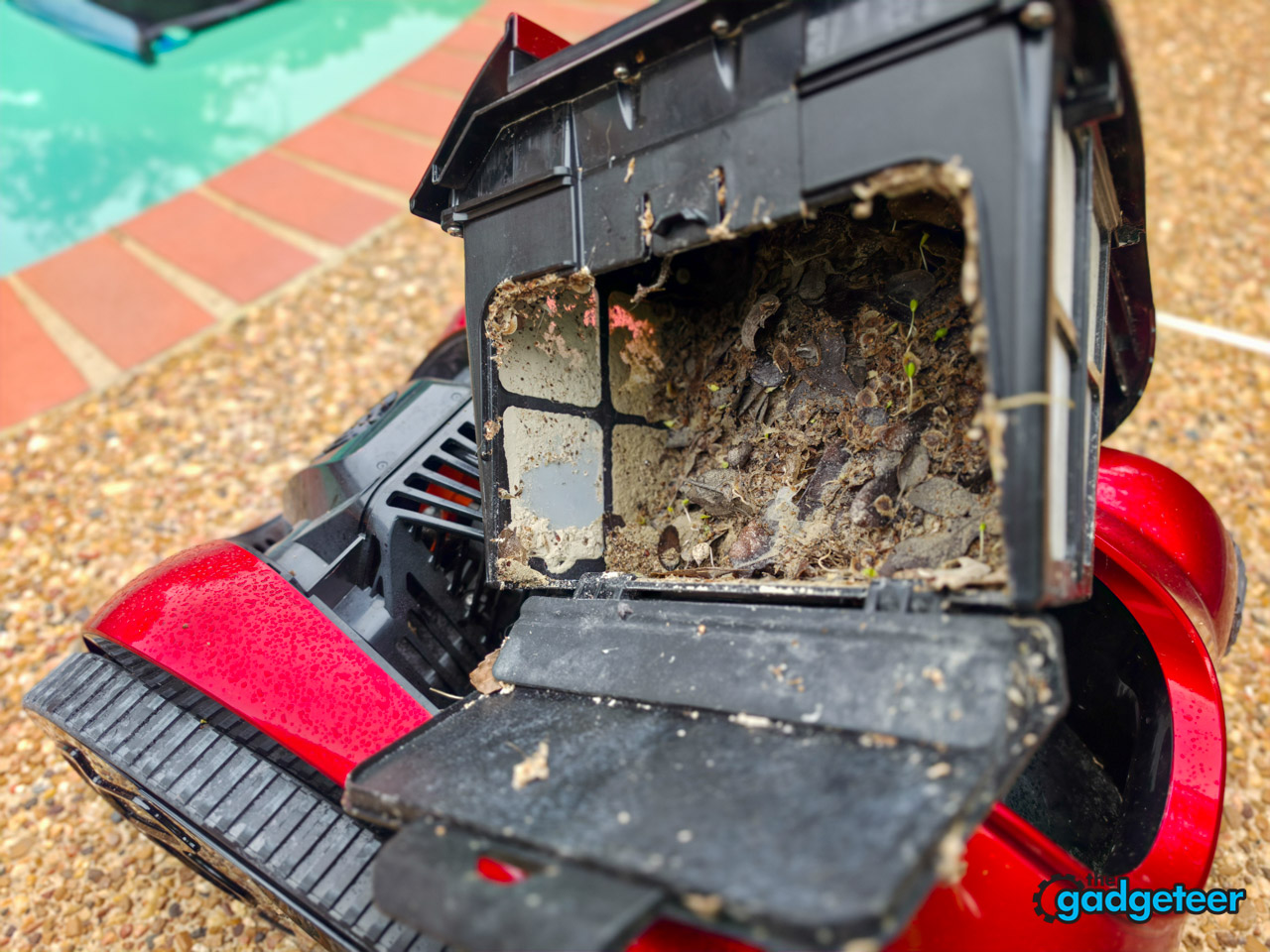
The worst part is what grows. Leave the filter compartment closed for 24 hours in warm weather and the decomposing organic matter starts sprouting. Tiny green shoots pushing through the compacted muck. It’s the kind of thing that makes you question whether the robot is saving you time or just redistributing the misery.
The AstroRinse station eliminates that entire cycle.
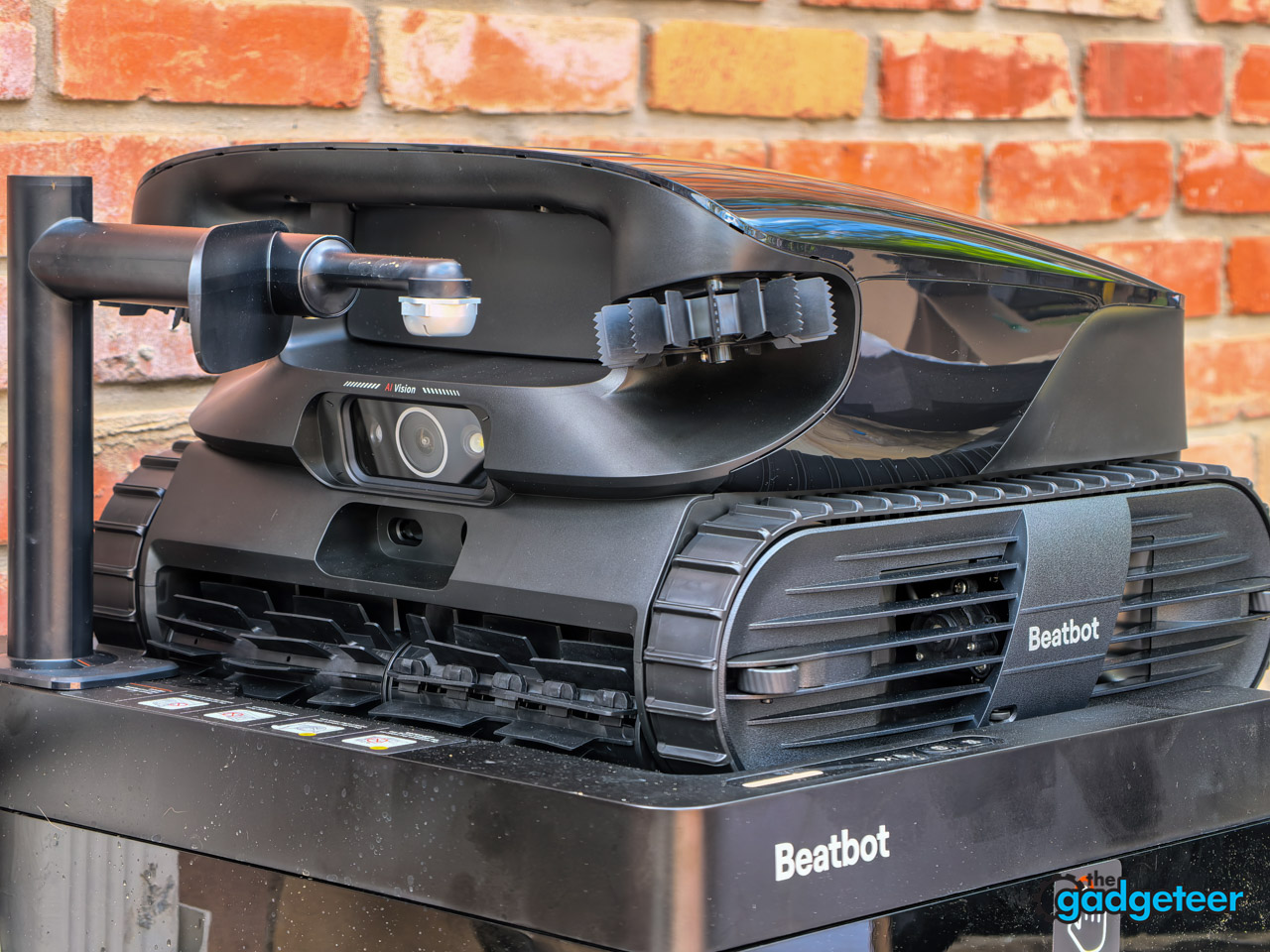
First, there is one physical step you cannot avoid: you do have to lift the AquaSense X out of the pool and place it on top of the AstroRinse station. The good news is that docking is not fussy. Once you set it down, it literally guides and aligns itself into position.
From there, the hands-off part begins. The robot docks, the station starts its rinse cycle, and about three minutes later the filter has been cleaned and the debris has been flushed into the station’s 22L basket.
You never handle the filter at its worst. The debris never gets a chance to dry, never bakes onto the mesh, and never starts its little compost experiment inside the robot’s body. After six cleaning cycles and eight self-cleaning sessions, I have not touched the filter once.
One minor caveat: the rinse faucet inside the station spins fast and does an impressive job on the filter and lower basket, but its placement means it does not quite reach the top edges of the basket or the underside of the lid. A quick pass with a garden hose every few sessions takes care of it in seconds.
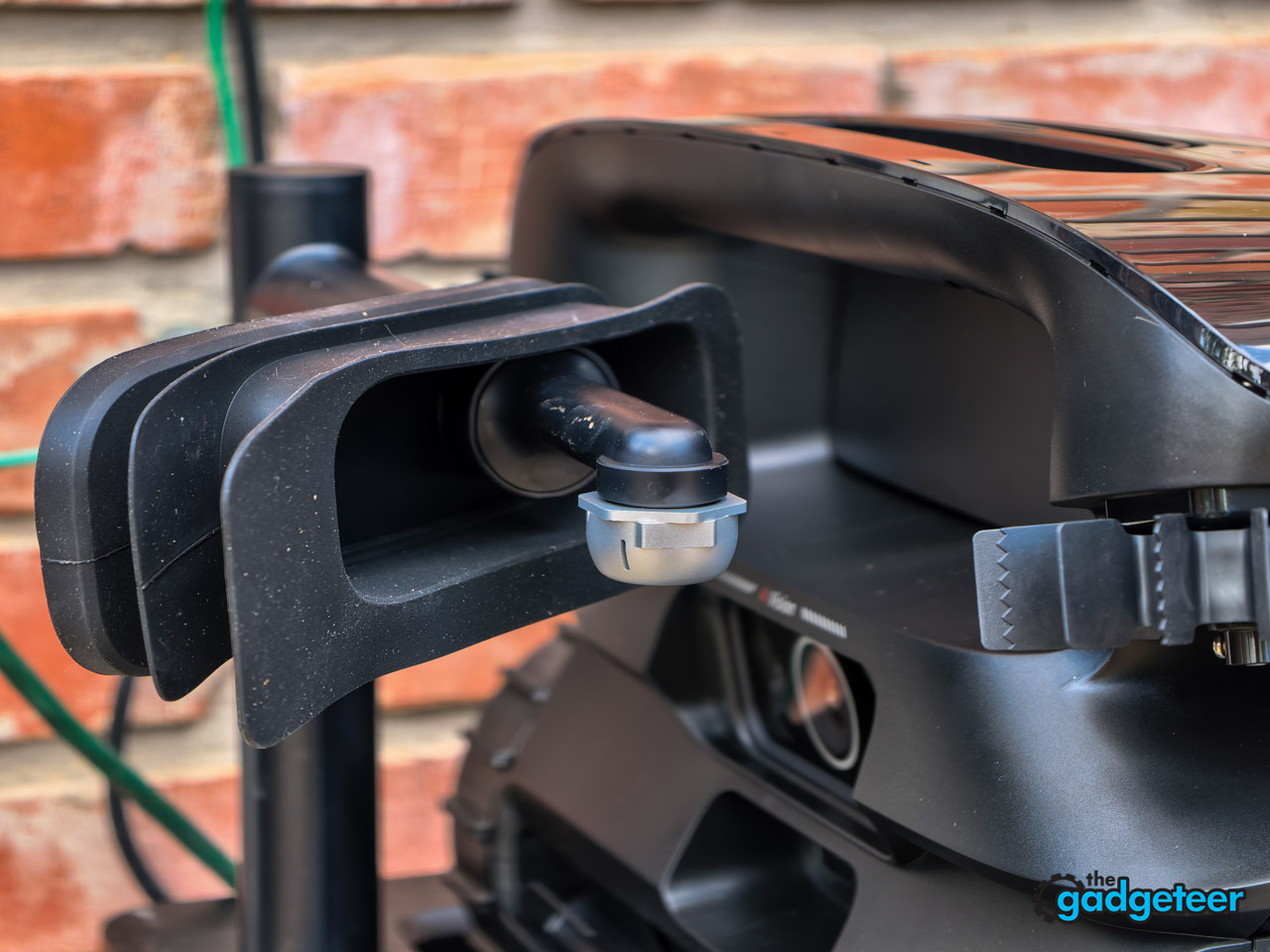
As you can see in the video, the whole process is so effortless I did it one-handed while filming with my phone in the other. Compared to the full pressure washer ordeal described above, it barely registers as maintenance. That is not a spec sheet improvement. That is the difference between a pool robot you dread maintaining and one you actually let run on schedule.
What the AquaSense X actually is
At its core, this is a 5-in-1 cordless pool cleaner: surface skimming, floor vacuuming, wall climbing, waterline scrubbing, and elevated platform cleaning. That matters because it is not just chasing leaves. It is built to handle the full cycle of pool mess, from floating bugs and pollen to the grit that settles on the floor, and the scum line that builds up at the waterline.
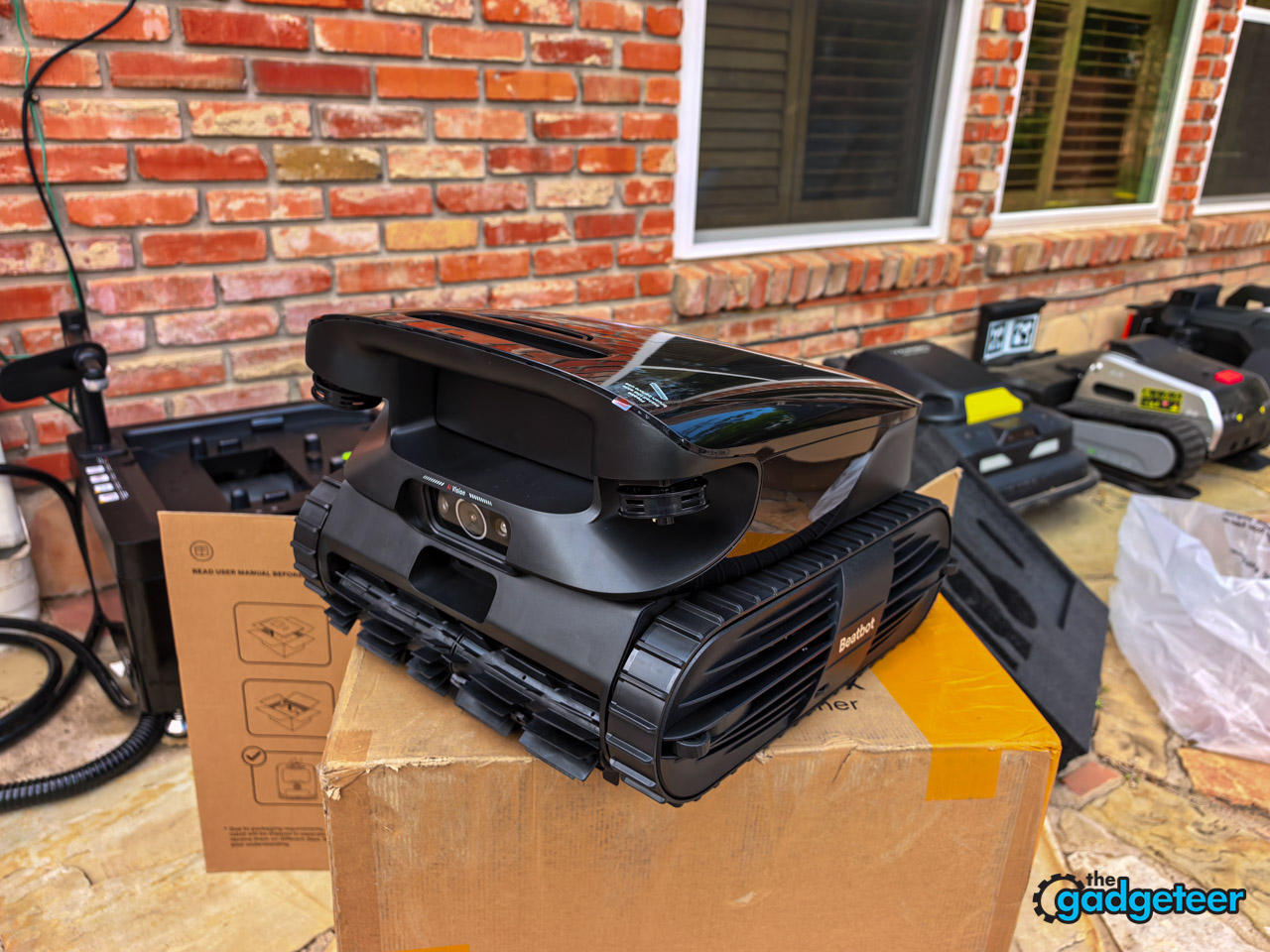
Eleven motors drive the system, pushing 6,800 gallons per hour of suction through a filtration setup rated down to 150 microns. In practical terms, that flow rate helps the robot keep pulling in heavier debris before it resettles, while the fine filtration is what makes the water look better after a few runs because it captures a lot of the sandy sediment and suspended particles that make the pool look dull.
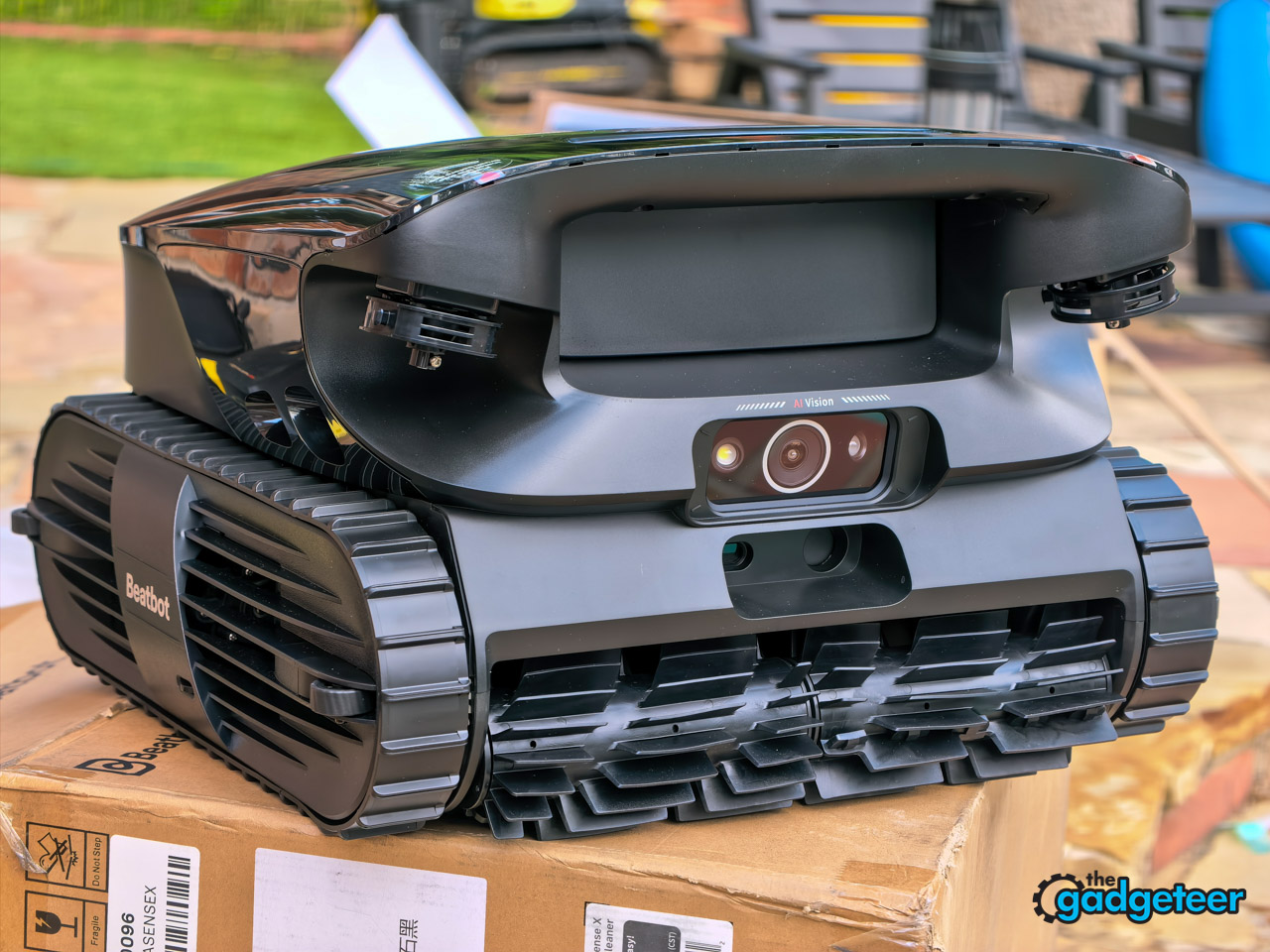
Navigation is the other half of the clean. The sensor package counts 29 units total, mixing infrared, ultrasonic, and Beatbot’s HybridSense AI Vision camera. Those sensors help it map the pool, avoid obstacles, and keep coverage consistent so it does not waste half a cycle re-cleaning the same strip.
Beatbot says the camera system can identify over 40 debris types on both the pool floor and the water surface. The exact count matters less than the behavior it enables. When it sees concentrated debris, it can retarget and clean that area instead of blindly following a route.
The battery is a 13,400 mAh lithium-ion pack that delivers up to 10 hours of surface cleaning, 5 hours of floor work, or 5 hours on walls and waterline. Coverage tops out at 3,875 square feet per charge, which handles the vast majority of residential pools without needing a mid-cycle recharge. When it docks, 88W wireless charging brings it from empty to full in roughly 4.5 hours.
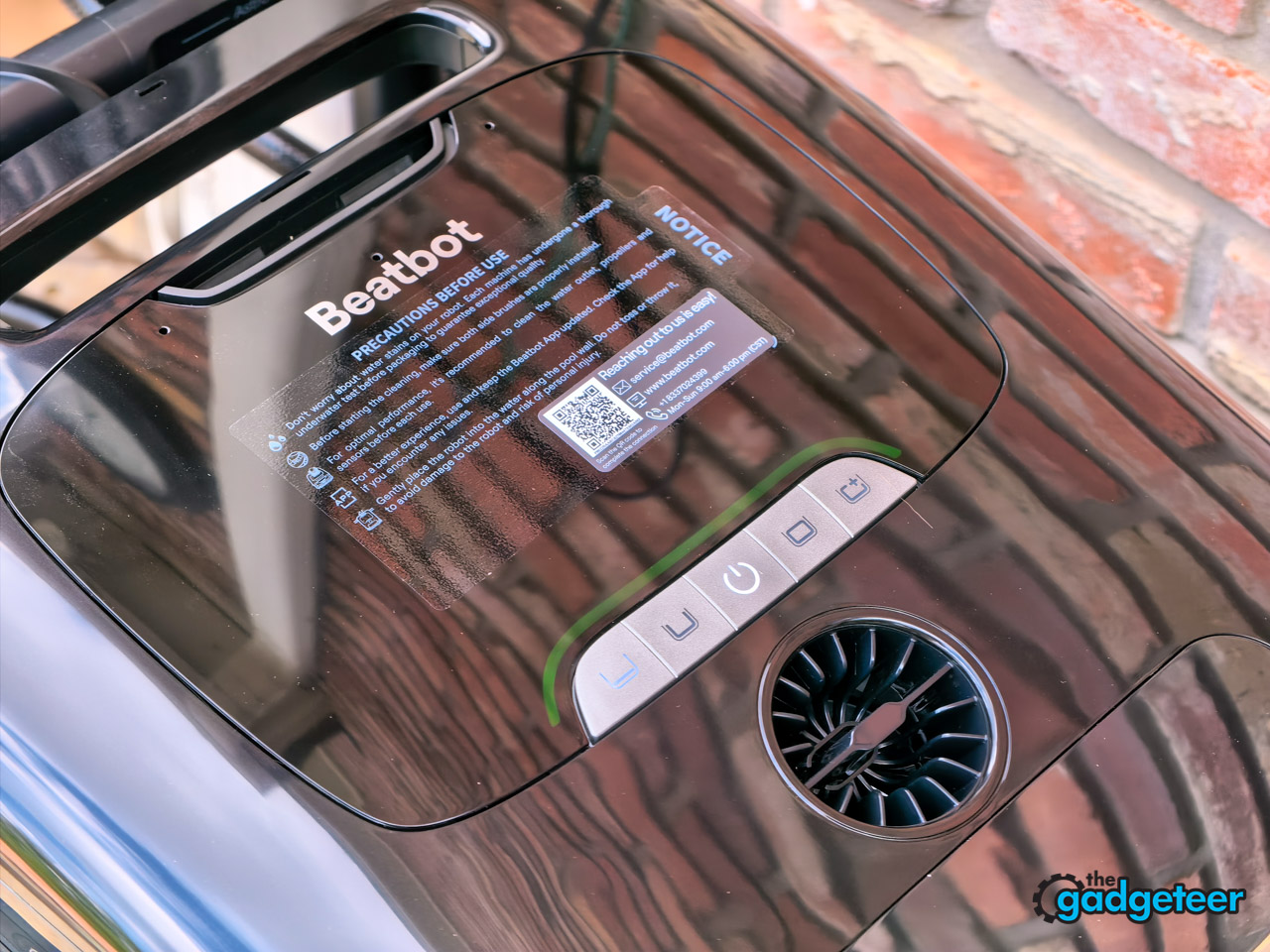
At 28.9 lbs for the robot and 41.9 lbs for the station, this isn’t something you’ll casually toss in the back of a golf cart. It’s built with automotive-grade IMR coating (UV-resistant, heat-insulated) and the station itself is weather-resistant with anti-freeze and corrosion-resistant properties, though Beatbot still recommends indoor winter storage and draining the hoses in freezing conditions. The robot is compatible with every pool type (above-ground and in-ground), every common shape (rectangular, round, kidney, freeform), and every major surface material (concrete, ceramic tile, vinyl, fiberglass).
One convenience detail worth noting: when surface cleaning finishes or the battery runs low, the AquaSense X automatically returns to the pool edge and parks above the water surface. Beatbot’s SmartDrain system releases residual water from the robot’s body so it’s lighter and easier to lift out. A one-click parking option lets you recall it manually. The station also includes a child lock, which is a practical touch if you have kids near the pool equipment.
The AstroRinse station changes everything
This is the feature that makes the AquaSense X feel like a godsend. With other robots, the cleaning cycle is only half the job, because you still have to deal with the filter, the gunk, and the rinse routine after every run. Here, everything works as expected and then keeps going.
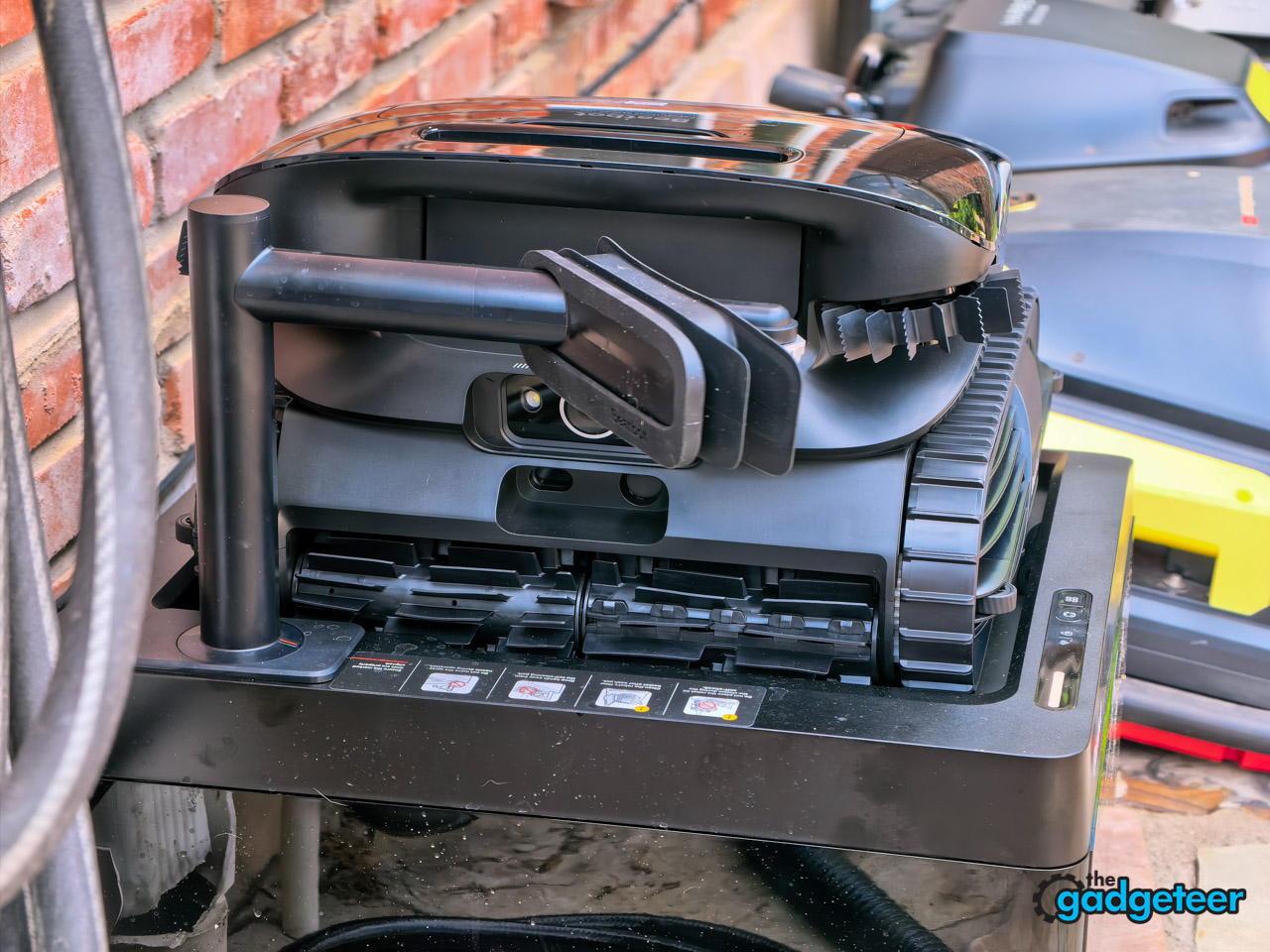
Using it is simple, and it is so easy anyone can do it. You lift the AquaSense X out of the pool and set it on top of the AstroRinse station. The whole setup looks like it came off the set of an alien movie, with the robot perched on this futuristic dock like it is about to get decontaminated. It aligns itself into position, docks, and starts the cycle. The station sounds like a compact pressure rinse running inside an enclosed box, and the first time you hear it, there is a real moment of “wait, is it actually cleaning the filter”.
Then you look. Three minutes later, the robot is clean enough to go right back in, and the mess you normally deal with has been moved into the station’s big debris basket. Without a doubt, this was hands down exactly what I expected based on every other Beatbot cleaner I have used. It just works. Over repeated cycles, the three-minute routine held up exactly the way you want it to. The entire point is consistency, and it delivered. I did not have to babysit it or clean the filter by hand between runs.
It is not hype to say this feels like the holy grail of robotic pool cleaning. The AstroRinse station removes the hassle that makes people stop using their pool robot on schedule. When the cleanup takes care of itself, you actually run the cleaner as often as you should, and that is how your pool stays consistently crystal clear.
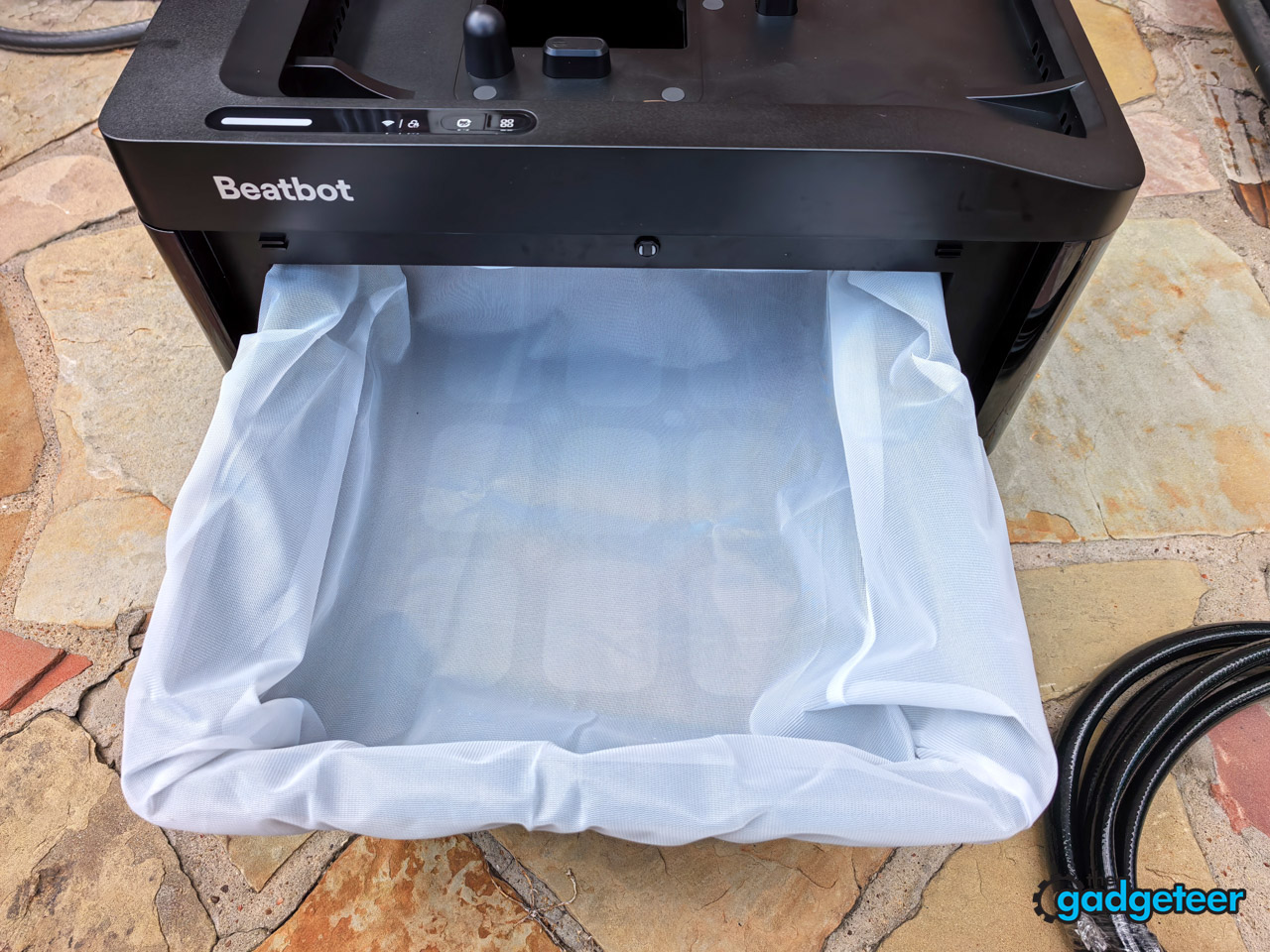
The station holds a 22L debris basket that Beatbot says can handle about 3,000 leaves before needing a manual empty. They estimate roughly two months between dump-outs assuming you’re running the station two to three times per week, though that varies by pool size, nearby trees, and how much your pool collects between sessions. The debris goes into a disposable bag, so when it’s time to empty, you’re pulling out a sealed bag rather than scooping muck by hand.
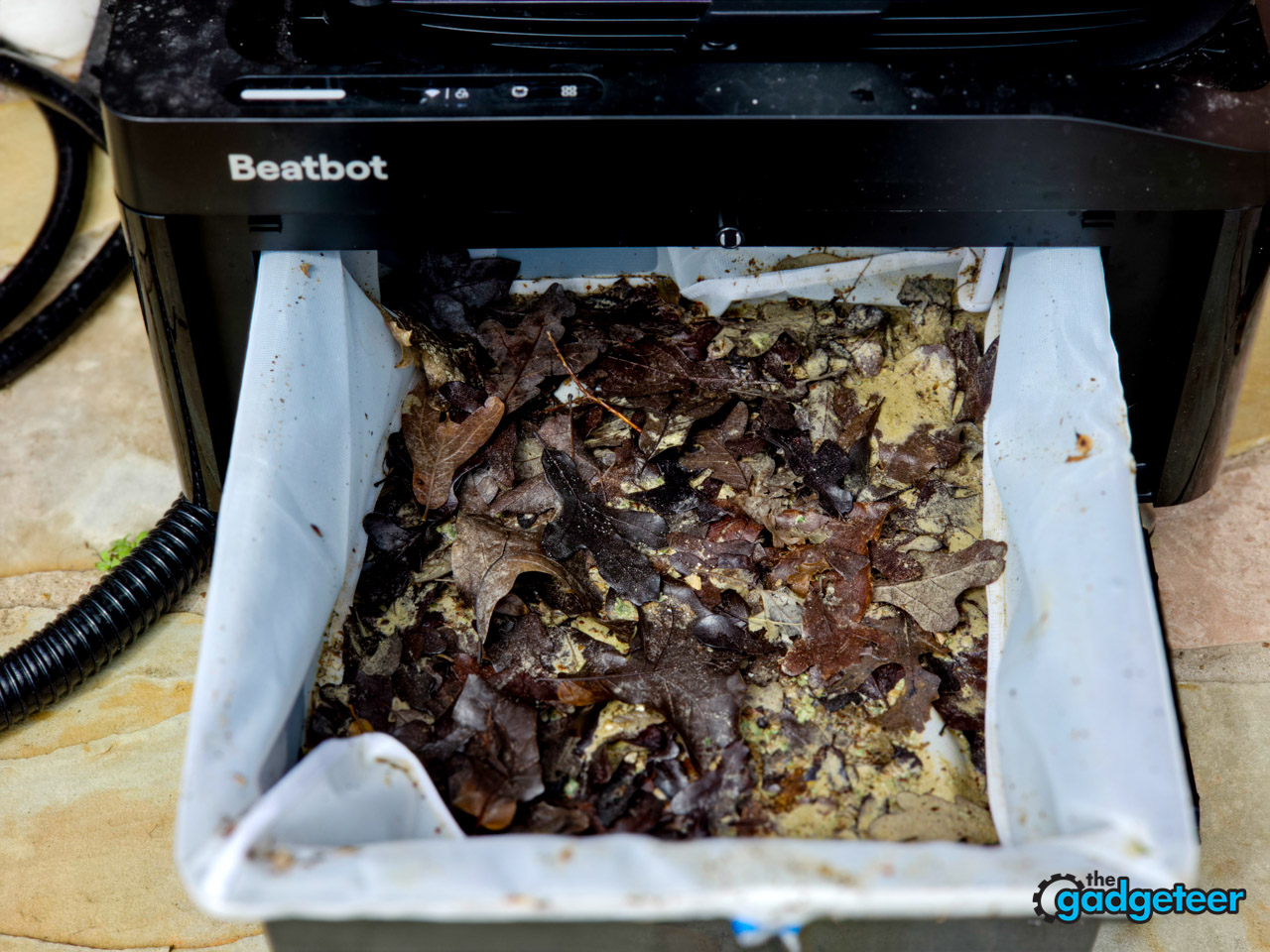
The station’s debris basket itself collects everything the robot flushes out. After eight self-cleaning sessions, I pulled the station’s drawer open and found the white disposable bag liner about one-fourth full. The contents tell the whole story of a North Texas April: countless waterlogged oak leaves in various stages of decomposition, a layer of sandy tan sediment settled along the bottom, and scattered fragments of smaller organic matter pressed flat by the weight of subsequent rinse cycles. All of it collected hands-free, flushed straight from the robot’s filter into the bag without me ever touching it. In a lighter season, Beatbot’s two-month estimate between manual empties seems reasonable. During the spring pollen apocalypse, expect to check it monthly. But even emptying the basket is a different experience: you’re pulling out a sealed disposable bag, not scrubbing caked organic sludge off a filter tray with a brush.
AI that actually does something useful
The HybridSense AI Vision system maps your pool on the first run and optimizes its cleaning path from there. It recognizes over 40 types of debris on both the floor and the water surface, which is double what the AquaSense 2 Ultra can detect.
AI Quick Mode is the feature that proved most useful in practice. When the camera spots a concentration of debris, the robot targets that area rather than completing its full systematic route. The result, according to Beatbot, is roughly half the cleaning time for typical maintenance runs.
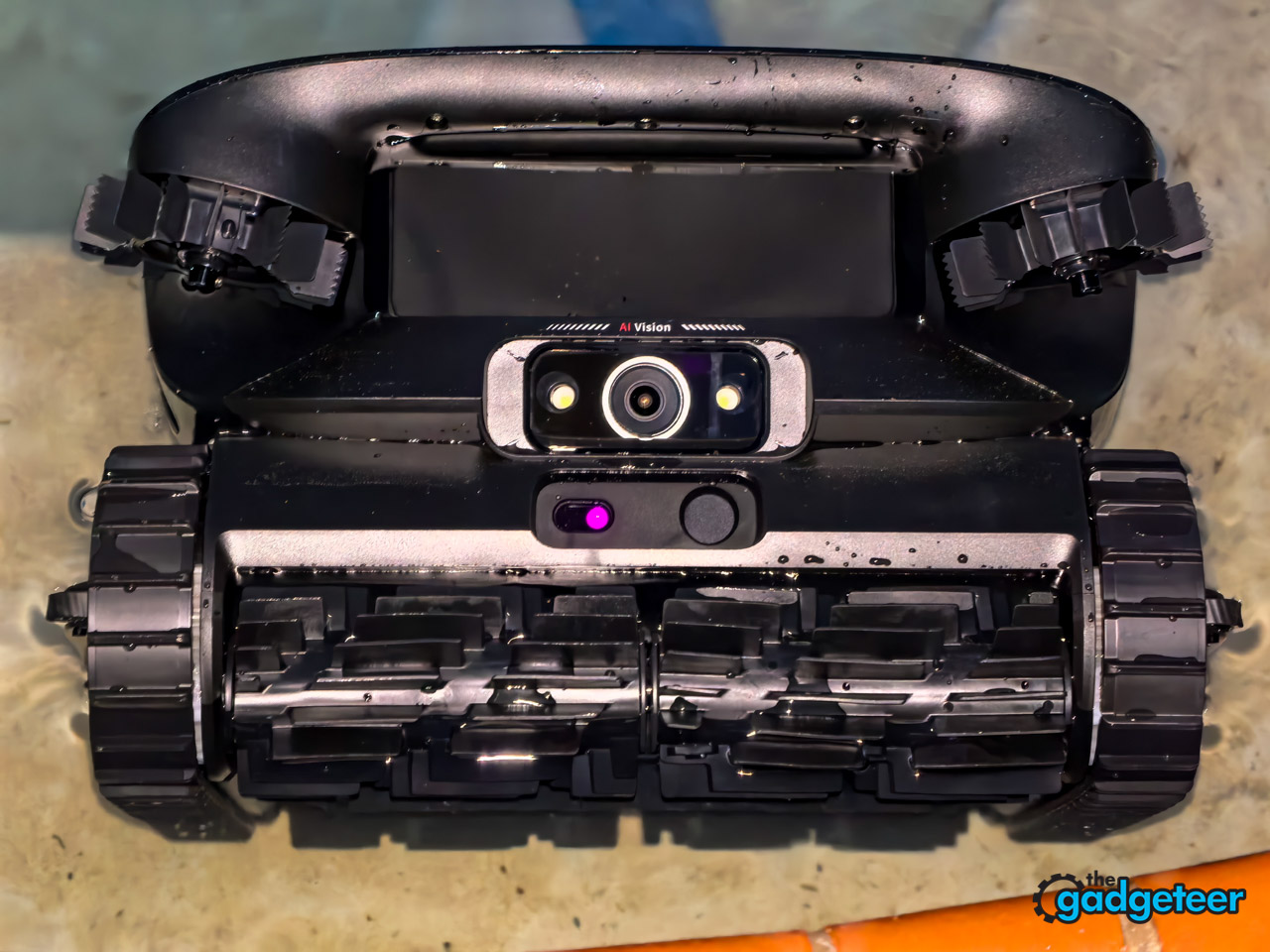
Watching it work is genuinely strange. The robot approaches a cluster of leaves and you can see it pause, scan, and adjust its path like it’s deciding where to go next. It looks like it’s thinking. The front camera tilts and the robot redirects mid-run, locking onto debris concentrations instead of blindly following its grid. It’s the kind of behavior that makes you stop and watch from the pool deck because it doesn’t move like any pool robot you’ve used before.
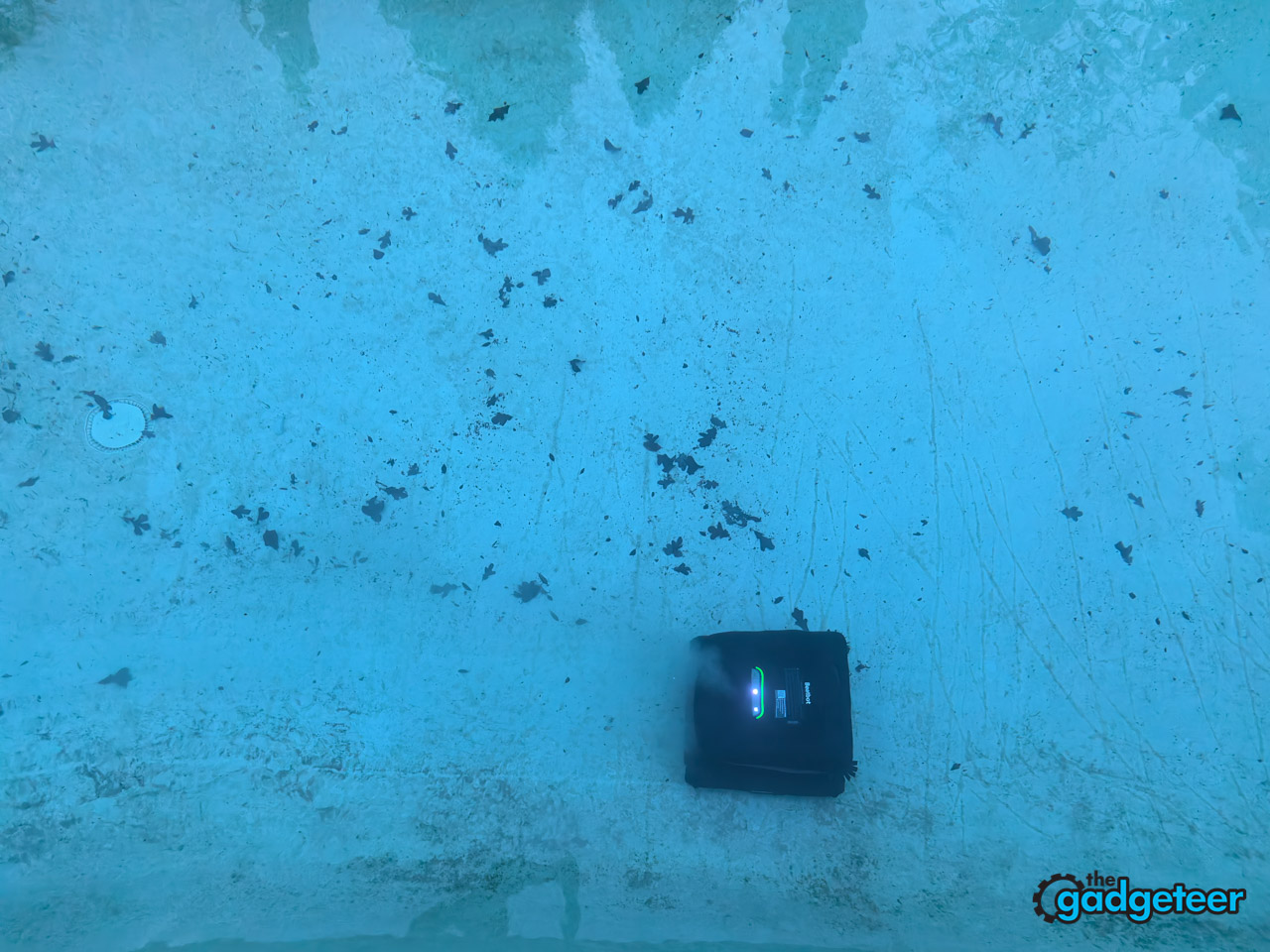
Some context on my testing conditions: my pool pump had been out of commission for months before the AquaSense X and AstroRinse station arrived. I’d been cleaning manually and with other robotic pool cleaners, but the floor and walls were a mess. Visible debris was only part of the problem. Fine sediment, microscopic particulates, and grime that you can’t see with the naked eye had settled into every surface. After three cleaning sessions, the pool was free of gunk. Not just the obvious stuff. The water clarity improved in a way that told me the 150-micron filtration was pulling material I hadn’t even realized was there.
One caveat worth noting: AI debris retargeting isn’t available in every mode. MultiZone Mode, ECO Mode, and wall-only Area Mode all run without it. For daily maintenance, that’s fine since Quick Mode and the standard cleaning cycles cover the most common scenarios. But if you’re running a specialized mode, the AI takes a step back.
AI Night Cleaning is another practical addition, and it was genuinely cool to watch in action. Dual 1,500 Lx front LEDs are not just for show. In my pool, they actually helped the camera see better in murky water, which made the robot’s behavior look more confident and more deliberate instead of lost. It also means you can run the cleaner at night or early in the morning when electricity rates drop and still feel like it is doing real work.
Seven modes, one app, and three voice assistants
The Beatbot App provides full control over seven cleaning modes, and it’s where you’ll set schedules, monitor cleaning progress, and check battery status. The AquaSense X is the only Beatbot model with voice assistant support through Google Home, Alexa, and Siri, though voice control is limited to surface cleaning only.
The app also handles custom area selection well. When you set up an Area Mode session and exclude certain zones, the cleaning logs reflect exactly what you asked the robot to do. Coverage data shows up only for the zones you selected, and excluded zones correctly report zero rather than generating misleading numbers. That is what you want from a reporting dashboard: data that matches reality so you can verify remotely that the robot actually followed your instructions. Cleaning logs track each session with runtime, battery consumption, and coverage area, which makes it easy to spot whether a run finished properly or got cut short.
Cleaning performance across five zones
Floor cleaning: The floor was the real stress test. With layers of fine sandy sediment, decomposed leaf fragments, and the kind of grit that settles into textured surfaces and refuses to move, this was the zone where the 6,800 GPH suction rate had to prove itself. You can hear the difference when the robot passes over a debris-heavy section versus clean floor. It pulls hard enough that waterlogged oak leaves, small twigs, and compacted organic clumps get lifted on the first pass rather than pushed around or tumbled ahead of the intake. The dual-layer 250/150-micron filtration does the rest. The outer layer catches the big stuff, and the 150-micron inner layer traps the fine silt and sandy particulate that makes your pool look dull even when there is nothing visibly floating.
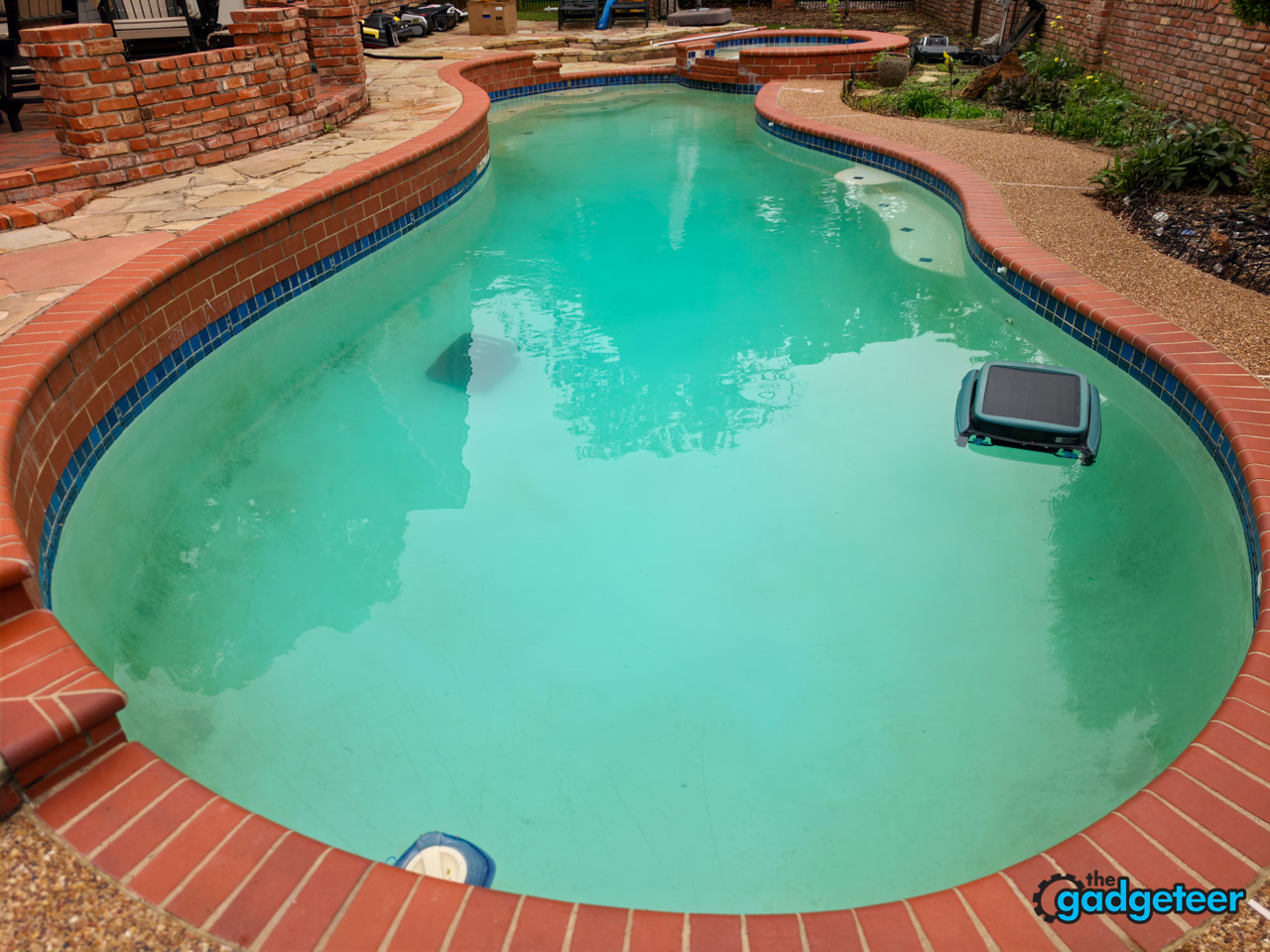
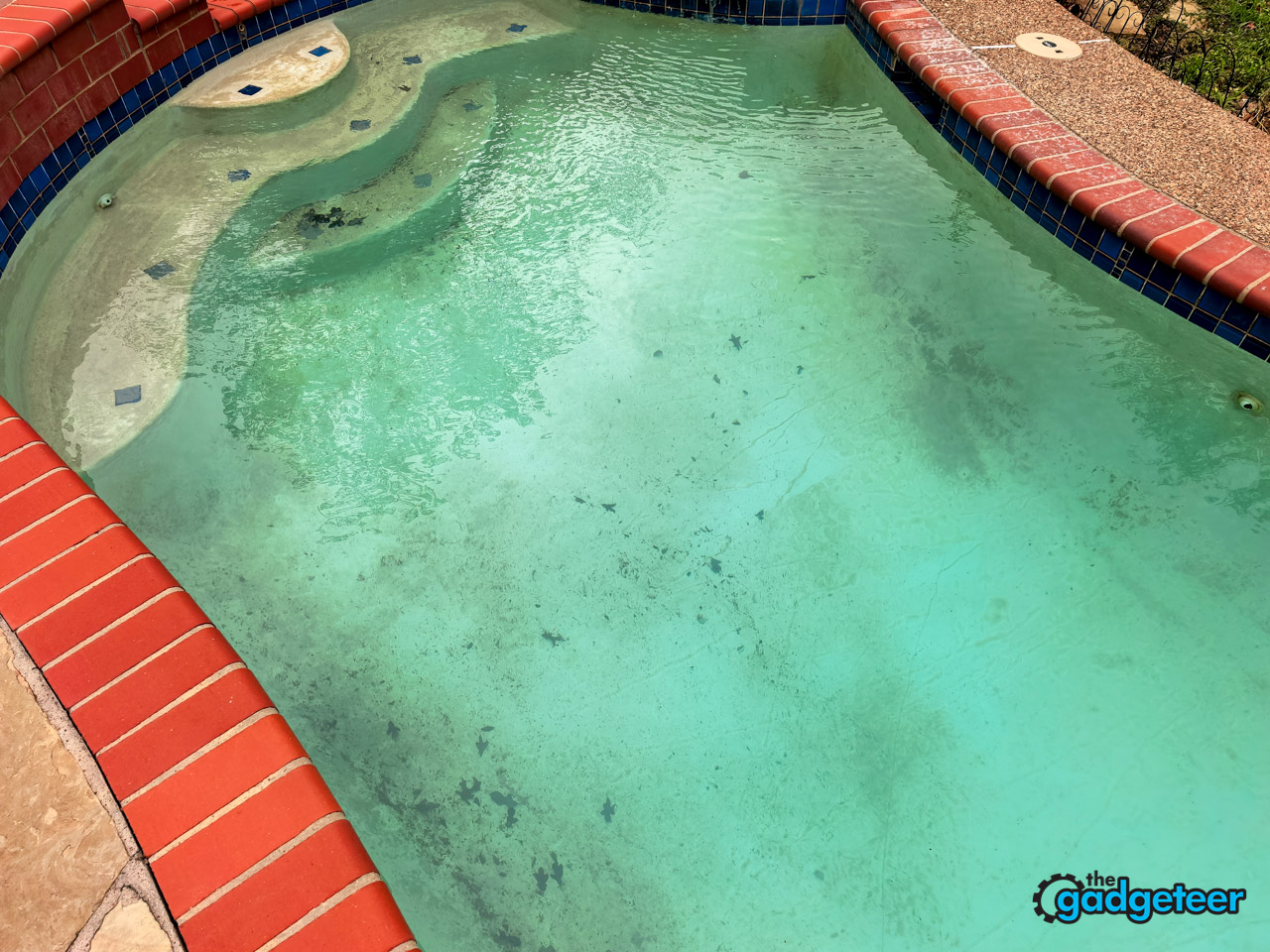
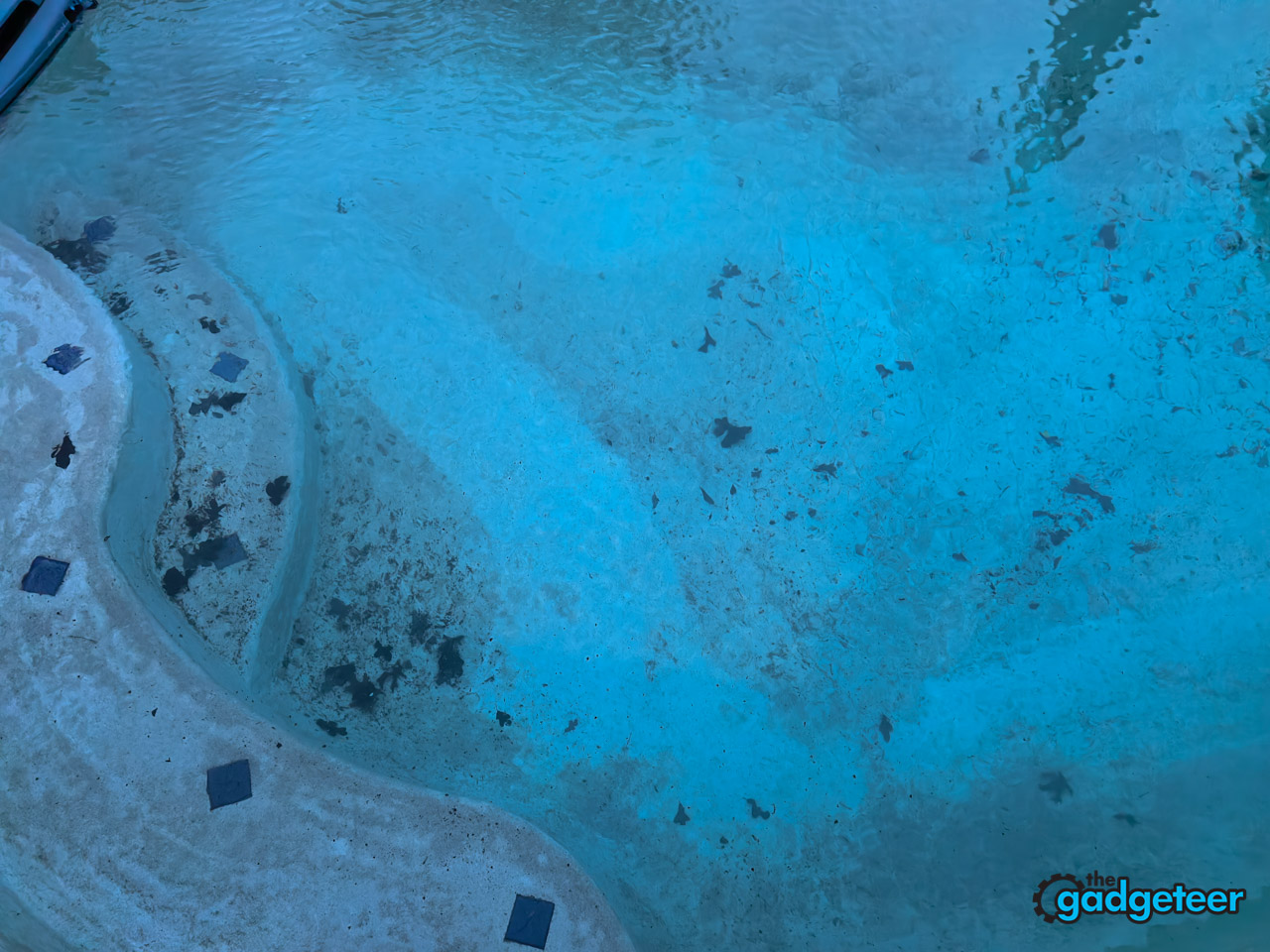
Coverage patterns were methodical and predictable. The app logged 46 minutes of floor time and 581 square feet of coverage during one Area Mode session set to Floor x2, and watching it work, you could see the overlapping passes rather than random wandering. Where it gets interesting is AI Quick Mode. Instead of grinding through the full grid, the camera identifies debris concentrations and the robot redirects mid-run to hit those spots first. On a pool that just needs daily maintenance rather than a deep recovery clean, Quick Mode cut the floor time roughly in half while still picking up everything visible.
One thing to keep in mind with fine sediment specifically: the robot’s brushes agitate settled silt before the suction pulls it in, which means there is a brief moment where the water near the robot looks cloudier before it clears. That is normal and expected with any floor-cleaning robot working on accumulated grit. Give it a full cycle and the filtration catches up. This was especially relevant in my case because I had shocked the pool multiple times while the pump was down (an unusual situation, not typical maintenance), and each shock treatment leaves behind a fine powdery residue that settles on the floor and blends in with the existing sediment. It is the kind of stuff you do not even realize is there until the robot stirs it up and the water turns milky for a few minutes. The AquaSense X pulled all of it. By the end of the run, the floor was noticeably cleaner to the touch, not just visually, which is how you know the 150-micron layer is earning its keep.
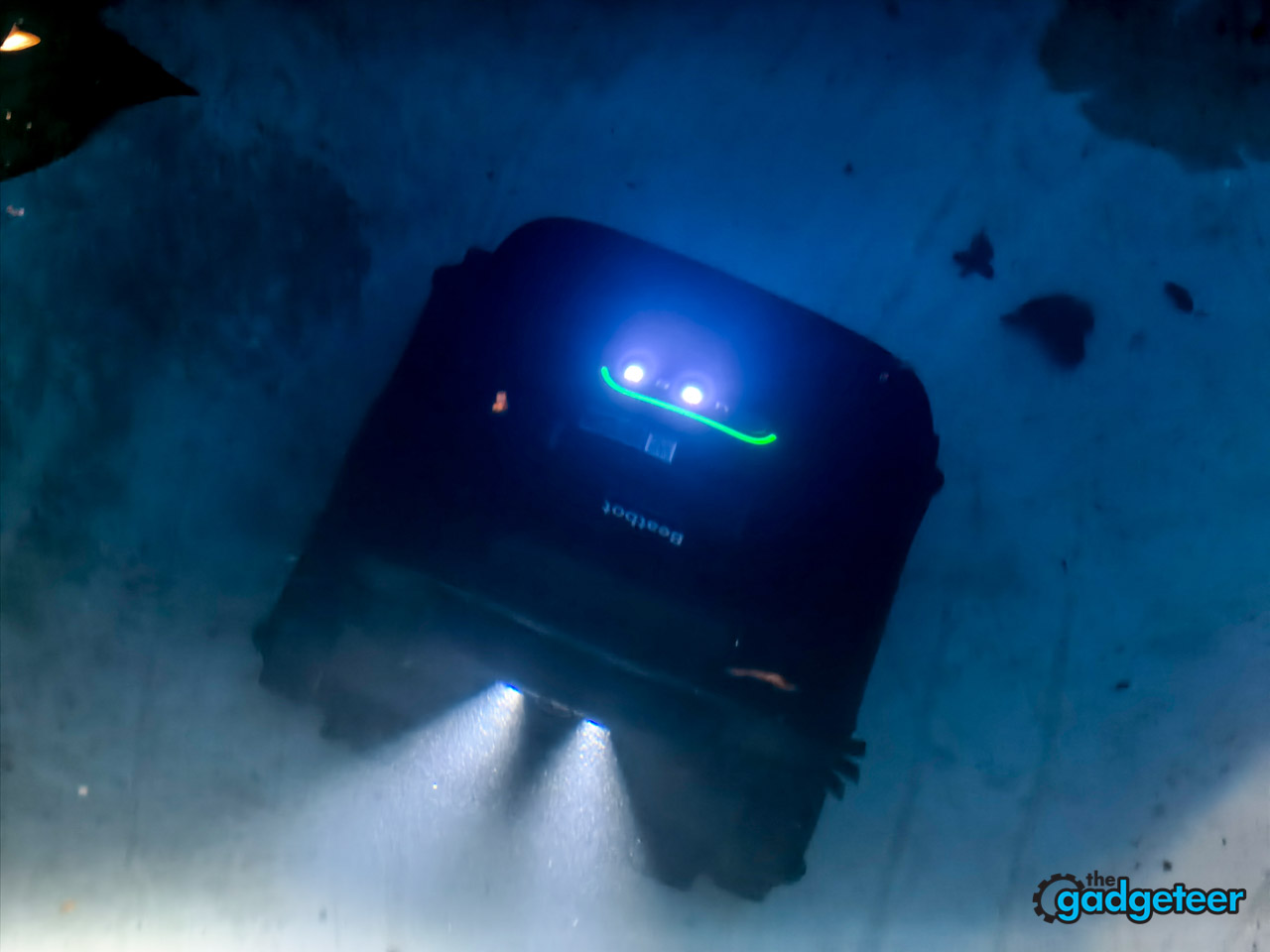
Surface skimming: This is where the AquaSense X earns its keep during pollen season. Oakf pollen coats the surface every morning like a yellow film, and by midday you have got leaves, the occasional bug, and that faint oily sheen that shows up when sunscreen or organic matter breaks down on the water. In surface mode, the robot adjusts its internal buoyancy to float level with the waterline and cruises across the pool drawing debris into the onboard basket. It cleared a full overnight pollen coat and a scattering of post-wind leaves in under 90 minutes, well within its 10-hour surface battery life. The pollen pickup was particularly impressive because that fine particulate tends to slip past cheaper skimmers.
One honest caveat: because the AquaSense X cleans sequentially across its five zones rather than simultaneously, any debris that lands on the surface after it moves to floor or wall mode sits there until the next cycle. A few stray leaves that blew in mid-run were still floating when it finished, which is not a software problem but simple physics. For pools surrounded by heavy tree cover, pairing it with a solar skimmer for continuous surface duty is worth considering. But for typical daily pollen and light debris loads, surface mode handled it without leaving noticeable gaps.
Wall climbing: Wall adhesion was solid and consistent. The AquaSense X locked onto the wall, climbed from the floor transition to the waterline, and traveled laterally in overlapping passes without losing grip or sliding back down. Curves and the rounded transitions near the steps gave it no trouble, and it handled the corners better than I expected given the geometry involved. The waterline transition, where the robot shifts from vertical wall scrubbing to the waterline band, was smooth and deliberate rather than jerky or uncertain.
The app logged 150 minutes of wall and waterline time during one Area Mode session (Apr 12, 196 minutes total, 72 percent battery, Floor x2 plus Wall and Waterline x2), which tells you this is not a quick once-over. It takes its time and covers methodically. One thing to note: the app reported 0 square feet for wall and waterline coverage on that same run and flagged it as terminated, which is by design since this was a custom Area Mode session. The coverage metrics are built for standard modes, not custom configurations, so the zeros are expected rather than a sign that something went wrong. The walls were visibly cleaner when I checked afterward, which is what actually matters. Stairs and tight corners are the one area where you may want to give a quick manual brush beforehand to push debris into open water where the robot can grab it more easily.
Waterline scrubbing: The waterline is where I noticed the most dramatic before-and-after difference. With the scum line that had built up while my pump was down, the AquaSense X attacked it with real pressure rather than just gliding past it the way some robots do. After two wall-and-waterline cycles, the scum band was noticeably lighter, and by the third session most of it was gone entirely. The scrubbing felt more aggressive than what I have experienced with previous pool robots, including earlier Beatbot models, where waterline cleaning sometimes came across as half-hearted. This one stays parked on the waterline long enough to actually work the buildup loose. Given that a disproportionate share of pool bacteria concentrates at the waterline, this is not a cosmetic feature. It is doing real sanitation work that most pool owners either ignore or handle with a pumice stone and elbow grease.
Elevated platforms: The AquaSense X uses its ultrasonic sensor array to detect, navigate onto, and clean elevated platforms like tanning ledges, sun shelves, and baja shelves, provided the platform sits at least 14 inches deep with a continuous area of at least 3.3 by 3.3 feet. These are the zones where fine silt and wind-blown debris accumulate and just sit there because the depth is too shallow for your main circulation to push anything toward the skimmers. Traditional pool robots do not touch these surfaces at all. The AquaSense X climbed onto the shelf, adjusted to the shallower depth, and vacuumed the accumulated sediment without getting stuck or losing orientation. It is not a zone that needs heavy scrubbing the way the waterline does, but the fact that it handles it autonomously means one less thing you are doing by hand with a brush between robot cycles.
The ClearWater clarifier kit
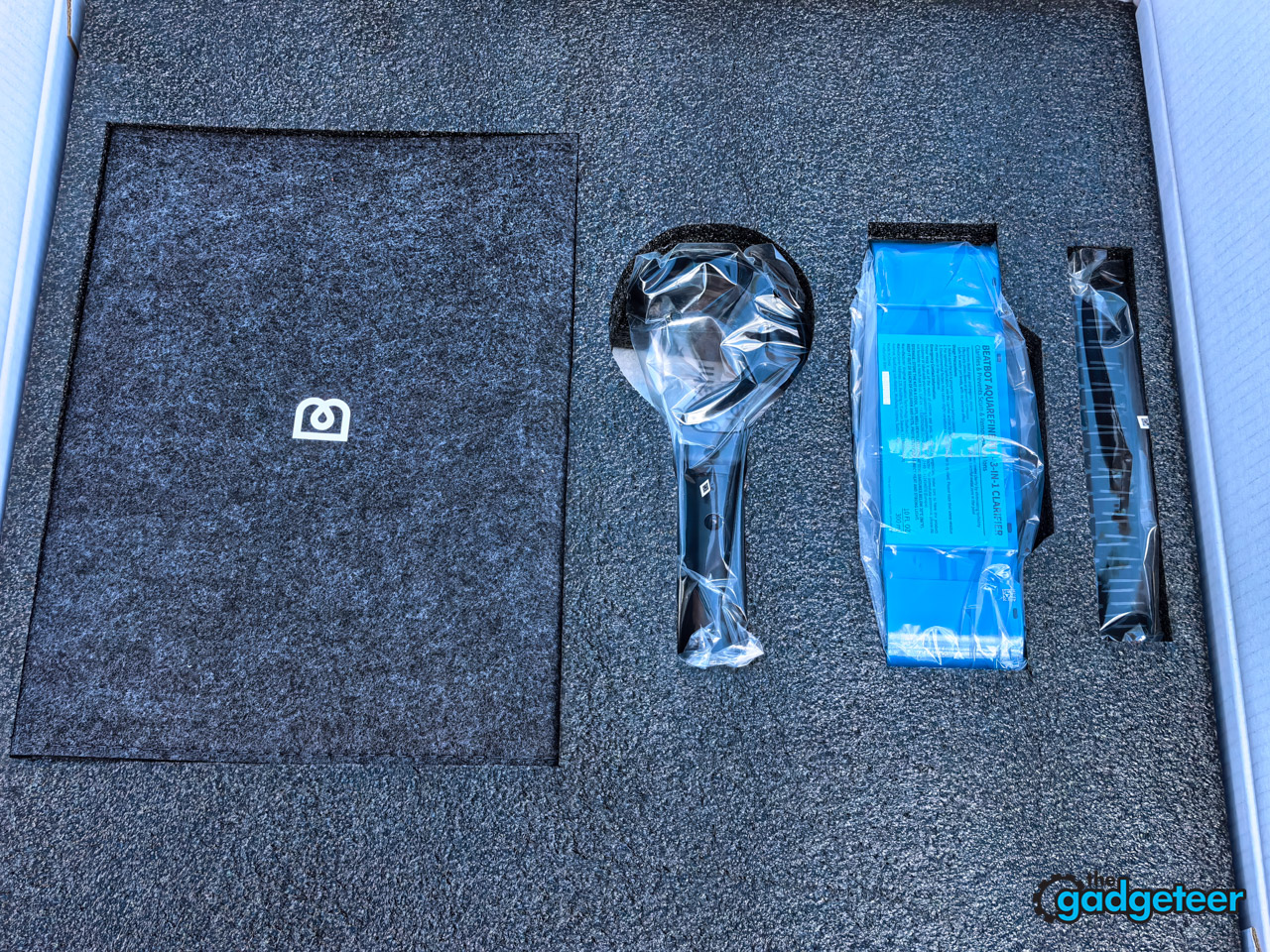
Beatbot includes an AquaRefine clarifier kit made from recycled crab shells. It handles water clarification, corrosion and scale inhibition, metal ion removal, and oil removal for up to 99,000 gallons per kit. Beatbot claims it works up to four times faster than traditional clarifiers. The packaging itself is 100% recycled cardboard, which fits the broader sustainability angle Beatbot is pushing across the product line.
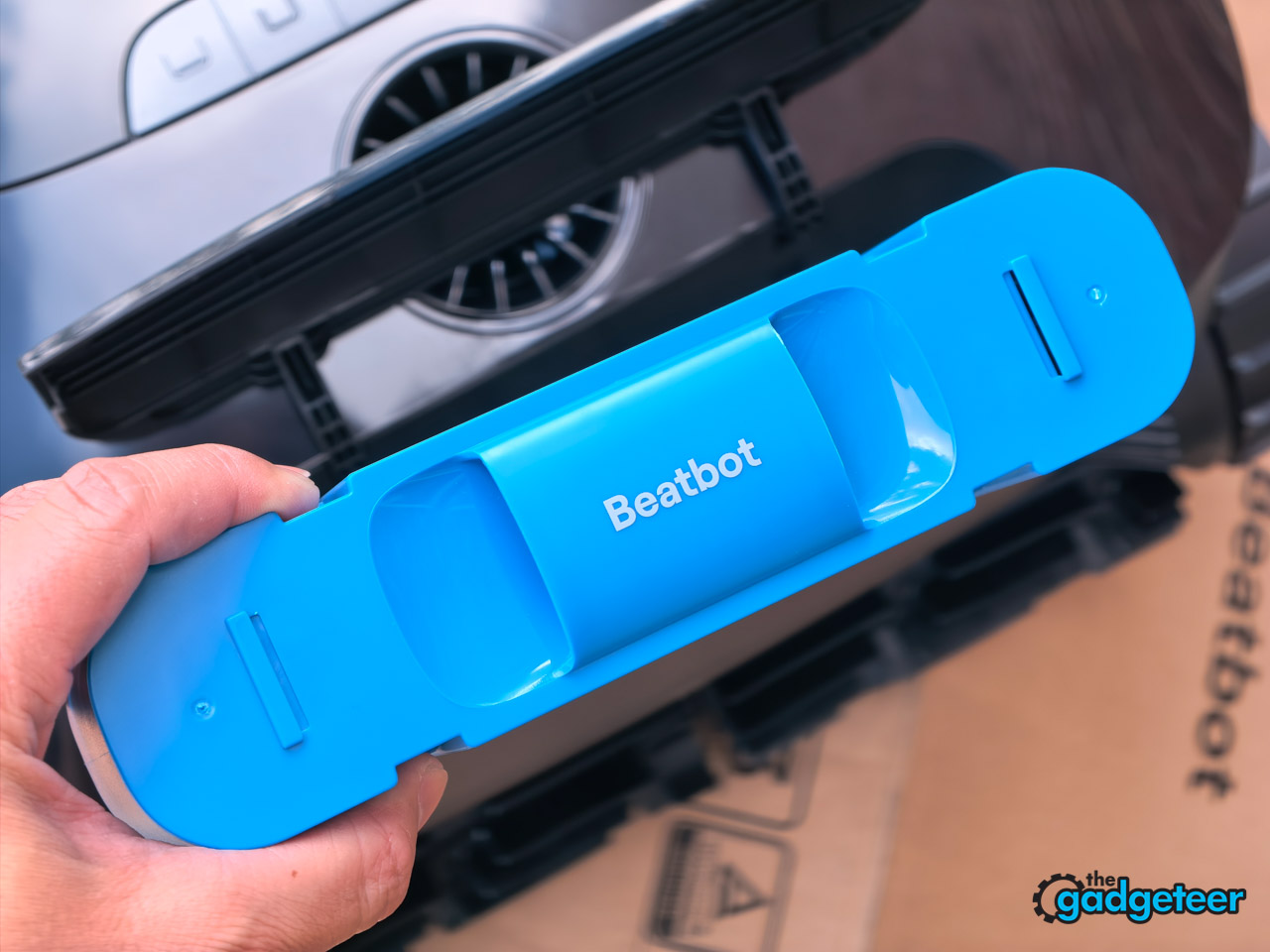
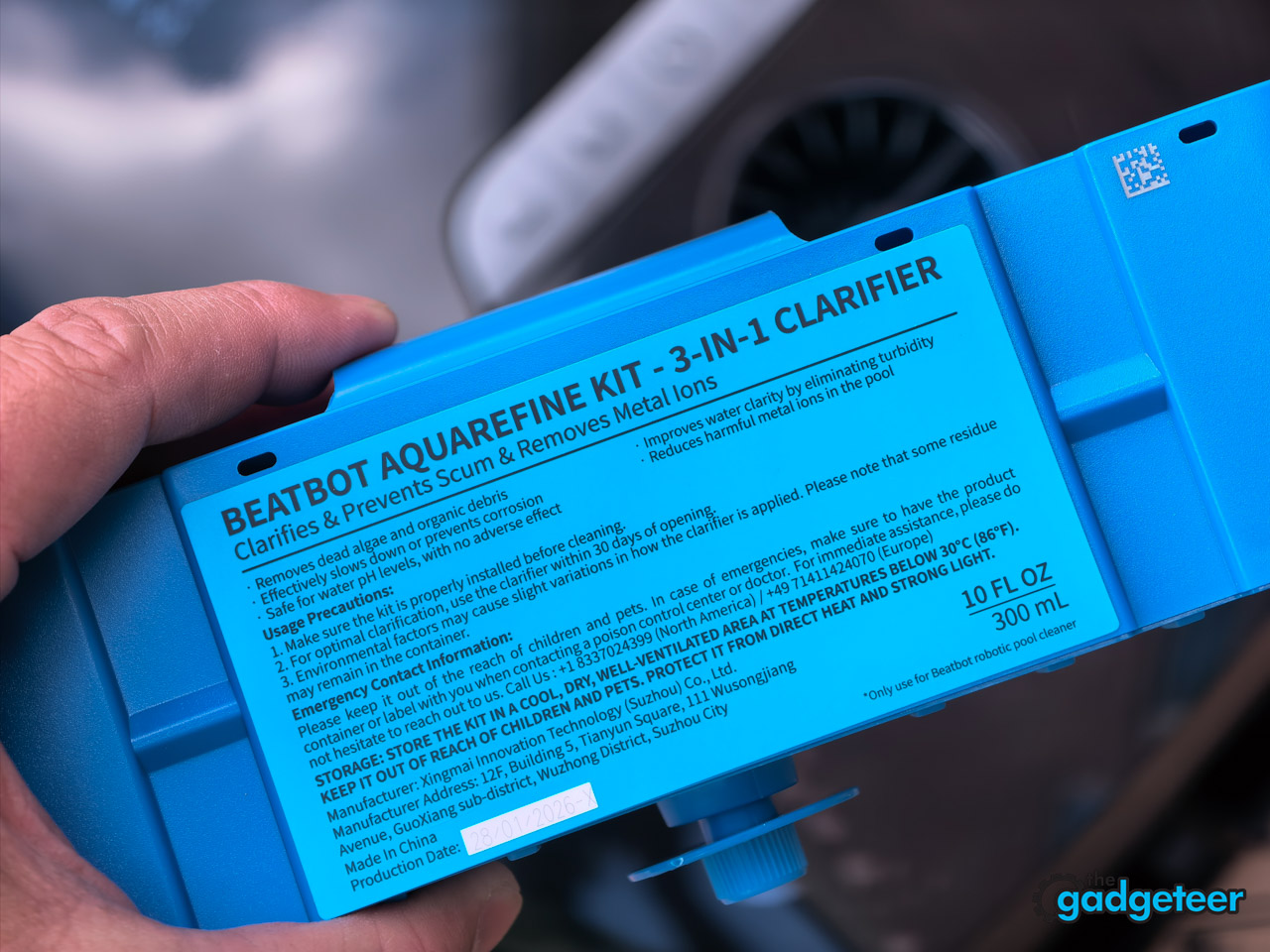
Honestly, if your pool is already clean and clear, you will not see much of a difference. It is the kind of add-on that makes more sense when you are fighting cloudiness or recovering from a messy stretch, not when your water is already dialed in.
Setup and installation
For a product that looks like it belongs on a sci-fi movie set, the AquaSense X is surprisingly straightforward to get running. The whole process breaks down into two parts: setting up the AstroRinse station and prepping the robot itself.
The station needs a flat spot near a power outlet and a water source with decent Wi-Fi coverage. Beatbot recommends keeping at least 3.3 feet of clearance behind the station for airflow and hose routing. From there, you install the spray nozzle assembly inside the station (one hex key, four screws, takes about two minutes), connect the included 12-foot water inlet hose to your faucet, and attach the drain hose to the outlet port. Run a quick leak check for 60 seconds, verify the built-in bubble level reads true, snap the rear cover panel back on, plug it in, and the station powers up with a breathing white light. Press the power button once and the station runs a self-check where the spray nozzle and levers cycle through their range of motion. When you hear “self-check complete,” the station is ready.
The robot side is even simpler. Clip the two side brush strips onto the brush supports, set the robot on the station to start charging (it talks to you: “starting to charge”), and pair the two by holding down the buttons on each unit for three seconds until you hear “pairing complete.” Download the Beatbot app, put the robot into network setup mode, and connect it to your Wi-Fi. The app gives you three pairing options: automatic Bluetooth search, QR code scan, or manual model selection.
Once everything is paired, you pick a cleaning mode, lower the robot into the pool along the wall, and it sinks to the floor within about three minutes before starting its first run. When it finishes, it parks itself at the surface. Lift it out, set it on the station, and the self-cleaning cycle kicks off automatically. The whole first-time setup from unboxing to first clean took me roughly 30 minutes, and most of that was waiting for the leak check and the initial charge. If you can connect a garden hose and download an app, you can set this up.
Build quality and long-term durability
The short version: build quality is the same high standard I have come to expect from Beatbot after testing previous models. Nothing about the AquaSense X feels like it was built to hit a price point and then forgotten about.
The automotive-grade IMR coating on the robot body has held up well through weeks of direct Texas sun exposure. No discoloration, no fading, no chalky residue forming on the surface the way cheaper plastics tend to break down under UV. The finish still looks the same as it did out of the box, and there are no visible scratches despite repeated docking sessions where the robot slides into the station’s locating pins. The coating feels smooth and dense rather than thin or painted on, which tracks with Beatbot’s claim that it is UV-resistant and heat-insulated. Time will tell how it holds up over a full summer of daily sun exposure, but so far there is nothing to flag.
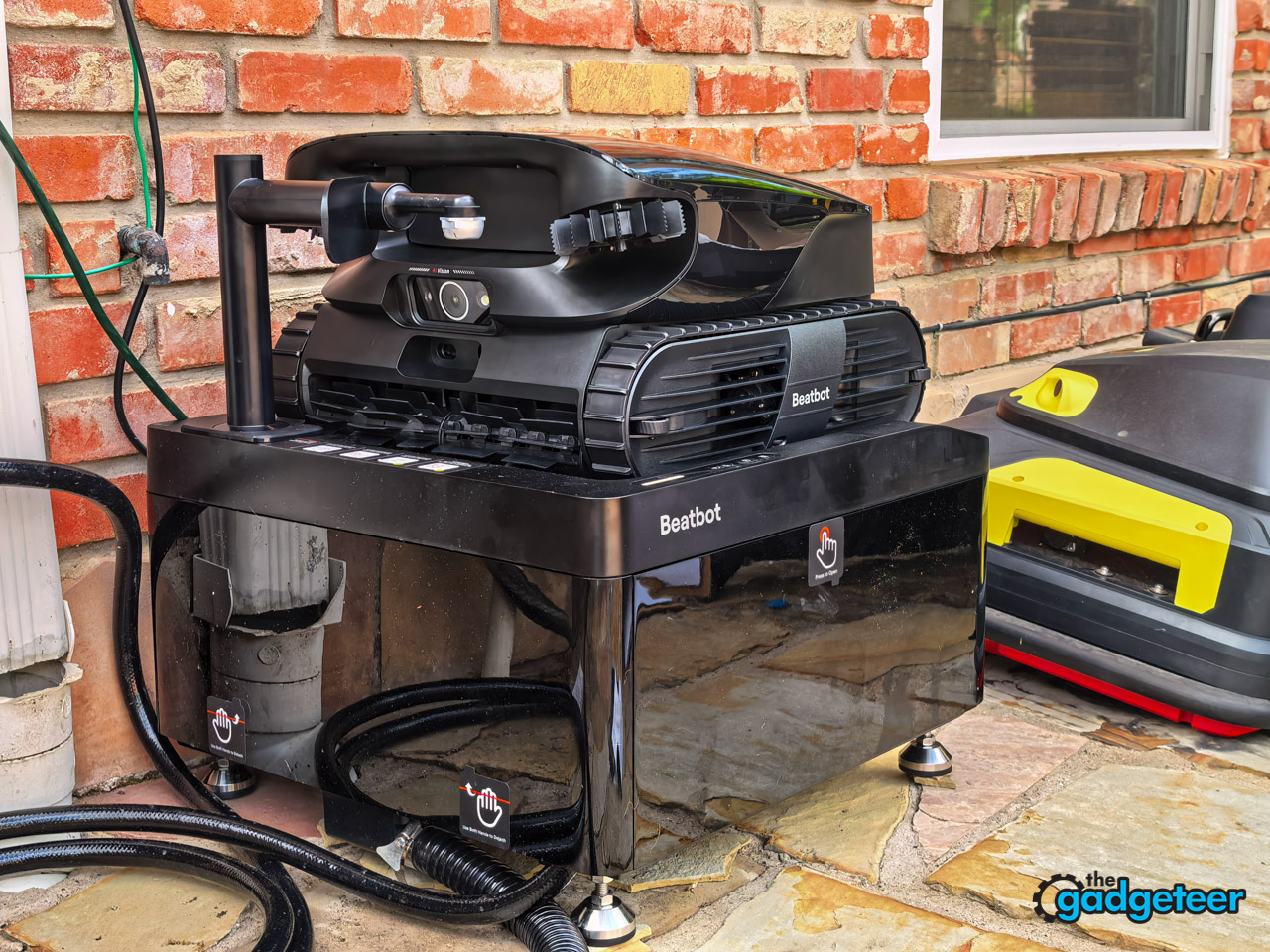
The station itself feels overbuilt in a good way. At 41.9 lbs, it is heavy enough that it stays planted and does not shift when the robot docks or during the rinse cycle. The panels fit tight with no rattling, the rear cover snaps on and off cleanly, and the drawer mechanism for the debris basket slides smooth without wobbling. The hose connections have stayed leak-free since the initial setup. Everything about the station says it was designed to sit outside year-round and take weather without complaint, which matters when you are leaving a $4,250 system poolside through summer storms and winter freezes.
The robot body panels have a solid, sealed feel with no flex when you grip the handle. The handle itself is comfortable enough for one-handed lifts, though at 28.9 lbs you are not doing that casually. The side brushes clip on securely and spin freely, and after multiple cleaning cycles there is no visible wear on the bristles or the mounting pegs. The charging contacts on both the robot and station show no corrosion or buildup despite constant exposure to pool water residue.
The 3-year warranty with full replacement is worth highlighting. Most pool robots in this category offer two years. Beatbot backs the AquaSense X with 16 certifications and the longer coverage window, which provides some insurance on a $4,250 purchase.
The $4,250 question
Yes, $4,250 is a lot of money for a pool robot. You can spend less than half that on a solid cordless cleaner and still get a machine that handles floors, walls, and surface debris. So who pays $4,250?
Pool owners who are tired of the maintenance cycle that comes after the cleaning cycle. Every cordless pool robot on the market still requires you to pull the filter, rinse it by hand, scrub the basket, and deal with the collected debris yourself. That is the part that makes people stop running their robot on schedule. The AstroRinse station removes it completely. Three minutes, hands-free, and the robot is clean, empty, and charging. No other pool robot at any price does this.
The most direct comparison is Beatbot’s own AquaSense 2 Ultra at $2,649. The Ultra is an excellent cleaner on its own, with 27 sensors, 5,500 GPH suction, and AI debris detection for around 20 types. But it still requires manual filter cleaning after every run. The $1,601 premium for the AquaSense X gets you the AstroRinse station, stronger suction at 6,800 GPH, double the debris detection types, voice assistant support, and a 3-year warranty instead of the standard two. That extra year of full replacement coverage on a product this expensive is not a throwaway line.
The total cost of ownership math works in the AquaSense X’s favor over time. No filter replacements from wear caused by aggressive hand scrubbing. No pressure washer sessions. No forgotten cleaning cycles because you did not feel like dealing with the filter that day. The pool stays cleaner because you actually run the robot as often as you should, which means fewer chemical corrections, less algae buildup, and less wear on your pool surfaces. None of that shows up on a spec sheet, but every pool owner who has let a cleaning cycle slide because the post-run cleanup felt like too much work knows exactly what it costs.
If you want cordless AI cleaning without the station, the AquaSense 2 Ultra at $2,649 delivers and then some. But if you are done dealing with the dirty side of pool robot ownership and you want the closest thing to a fully autonomous cleaning system that exists right now, the AquaSense X with the AstroRinse station is worth every dollar. I would pay for this myself, and I say that as someone who has tested enough pool robots to know exactly what the alternatives feel like after the first month of ownership.
Price: $4,250
Where to buy: Beatbot.com
Source: The sample for this review was provided by Beatbot. Beatbot did not have a final say on the review and did not preview the review before it was published.
Love our content?
Sign up for our newsletter today.
No ads, no spam, just links to our latest articles!