

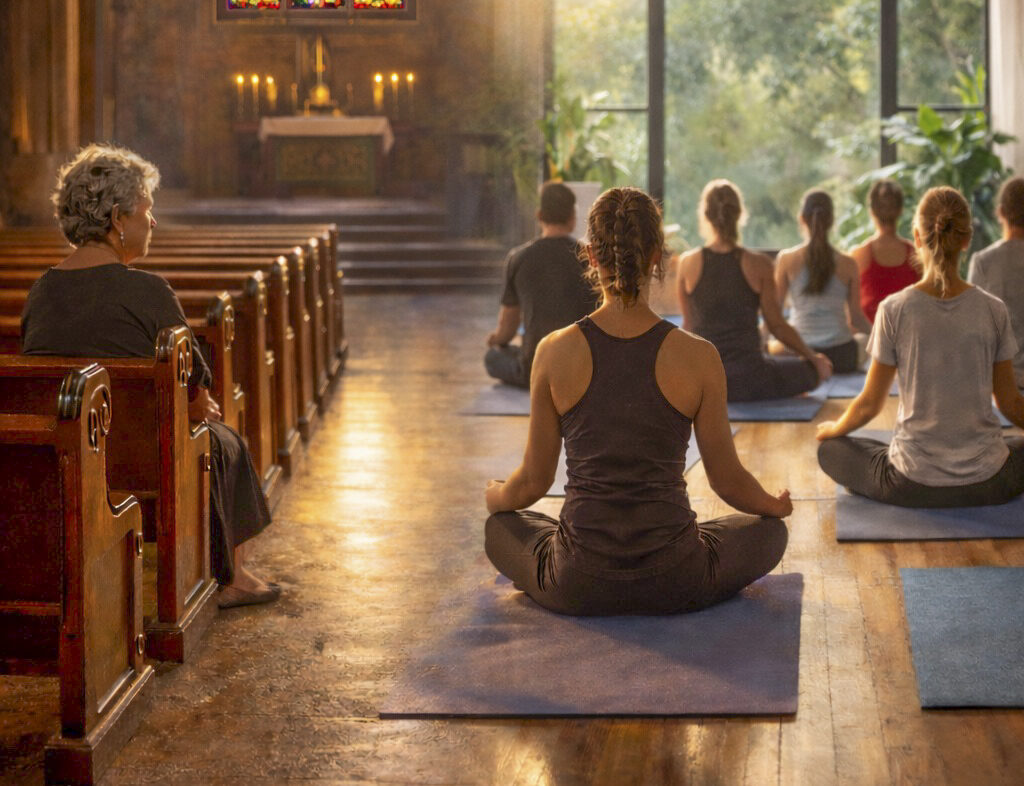
As houses of worship close, yoga schools provide new spaces for spiritual community and contemplative practice
By Satguru Bodhinatha Veylanswami
Yoga may be the fastest-growing expression of human spirituality. There are an estimated 300 million yoga practitioners worldwide. If yoga were a religion (instead of a part of Hinduism), it would be the fifth largest in the world. According to Pew Research, the percentage of American adults practicing yoga rose from 5% in 2002 to 16% by 2022, with participation reaching approximately 18% (38.4 million) of the population in 2025. In Europe, France reports that about 10.7 million people (roughly 20% of the population) have practiced yoga in the past three years, with participation tripling over the last decade. Italy has about six million practitioners, tripling in six years from roughly two million, and is home to hundreds of yoga schools.

What is fueling this burgeoning of yoga practitioners? Certainly, one major societal factor is the advent of the International Day of Yoga—an annual global observance held on June 21, recognized by the United Nations since its proclamation in December 2014. The initiative was proposed by Prime Minister Narendra Modi during his 2014 address to the UN General Assembly, emphasizing yoga as an invaluable gift from India’s ancient tradition that embodies the unity of mind and body, thought and action.
The International Day of Yoga is celebrated worldwide by millions through free yoga sessions, workshops, demonstrations and online classes welcoming all ages and abilities, regardless of nationality or religion. The observance promotes yoga not only as physical exercise but as a path to self-awareness, balance, mindfulness and spiritual growth. In 2025, Guatemala hosted “the world’s largest yoga gathering outside India,” with over 10,000 participants, highlighting yoga’s appeal across Central America.
A second factor fueling this growth of yoga practitioners is that modern medicine, psychology and wellness research have increasingly validated what yogic traditions articulated millennia ago: that disciplined engagement with the body, breath and mind has measurable effects on human well-being. Yoga schools have devised courses to benefit practitioners in these aspects of their lives. For example, The Art of Living Foundation offers breath, meditation and yoga programs that “find a solution for stress, mental health, weight loss, depression, anger, sleep, wellness, relationships, parenting, back pain, fatigue and immunity.”
The Decline
When it comes to religious and spiritual areas in serious decline, the one receiving the most headline publicity is the closure and sale of Christian churches due to drops in attendance. It’s estimated that around 15,000 churches in the US could close their doors in 2025, a record number. This is part of a longer-term trend, with the National Council of Churches projecting that about 100,000 churches may close over the next several years, representing roughly a quarter of the country’s estimated 350,000 to 400,000 churches.
Jewish synagogues in the US are also closing, with reports that many Reform synagogues have shut or are shutting their doors due to declining membership and demographic shifts. Though Hindu institutions in Western countries have not experienced this trend of closing, they do face difficulty in getting the younger generation to attend temple ceremonies, which could cause a significant drop in future attendance.
A Pew Research Center analysis by age group provides useful information. Fifty percent of adults born in 1940 or before attend religious services at least monthly, compared to twenty-five percent of adults born since 1990. Thirteen percent of adults born in 1940 or before identify as religiously unaffiliated, compared to forty-four percent of adults born since 1990. This trend of disaffiliation is also prominent among younger generations in Europe, Australia and New Zealand.
The shift in the religious landscape is most visible in the buildings that once defined it. As traditional attendance drops, we are witnessing a phenomenon called “adaptive reuse,” where historic churches are being repurposed as secular “third spaces.” In Pittsburgh, the former St. John the Baptist Church is now The Church Brew Works, a popular brewery; in other cities, grand cathedrals have been sliced into luxury lofts and boutique hotels.
A significant trend is the rebirth of these spaces as centers for wellness, such as Whole Sky Yoga in New York, which operates beneath the vaulted ceilings of a former church. This physical transition serves as a potent metaphor for the third factor fueling yoga’s popularity: youth today value direct experience over inherited belief. When a yoga school replaces a chapel, it signals a shift from a “gatekeeper” model of spirituality to a “gateway” model, where seekers use the tools of Hindu tradition to experience the Divinity within themselves.
The shift has not gone unnoticed by traditional leadership. In 2001, the Reverend Richard Farr famously banned yoga from his Essex church hall, labeling it an “un-Christian” gateway into Eastern mysticism. Ironically, this is precisely what many seekers now desire—a direct gateway into the mystical experience and personal realization found within the yoga school. The “gateway to Hinduism” argument pioneered by Farr in 2001 remained a central talking point for conservative Christian groups for decades. This culminated in high-profile legal battles, such as the 2013 lawsuit against a California school district and a long-standing ban on yoga in Alabama public schools that was only partially lifted in 2021.
Most of the religiously unaffiliated still hold spiritual beliefs. In the US, 83% of the unaffiliated believe in God or a universal spirit and 70% believe in some form of afterlife, even though they do not identify with organized religion. This data supports the conclusion that religion and spirituality remain strong in Western countries, but their nature has radically changed.
The Yoga School
As the physical landmarks of Western faith transition into new roles, the yoga school is emerging as the modern equivalent of the church, synagogue or temple. For a growing number of seekers—including Hindu youth—the studio has become their primary “sacred space.” While many instructors focus on physical asanas, an increasing number of schools are reclaiming yoga’s deeper roots. They are evolving into centers of Vedic study, integrating meditation and the Yoga Sutras into their core curriculum through dedicated philosophy workshops, rigorous teacher training programs and immersive retreats focused on classical scriptural foundations.
Some yoga schools even maintain shrines to Hindu Deities and perform regular ceremonies. Two examples are Eddie Stern’s Broome Street Yoga in New York with its adjacent Ganesh Temple, and the Yoga Vidya Ashram, located near Bad Meinberg, northern Germany, which maintains multiple shrines, performs arati and conducts a traditional daily Vedic homa.
The Yoga Sutras
While various Hindu scriptures present the teachings of yoga, the most widely studied is Sage Patanjali’s Yoga Sutras. This system, known as Classical Yoga, is built upon eight progressive “limbs” (ashtanga) that guide the practitioner from outer ethical behavior to inner spiritual absorption. In the West, the third limb—physical postures (asana)—receives the most attention, often overshadowing the vital ethical restraints (yama) and religious observances (niyama) that form the system’s foundation. Significantly, Patanjali emphasizes Ishvara-pranidhana—devotion and surrender to God—as a direct means to attain the deepest states of meditation. By engaging with the full breadth of all eight limbs, practitioners find that yoga is far more than a wellness trend; it is a comprehensive religious and philosophical system that addresses the totality of human existence, including the worship of a Supreme Being.
Conclusion
Ultimately, the decline of institutional pews does not signal a retreat from the sacred, but rather a migration toward it. We are witnessing a historic pivot away from “gatekeeper” systems of belief and toward mystical faiths of direct experience. As seekers move from the pulpit to the yoga mat, they are trading dogmatic membership for personal realization. This burgeoning interest in yoga’s spiritual depths suggests that while traditional religious structures may be fading, the human thirst for an authentic encounter with the Divine is stronger than ever—making the ancient wisdom of Hinduism more relevant today than perhaps at any time in the modern era.
Post Views: 49