

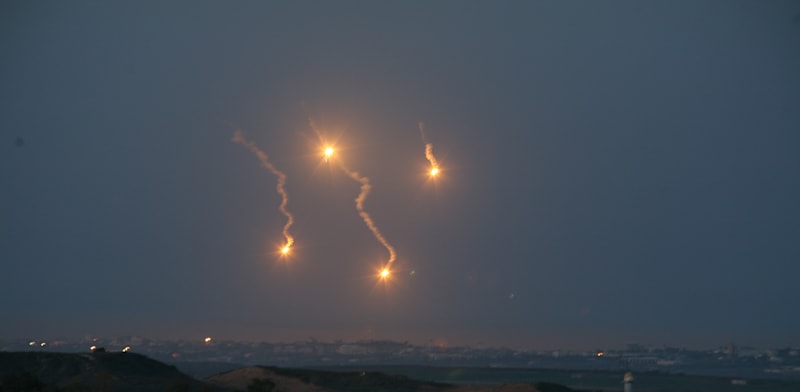
A new US Congress study on the THAAD ballistic missile interception system sheds worrying light on the inventory of interceptors available to the US in the near future. The document says, “There is concern that the rate of use of THAAD interceptors during Operation Epic Fury has further reduced the limited stock of interceptors.”
Despite the problematic reputation that the THAAD system has acquired for itself over the past few years, during which it was deployed in the Middle East, Congress claims that the interception rate of the US system reaches about 90% of all Iranian ballistic missiles and drones, with an emphasis on the UAE, a comparable rate to the Arrow 3, the Israel-US jointly developed system, used exclusively by the IDF.
The study also found that half of all interceptions used to defend Israeli skies in the operation against Iran in June were made by the THAAD system – ninety-two interceptions in total out of an estimated supply of 632 interceptors, and added it would take many years before the stockpile of interceptors could be fully replenished.
“It could take three to eight years to replenish the THAAD missile stockpile, each of which costs an estimated $12.7 million.” The Foreign Policy Research Institute (FPRI), which provided some of the materials to the Congressional Research Service (CRS), found that the first days of the current US Operation Epic Fury were more intensive than the opening of any other air campaign in the history of the US military, with 5,197 munitions across 35 types carrying a munitions-only replacement bill of $10 – $16 billion in four days.
“No shortage of bombs.”
FPRI said, “The coalition can keep attacking because there is a mass of bombs. The strategic constraint sits in the invisible parts: the interceptors that keep bases alive, the long-range weapons that hold enemy launchers at risk, and the sensor architecture that makes missile defense efficient and functional.
“The war in Iran creates the strategic illusion of an ongoing tactical bombing campaign, but its readiness for a larger emergency in a new arena (e.g., China, etc.) fades with every actual munition fired.”
According to the study, in the first four days of Operation Epic Fury, US Patriot batteries defending the Gulf states fired 943 interceptors – equivalent to the number of interceptors produced at Lockheed Martin and Boeing factories in 18 months. Together, they produce 620 interceptors a year, along with a factory in Poland that makes launchers for the Patriot.
The Payne Institute estimates that the war has consumed about a third of the THAAD missile stockpile, whose annual production rate does not exceed about 100. “US allied Gulf states are the ones that ‘bleed’ the bulk of the ammunition, but they are the last to receive resupply because of the priority given to the US military.”
RELATED ARTICLES

Missile damage a fraction of 2025 fighting
380 missiles to Israel
According to data from Tel Aviv University Institute of National Security Studies (INSS) as of Sunday some 380 Iranian ballistic missiles had reached Israel from Iran. The Iranians have an estimated 1,000-1,500 ballistic missiles capable of reaching Israel out of the 2,000-2,500 missiles they had before the current operation. The missiles fired at the Gulf are not from this Iranian arsenal, as they are intended for shorter ranges. So far, the US and Israel have destroyed about 200 launchers, 135 have failed, meaning they remain trapped in buildings, and the Iranians have about 120 functioning launchers left.
According to this data, Israel and the US are only halfway to destroying Iranian missiles and launchers, and at the pace of fighting, which has slowed somewhat, it appears that it will take many more weeks to complete the job.
Does Israel have a shortage of Arrow 3 missiles, like the US and UAE shortage of THAAD missiles? Israel’s Ministry of Defense declines to comment on the matter, but a former senior official in the US Defense Intelligence Agency reassuringly says, “Iran has no chance of winning the arms race, since their production capacity has dropped to zero, while that of the Americans and Israelis is large.”
While Arrow 3 missiles can intercept ballistic missiles in space, David’s Sling can, according to its original specifications, reach a lower layer. However, the success rates of David’s Sling are not always as good, as shown by efforts to intercept ballistic missiles in Dimona and Arad on Saturday, which were made using David’s Sling and not THAAD, as was mistakenly reported in several media outlets.
How do you decide who will fire?
A former senior IDF official says a multi-layered interception policy was established to repel ballistic missiles: “You want to hit the Iranian missile first with Arrow 3, if that doesn’t work, you fire Arrow 2, and then if that doesn’t work either David’s Sling or THAAD.”
How do you decide whether it is the US that fires THAAD or the Israelis that fire Arrow 3 at the target? The decision is made jointly by a US-Israeli control room, which receives data about the launch of the Iranian missile from all the radars in the Middle East, and is available to both armies equally.
The decision on which system to fire – Arrow or THAAD – is made jointly by the two countries based on the proximity of the batteries to the estimated point of impact. “If the US lacks supplies, it’s a sign that they didn’t properly prepare for the operation, because maybe they didn’t really plan one. It takes months to accumulate supplies, and it seems that the operation came as quite a surprise to them,” says the senior official.
Published by Globes, Israel business news – en.globes.co.il – on March 24, 2026.
© Copyright of Globes Publisher Itonut (1983) Ltd., 2026.