

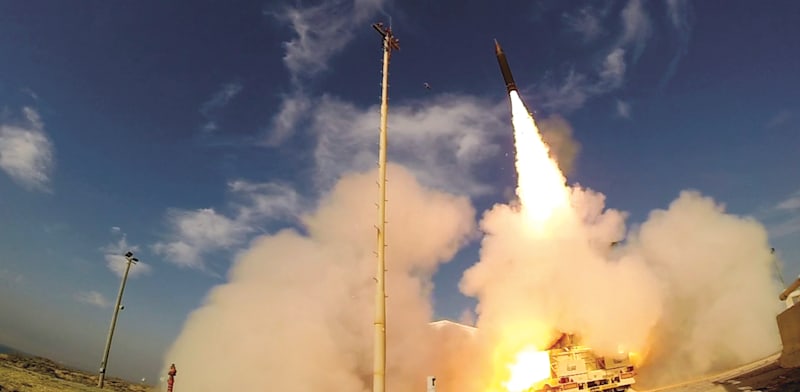
Israel defense companies are currently publishing their financial reports for 2025, which are showing a big jump in their orders backlogs. An investigation by “Globes” finds that the public companies in the defense sector, together with government-owned Rafael Advanced Defense Systems and Israel Aerospace Industries (IAI), have a huge orders backlog of over $80 billion. For comparison, this is an amount significantly higher than Israel’s health budget or the country’s total annual interest repayments.
The latest to publish its financial report showing an increase in the order backlog is Elbit Systems Ltd. (Nasdaq: ESLT; TASE:ESLT), the most valuable Israeli company traded on the TASE and Wall Street. Elbit ended 2025 with an order backlog at a record level of $28.1 billion – an increase of $2.9 billion during the fourth quarter alone and an increase of $5.5 billion from 2024..
By geographic region, Israel accounted for 32.2% of sales in 2025, with over $2.5 billion – a growth of 28.6%. Europe, where sales grew by 17.5% to $2.1 billion, accounted for 27% of sales, and North America with a share of 20.9% and an annual growth of 9.1%.
Elbit’s record orders backlog reflects the growing demand for defense systems. In recent years, due to the war in the Middle East and, earlier, the Russia-Ukraine war, there has been a change in the policies of countries, which are increasing defense budgets.
Elbit is not alone
Elbit Systems is by no means the only Israeli company benefiting from the big demand for defense products. Others have already published their financial reports including IAI, which had an orders backlog of $29 billion at the end of 2025, compared with $25 billion at the end of 2024.
Next Vision (TASE: NXSN) had an orders backlog of $218 million at the end of 2025, which had already climbed to $288 million last week. Rafael, will report its latest figures in the coming few days, but several months ago its orders backlog was $22 billion. At Rafael, which unlike IAI and Elbit that are more focused overseas, the orders backlog is split roughly 50-50 between Israel and abroad.
Between the backlog and cash
The backlog of orders of Israeli defense companies will translate into sales in the coming years and provides prosperous prospects for the companies and their investors. At a conference held by Elbit at the Tel Aviv Stock Exchange, CFO Dr. Kobi Kagan said, “The results are very strong. We have crossed the $500 million mark in free cash flow, and for the first time we reported quarterly revenue of over $2 billion – a record quarter.”
RELATED ARTICLES
Elbit CEO: We don’t wait for customers to define needs
As Modi visits, Israel-India defense cooperation deepens
India and Israel’s winning combination
According to Kagan, Elbit moded last year towards the long-term aims it had set for itself. “The backlog grew by 24% compared with the previous year, and sales grew by 16%, and hence it is clear that the backlog supports continued sales growth,” said Kagan. Referring to the company’s divisions, he said, “The distribution is almost balanced between the divisions, and that is significant. Elbit does not rely on one division or one geographic region.”
Despite the impressive numbers, analysts point out that a backlog of orders does not immediately translate into cash. David Levinson, an analyst at Bank Hapoalim’s research unit, explains that defense industries have a limited “top speed.” According to him, companies can grow at a double-digit rate of 15% to 20% in sales per year at most, due to infrastructural limitations of factories and a long training time for skilled personnel.
“Investing in factories and hiring workers takes time,” says Levinson. He adds that there is a global bottleneck in the ammunition sector and companies are careful not to sign contracts that they cannot deliver: “They simply will not sign a contract if they cannot deliver the ammunition. They will not do so at the expense of an existing commitment to another country.”
However, Idan Seri, investment manager and analyst at Anek Capital Israel, claims that the reported backlog does not yet reflect the full demand. “There is a difference between a signed backlog and a backlog of opportunities,” says Sari. “The US defense budget is growing to historic proportions, and we do not yet see its impact in the numbers.” According to him, strategic projects currently in development, such as the Golden Dome (laser system), are expected to inject additional billions into the backlog in the coming years once they reach the procurement stage.
Tight schedules
Will Isarael’s defense companies be able to fulfil this huge orders backlog abroad, together with the high demand in Israel due to domestic security challenges? Levinson makes it clear that the business model of the large companies, and especially Elbit, is built to prevent such conflicting demands.
“Defense industries are essentially local,” he explains. “Elbit Israel produces for Israel, and Elbit England produces for England. Each subsidiary is ‘locally patriotic’ and is prioritized in relation to the local country in which it operates. If there is a shortage, Israeli production will be directed first to the IDF, but this does not come at the expense of the international market, which relies on subsidiaries abroad.
The most surprising figure, according to Elad Kraus, research director at Meitav Brokerage, is not just the size of the backlog but the speed with which customers expect to receive the goods. Unlike in the past, where the backlog of orders was spread over many years, today customers around the world are in a pressured arms race. “The main thing is that these are orders for here and now,” Kraus explains. “At Elbit, for example, over half of this huge backlog – about 54% – is intended for delivery in the next two years. This figure illustrates not only the high demand, but also the enormous pressure placed on the shoulders of the industries to deliver the systems on extremely tight schedules.”
Kraus adds that the current backlog gives the major players extraordinary operational stability. “You could say that Elbit is more or less closed for the next three years,” he says. “This is a very high operational strength that is also being felt in the aerospace industry, where we are seeing jumps in backlog levels that we have not seen before. This boom is also permeating medium-sized companies, such as Next Vision, which are showing a significant increase in orders, mainly from the international market.”
More employees and factories
Elbit Systems CEO Bezhalel Machlis presented the company’s strategy, which is built on several pillars including strategic partnerships with customers, an international presence with subsidiaries, investment in innovation and R&D, and the quality of the company’s employees. Machlis noted that the number of employees increased by about 2,000 to 24,000 in the past year, of which 14,000 are in Israel.
These developments are taking place throughout the industry. According to Kraus, the ability to meet commitments is the main challenge in the coming year. “To meet demand, companies will have to make structural changes, open new production lines and factories, and perhaps even acquire additional activities. This requires rethinking the entire supply chain in order to deliver the goods on time.”
Machlis says, “The market is undergoing very major changes. There is an ongoing war in the Middle East, and the situation in Iran has a great impact on the company’s activities.” According to him, in the war against Iran, the Ministry of Defense uses a great deal of Elbit’s armaments, including munitions that most importantly the air force drops on Iran and drone systems that are used to destroy missile batteries and launchers. “Elbit’s involvement in combat is significant, and it affects other countries in the region, some of which we are active in,” said Machlis, noting that the company also operates through a subsidiary in the UAE.
“This connects to other conflicts in the world: the Russia-Ukraine war, which is creating a significant supply hub in Europe, the rise in tension between the US and China, and recently, growing tensions between India and Pakistan,” added Machlis.
This has all led to an increase in defense budgets, and the desire of countries to procure “here and now” and obtain proven operational solutions as soon as possible. Another trend is that countries are seeking to reduce dependence on external factors in the supply chain and produce at home, and Elbit has prepared for this through its subsidiaries around the world.
Published by Globes, Israel business news – en.globes.co.il – on March 18, 2026.
© Copyright of Globes Publisher Itonut (1983) Ltd., 2026.