

The Conspiracy of Duryodhana
The Mahabharata chronicles numerous incidents that reveal the deep-seated animosity between the Kauravas and Pandavas. Among these, the attempt on Bhimasena’s life stands as one of the earliest and most treacherous acts orchestrated by Duryodhana. Recognizing that Bhima possessed extraordinary physical strength that posed the greatest threat to his ambitions, Duryodhana devised a sinister plan to eliminate his cousin through deceit and poison.
The occasion was seemingly innocent—a recreational outing to the banks of the sacred Ganga River. The Kauravas invited their Pandava cousins for water sports and festivities in a beautiful garden. However, beneath this facade of familial camaraderie, Duryodhana harbored murderous intentions. During the feast that followed their activities, he mixed the deadly Kalkut poison into Bhima’s food, a toxin so potent that it would incapacitate even the mightiest warrior.

The Descent into Naglok
As the poison coursed through Bhima’s veins, his immense strength began to wane. Exhausted from the day’s activities and weakened by the venom, Bhima sought rest in a cool spot within the garden. His body, usually animated with tremendous energy, lay motionless like an uprooted tree. Seizing this opportunity, Duryodhana and his brothers bound the unconscious Bhima with thick, sturdy vines and callously cast him from the elevated riverbank into the depths of the Ganga.
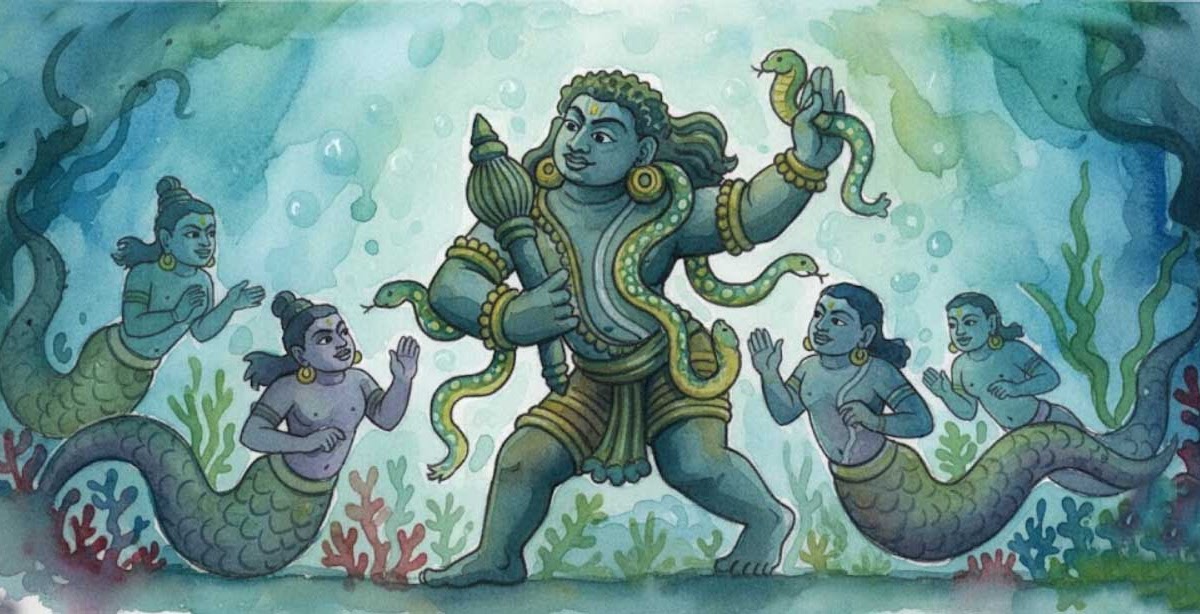
The unconscious Pandava prince sank through the holy waters, eventually reaching the mystical realm of Naglok—the subterranean world inhabited by serpents. His sudden arrival disturbed numerous Nagkumars (serpent princes), and in their agitation, these venomous snakes bit Bhima repeatedly with their fangs dripping with fierce poison. This seemingly dire situation proved to be an act of divine providence.
The Antidote Within the Venom
In one of the most remarkable reversals in the epic, the snake venom acted as a powerful antidote to the Kalkut poison that Duryodhana had administered. The more potent serpent venom neutralized the earlier poison, cleansing Bhima’s body of the toxin that threatened his life. Moreover, the snakes’ fangs, despite their sharpness, could barely penetrate Bhima’s iron-like skin, which had been toughened through years of rigorous training and divine blessing.
Awakening from his stupor with renewed vigor, Bhima’s natural strength returned manifold. He broke free from his bonds with ease and, in his fury, seized the attacking serpents and hurled them to the ground. Many fled in terror, having never encountered such a formidable being in their realm. The remaining serpents, bewildered and frightened, hastened to report this extraordinary incident to their sovereigns.
The Recognition by Nagaraj Aryak
The news reached Vasuki, the king of all Nagas, and Aryak, another prominent serpent king. Together, they proceeded to investigate this unusual intruder in their domain. What they discovered was the young, fierce Bhimasena, radiating power and courage even in the depths of the underworld.
Nagaraj Aryak’s recognition of Bhima holds profound significance. Aryak was the maternal grandfather of Shurasena, who was Kunti’s father, making him Bhima’s great-great-grandfather through the maternal line. This ancestral connection demonstrates the intricate web of relationships that permeate the Mahabharata, where divine and serpent lineages intertwine with human dynasties. Upon recognizing his descendant, Aryak embraced Bhima with great affection, his heart swelling with pride at the young warrior’s strength and valor.
The Gift of Supernatural Strength
Deeply impressed by Bhima’s prowess and moved by their familial bond, Aryak recommended a rare honor to Vasuki. He suggested that Bhima be offered the sacred elixir from the fountain of power—a miraculous drink that would grant the strength of one thousand elephants with each bowl consumed. This was no ordinary gift; such elixirs were typically reserved for celestial beings and the most worthy of mortals.
Vasuki, recognizing both Bhima’s worthiness and the justice of Aryak’s recommendation, agreed to this proposal. The elixir was brought forth, and Bhima, true to his nature as Vrikodara (one with a wolf’s appetite), consumed not one but eight bowls of this divine nectar. As the power of eight thousand elephants coursed through his body, Bhima fell into a deep, restorative sleep, his physical form integrating and harmonizing with this supernatural strength.
Symbolism and Deeper Meanings
This episode carries multiple layers of symbolism that resonate throughout Hindu philosophy and the broader narrative of the Mahabharata. The descent into water represents a symbolic death and rebirth—Bhima enters the Ganga as a poisoned, bound victim and emerges as a divinely empowered warrior. This mirrors the concept of transformation through ordeal, a recurring theme in Hindu scriptures.
The snake venom neutralizing the poison illustrates the principle that extreme remedies can counter extreme maladies. In Ayurveda and Hindu medical traditions, the concept of “visha” (poison) being used to treat poison is well established. Furthermore, it demonstrates divine intervention working through natural means—what appeared as an attack by serpents was actually the mechanism of Bhima’s salvation.
The recognition by Aryak emphasizes the importance of ancestral connections and the principle of “pitru rina” (debt to ancestors) in Hindu dharma. Even in the underworld, familial bonds transcend realms, and ancestors continue to watch over and support their descendants. This incident proves that righteousness and noble lineage attract divine protection, even when one faces the gravest dangers.
The Role of Destiny and Divine Will
The entire sequence of events—from Duryodhana’s treachery to Bhima’s empowerment—can be understood as orchestrated by divine will. What the Kauravas intended as Bhima’s end became the means of his enhancement. This reversal exemplifies the Hindu concept of “daiva” (divine fate) and “karma phala” (fruits of action). Duryodhana’s evil actions, meant to destroy, instead strengthened his future opponent.
The Mahabharata repeatedly demonstrates that those who act with adharma (unrighteousness) inadvertently create the conditions for their own downfall. Duryodhana’s attempt on Bhima’s life not only failed but resulted in Bhima becoming even more formidable—a warrior with the strength of eight thousand elephants, who would later prove crucial in the Kurukshetra war.
Lessons for Spiritual Seekers
This narrative offers several teachings for practitioners of dharma. First, it illustrates that apparent disasters may conceal hidden blessings. What seems like the end may actually be a new beginning, transformed and elevated. Second, it demonstrates the power of noble lineage and righteous character in attracting divine grace. Bhima’s inherent virtue, despite being unconscious, drew the recognition and support of his ancestor Aryak.
Third, the story teaches that evil actions ultimately rebound upon their perpetrators. Duryodhana’s attempt to weaken the Pandavas only strengthened them, setting the stage for his eventual defeat. Finally, it shows that one’s true strength is revealed in adversity—Bhima’s iron-like constitution and indomitable spirit were tested and proven even in unconsciousness.
The Return to the World
After sleeping for eight days in Naglok, Bhima awakened fully transformed. The serpent kings escorted him back to the surface, ensuring his safe return to the mortal world. When he rejoined his family, the Pandavas and Kunti were overwhelmed with relief and joy, having feared him lost forever. Bhima’s return marked not just his physical survival but his emergence as an even more formidable warrior, now carrying within him supernatural strength that would prove decisive in future battles.
This episode remains one of the most significant early events in Bhima’s life, shaping his destiny and demonstrating that those who follow dharma are protected by forces seen and unseen, from realms both earthly and divine.