

NovaUCD-based company draws on experience of engineers with ESA missions
Trade
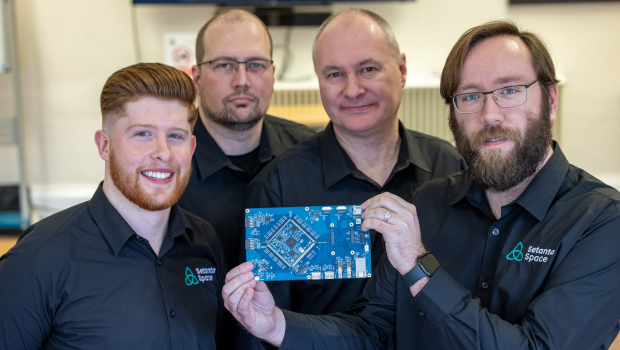
Pictured: Jake O’Brien, Tomas Chester, Adam Taylor, and James Murphy, Setanta Space Systems
A start-up founded by an Irish team of engineers with backgrounds in European Space Agency (ESA) missions is developing novel modular onboard computing hardware and software to make spacecraft more autonomous, resilient and capable.
Setanta Space Systems aims to address one of the most persistent limitations in modern spacecraft: the lack of high-performance, flexible computing at the edge. While satellites are generating increasing volumes of data and operating in more complex environments, much of today’s avionics still relies on legacy architectures that constrain autonomy and require heavy dependence on ground operations.
Setanta Space is developing a family of modular and scalable computing platforms that combine radiation-tolerant electronics with deployable AI, enabling spacecraft to process sensor data, detect anomalies and make operational decisions in orbit rather than waiting for instructions from Earth. By reducing latency and bandwidth requirements, this architecture allows missions to respond faster, operate more independently and extract more value.

“At Setanta Space, we believe spacecraft need to be smarter,” said James Murphy, founder and chief technical officer. “Our goal is to provide the hardware and software foundation that enables true onboard autonomy, from health monitoring and anomaly detection to perception and real-time data processing. We want intelligence to be built into every mission from day one.”
Headquartered at NovaUCD in Dublin, Setanta Space’s product line is based around a modular hardware concept that allows computing subsystems to be integrated, upgraded or reconfigured without redesigning an entire spacecraft avionics stack.
This design philosophy is intended to shorten development cycles and give mission designers greater flexibility as requirements evolve. The company’s roadmap includes scalable onboard computers, radiation-tolerant vision sensors and a software platform for developing and deploying AI workloads across flight hardware.
Murphy added: “Over the coming year, Setanta Space plans to deliver early development kits and pilot projects with customers, expand partnerships with European and international integrators, and participate in ESA and EU innovation programmes to accelerate technology maturation. We also intend to establish a presence in the United States to support commercial growth and closer engagement with the broader aerospace ecosystem.
“Our ambition is to become a trusted provider of intelligent computing for space. Whether supporting a CubeSat, a constellation or a deep-space mission, we want our systems to give spacecraft the ability to sense, decide and act independently.”
TechCentral Reporters