

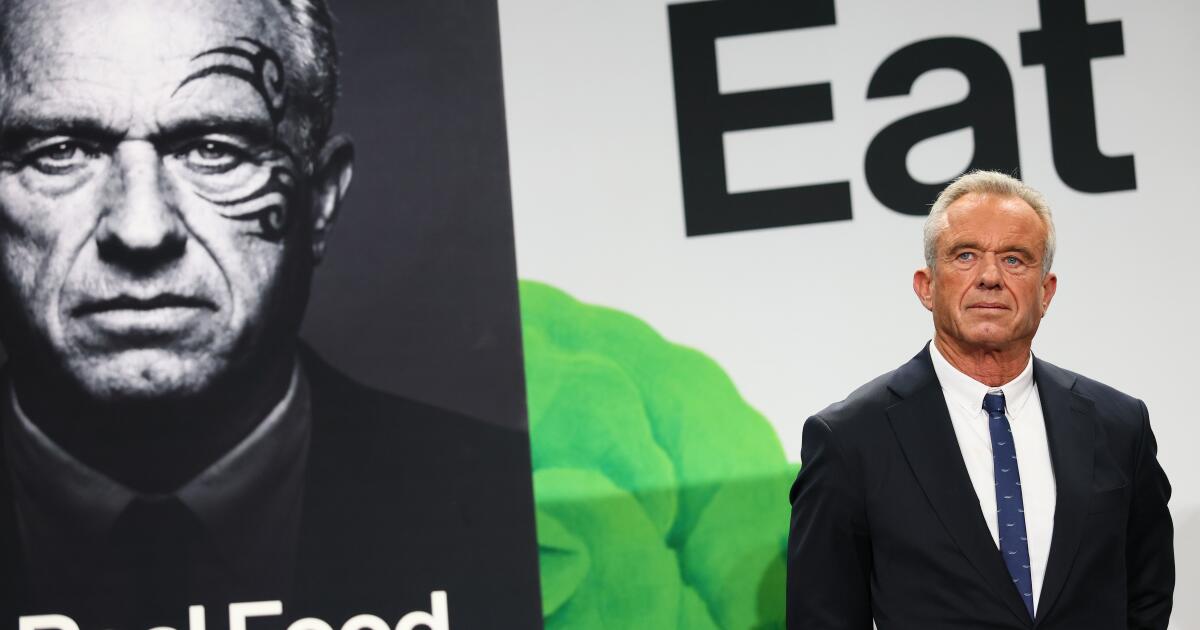
This week, Secretary of Health and Human Services Robert F. Kennedy Jr. — the individual entrusted with safeguarding the health of 330 million Americans — posted a 90-second video of himself and Kid Rock doing shirtless calisthenics in blue jeans, riding a stationary bike in the sauna, doing a slow-motion cold plunge and toasting glasses of whole milk in the pool. The internet responded with memes and mockery. I sat in my office at UCLA, where I’ve practiced pulmonary and critical care medicine for more than 40 years, and I did not laugh.
I felt the anger, real anger.
Because here’s what was not in that video: the more than 2,200 Americans who contracted measles in 2025, in a country that effectively eliminated the disease in 2000. The three who died. The more than 900 confirmed cases already reported in the U.S. in 2026. The children in South Carolina — totaling nearly 1,000 cases from a single outbreak — whose parents were persuaded by rhetoric this secretary spent decades amplifying about how the MMR vaccine was more dangerous than the disease. It is not. Decades of rigorous science have shown it is not.
When the absurd reaches a certain pitch, mockery is a natural defense. But I worry we’ve become so numbed by spectacle, so conditioned to treat governance as entertainment, that we’ve lost our capacity for the emotion this moment demands: genuine outrage. The real thing. The kind that mobilizes physicians, parents and legislators to say, “This is not acceptable.”
Let me be precise about what Kennedy has done in his first year as HHS Secretary, because the shirtless antics are designed to distract you from it.
He fired all 17 members of the Advisory Committee on Immunization Practices — the expert panel that has guided national vaccine policy for decades — and replaced them with vaccine skeptics. He forced out Centers for Disease Control and Prevention Director Susan Monarez. He cut National Institutes of Health funding, gutting cancer research and addiction treatment programs. He stopped federal support for mRNA research — one of the most significant advances in the history of immunology, being developed for vaccines against multiple sclerosis, influenza and certain cancers. When the FDA initially rejected Moderna’s mRNA flu vaccine this month on what experts called ideological grounds, only public backlash forced a reversal — during one of the worst flu seasons in modern history.
Then, last month, Kennedy gutted the childhood immunization schedule, reducing universally recommended vaccines from ages 11 to 17. Hepatitis A, hepatitis B, rotavirus and influenza were relegated to “shared clinical decision-making” — a bureaucratic euphemism for abandonment. Routine recommendations trigger automatic prompts in electronic medical records and allow nurses to vaccinate under standing orders. Shared decision-making requires a physician at every vaccination decision, creating bottlenecks that will reduce uptake among the more than 100 million Americans without regular primary care access.
During Kennedy’s 2025 confirmation hearings, he told senators under oath: “I support vaccines. I support the childhood schedule.” Sen. Bill Cassidy, a Republican physician from Louisiana, voted to confirm Kennedy explicitly on those pledges. Every pledge has been broken. The lone Republican who voted against him — Sen. Mitch McConnell of Kentucky, a polio survivor — warned his colleagues. They did not listen. Trust in the CDC has since plummeted from 66% to 54%. Confidence in MMR vaccine school requirements among Republicans has fallen 27 points in just six years.
These are not poll numbers. They are harbingers of future outbreaks, future hospitalizations, future deaths.
I’ve seen this before. I was an intern at UCLA in the early 1980s when the first cases of what we would come to call AIDS appeared on our wards — young men dying of infections we had never seen in previously healthy patients. I watched an institution and a government fail to respond with the urgency a nascent epidemic demanded, and I watched people die because of that failure. The lesson was not subtle: When public health leadership falters, when ideology supplants science, when the people in charge decide that politics matters more than medicine, people die. Not in the abstract. In beds. In hospitals. In Los Angeles.
I am watching it happen again. The United States is poised to lose its measles elimination status — an achievement that took decades to build. Kennedy’s newly appointed CDC deputy Ralph Abraham responded to this prospect by calling it “just the cost of doing business.” Three people died of measles in this country last year. The cost of doing business.
So, when I see the secretary of Health and Human Services drinking whole milk in a pool with Kid Rock, I do not see comedy; nor should the response be memes or sarcasm. I see a man who bears direct responsibility for the resurgence of vaccine-preventable disease in the most medically advanced nation on Earth, performing a grotesque pantomime of wellness while children get sick. That is not a joke. It is a scandal. And it is long past time we treated it as one.
Robert B. Shpiner is a clinical professor of medicine at UCLA David Geffen School of Medicine, with over 40 years of ICU experience at Ronald Reagan UCLA Medical Center.
Insights
L.A. Times Insights delivers AI-generated analysis on Voices content to offer all points of view. Insights does not appear on any news articles.
Viewpoint
Perspectives
The following AI-generated content is powered by Perplexity. The Los Angeles Times editorial staff does not create or edit the content.
Ideas expressed in the piece
-
The author argues that Secretary Kennedy’s public relations activities, such as filming shirtless calisthenics with Kid Rock, serve as a distraction from consequential policy decisions that threaten public health. The performative nature of these activities obscures the substantive harm being caused to vaccine confidence and disease prevention infrastructure.
-
Kennedy has systematically dismantled the scientific foundation of vaccine policy by firing all 17 members of the Advisory Committee on Immunization Practices and replacing them with vaccine skeptics, according to the article. This has directly contributed to a dramatic resurgence of measles, with more than 2,200 cases in 2025 and over 900 cases already reported in early 2026, including nearly 1,000 cases from a single outbreak in South Carolina.
-
The author contends that Kennedy broke explicit commitments made during his 2025 confirmation hearings, when he pledged support for vaccines and the childhood immunization schedule. Instead, the secretary gutted the childhood immunization schedule by moving routine vaccines like hepatitis A, hepatitis B, rotavirus, and influenza from universal recommendations to “shared clinical decision-making,” a change that will reduce vaccination access for over 100 million Americans without regular primary care access.
-
The author emphasizes that these policy changes have demonstrably eroded public trust in public health institutions, with CDC confidence dropping from 66% to 54% and Republican confidence in MMR vaccine school requirements falling 27 points in six years. These declining trust metrics are not merely statistical but represent precursors to future disease outbreaks, hospitalizations, and deaths.
Different views on the topic
-
The administration frames the leadership reorganization as an effort to streamline management and advance health policy priorities, rather than undermine vaccine safety[1]. The White House has characterized the changes as strengthening focus on Kennedy’s “Make America Healthy Again” agenda ahead of midterm elections[1].
-
The administration’s stated priorities for these organizational changes include drug pricing reforms, dietary guideline adjustments, elimination of artificial food dyes, and initiatives to increase healthcare affordability through Trump’s most-favored-nation drug pricing policies[1]. These reforms are positioned as addressing broader health system efficiency and accessibility rather than vaccine policy changes.
-
Kennedy’s defenders point to his expanded emphasis on regulatory reforms and cost controls as reflecting a different approach to federal health management[1]. The reorganization places leaders with roles in drug price negotiations and Medicare Advantage cost oversight in expanded positions, suggesting a focus on healthcare economics and systemic efficiency[1].