

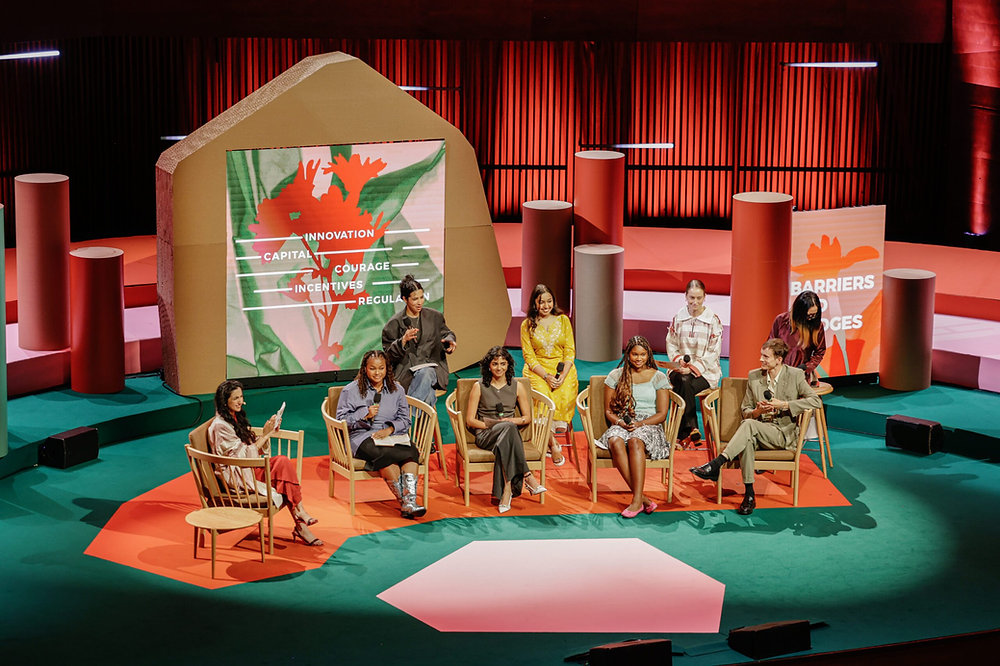

Next Gen Reflections is a series of articles written by members of Next Gen Assembly, an impactful advocacy programme for talented students and early-career professionals, led by Global Fashion Agenda and Centre for Sustainable Fashion’s Fashion Values programme, supported by Target. This article was written by 2025 member Rory Frost.
Each year, the Next Gen Assembly showcases a group of eight young, diverse leaders passionate about challenging the fashion industry from heel to fascinator. Parallel to the inspiring work that our cohort have produced over the last 12 months, we also serve as a reflection of our wider demographic. Young people involved in fashion reflect a transforming sector: their actions are changing, and this is already being felt across the value chain. By positioning ourselves as the next leaders of fashion, we can better understand our visions for an industry we will lead in the near future.
It is impossible to fit the global Gen Z fashion consumer into one sample size, but some things are evident. Firstly, our choices are driven by our values. Première Vision & Institute Francais de la Mode’s 2024 study on young Europeans highlights ‘the younger the consumer, the more likely they are to buy eco-friendly products’. This study also suggests Gen Z investment in sustainable fashion often goes deeper, as younger Europeans are prepared to spend more for a quality find. Additionally, there is a social dimension to Gen Z’s fashion choices, reflected in an increasing demand for transparency and representation. We desire to understand the history, culture and practices behind our purchases, knowing where our clothes come from and with whose hands they were created. Similarly, we want to see brands not only incorporate fair and just practices, but speak them out loud.
This authenticity our generation desires from brands comes from within. Our clothing choices are more than ever a reflection of the identities we want to show. As Trenae Williams from Fibre2Fashion declares ‘Gen Z thrives on experimentation and re-invention’. We want to wear clothes that reflect who we are and what we care about, not just the macro-fashion trends that we encounter. This spectrum also reflects the chaotic environment our generation has grown up in. We have come of age amid economic instability, accelerating climate breakdown, deepening political polarisation and the constant hum of global crises unfolding in real time through our screens. Our lives are growing more unstable, and our clothing is a reflection of that.
You can describe Gen Z in this way by analysing their spending patterns and purchasing power, influenced by the world’s broader economic forces. However, I think it’s more interesting to empower them in a different way – as the challenger, the innovator, the author. Positioning our generation as leaders shifts our conversations into action: from responding to systems, to actively rewriting them.
So if we were leading fashion’s boardroom today, what is on our agenda?
Speculative futures thinking allows us to interrogate this question – imagining an industry that is shaped by our values and lived experience. This is explored by Prof Dilys Williams in her 2024 paper Fashion Otherwise, where she highlights the value of mindsets of possibility for designing as, ‘the ability to imagine that-which-does-not-yet-exist, and to make it appear in the material form is a purposeful addition’. This is an encouragement for the fashion sector to think beyond its current realms, but where do we start?
How can we put our demands into action so that Gen Z is actively listened to?
The Next Gen Assembly 2025 Manifesto is a colourful roadmap, showcasing a diverse collection of missions that we want to see enacted by the industry. This blueprint helps us challenge wider systems through renewed interactions with fashion, envisioning what the future could look like instead – an ecosystem rooted in care, accountability and collective progress.

Reclaim the fashion narrative
By reclaiming the narrative, young people can speak for themselves – about the opportunities to enter an industry where our passion aligns with our work and in an environment where graduates aren’t fighting over a handful of glorified positions. Reclaiming the narrative is more than just representation; it is about redistributing power and redefining what success looks like within fashion.
As digital natives, we look to social media for fashion storytelling, styling advice and inspiration for our next purchase. By creating stories that challenge the notion that fashion is purely a practice of consumerism, we can hear stories about fashion’s impact on land, personal anecdotes from craftspeople, and discuss nature as a living partner. We can learn more about valuing nature whilst sharing these learnings with our own small communities, both online and in-person. Our circles are not simply passive audiences; they are our own ecosystems of influence.
Finally, by reclaiming the narrative we can ensure transparency is a baseline, not just a marketing tactic. Transparency without accountability is performance, and young people are increasingly unwilling to accept surface-level claims in place of real action.
Gen Z’s fashion lovers are an interconnected, global web of inspiring individuals who all play a key role in accelerating action. It is clear that the future fashion worker does not neatly fit into existing job descriptions, which exposes how narrow our current systems are. But, by envisioning what the next fashion jobs could be – imagine the Traceability Analyst, Regenerative Product Specialist, the Circular Design Strategist or Digital Fashion Storyteller – we can put these aspirations into motion. These future, and emerging, roles bring us closer to our shared goals and reflect an industry that better intersects creativity, technical knowledge and care.
The Next Gen Assembly’s manifesto is evidence that young leadership is already happening. Youth-led initiatives in fashion are crucial to re-wiring the industry to suit our generation’s core values of respect, care and community. As a young person invested in this industry and the potential of my generation, I commit to sharing my own perspective and learning from others.
We’re not just determining our futures – we’re shaping the present.

About Rory, Next Gen Assembly 2025 member
Rory Frost is currently pursuing a Master’s degree in International Relations at both King’s College London and Sciences Po Paris. His research focuses on Environmental Policy and Global Governance, with a keen insight for exploring the links between political behaviour and climate change. Alongside his background in international affairs, Rory is an active sustainability advocate within the fashion industry, with experience in fashion communications and project management.