

Share

Sir Jony Ive, the man who famously stripped the physical keyboard away from the mobile with his iconic iPhone design, has taken a very different approach with his latest project for Ferrari..
As Ferrari unveils the “Luce”, the famous Italian brand’s first fully electric sports car, the spotlight has fallen on an interior designed by Ive and his creative collective, LoveFrom.
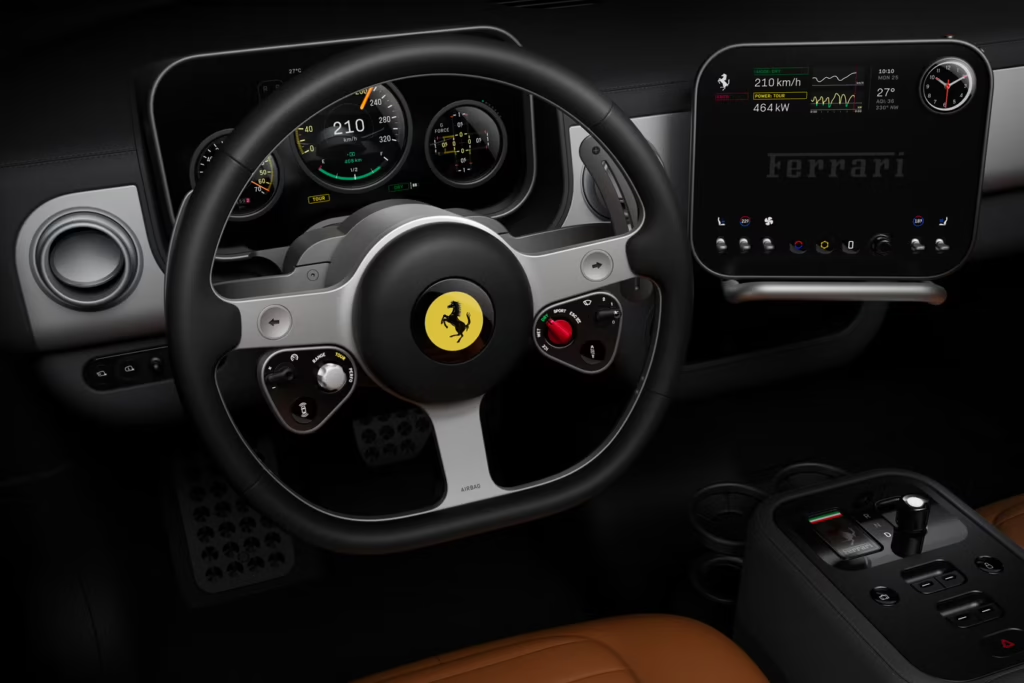
While the rest of the automotive industry is currently engaged in a “screen war,” competing to see who can bolt the largest and shiniest tablet to a dashboard, Ive has taken a radical detour back to physical buttons.
The cabin of the Luce is a study in what Ive calls “clarity and simplicity.” Eschewing the fingerprint-smudged glass slabs that define modern EVs, the Luce features a meticulously organized environment of physical toggles, machined aluminium switches and Gorilla Glass dials.
It is a design that feels both retro and deeply human, drawing inspiration from the aviation-style gauges and three-spoke Nardi steering wheels of 1950s Ferraris. However, it is the philosophy behind these controls, rather than just their aesthetic, that marks Ive’s most significant departure from contemporary car design.

Touch screens wrong for car interiors, claims Ive
Ive’s primary critique of the modern car interior is one of safety and soul. In a startling admission for the father of the modern touchscreen, he has declared that touch is the “wrong technology” for a car’s primary interface.
It’s an argument grounded, he claims, in the reality of driving because a touchscreen requires a driver to look away from the road to confirm they have hit a virtual button. In a Ferrari, where performance is measured in split seconds, that distraction is more than an annoyance – it is a design flaw.
To solve this, Ive has focused on “eyes-busy, hands-on” interaction. Every switch in the Luce has been engineered to feel different to the touch, allowing a driver to adjust the climate, suspension, or drive modes by muscle memory alone.

The centerpiece of this experience is a physical key made of Gorilla Glass with an E Ink display. When docked into the centre console, it triggers a “startup ceremony” where light flows from the key across the dashboard’s digital-analogue hybrid dials.
Even the gear selector has been reimagined as a technical work of art, using laser-drilled holes half the width of a human hair to back-light the graphics.
By prioritizing these mechanical interactions, Ive is attempting to restore a sense of visceral connection that many fear will be lost in the transition to electric power. And while the Luce features state-of-the-art Samsung OLED displays, they are often tucked behind physical needles or layered with lenses to create a “parallax effect” that mimics the depth of an old-school chronograph.
It is a sophisticated rejection of the “easy and lazy” design trend of massive screens, proving that, for Jony Ive, the future of the electric car isn’t just about how it moves, but how it feels beneath your fingertips.
Related Posts
Discover more from Tech Digest
Subscribe to get the latest posts sent to your email.