

Share

The golden age of aviation returns to the spotlight today as the UK celebrates the 50th anniversary of Concorde’s first commercial supersonic flights…
Half a century ago, on January 21, 1976, the world (temporarily) grew smaller as British Airways and Air France launched Concorde with simultaneous departures from London and Paris, beginning a 27-year era of travel that remains unmatched.
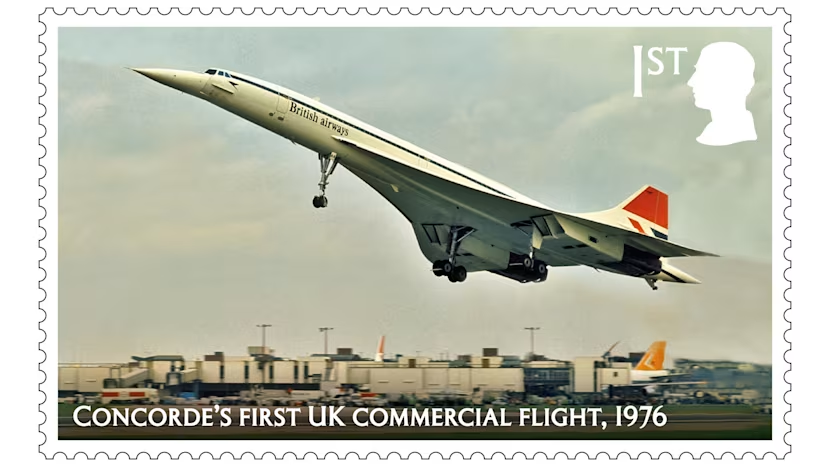
To commemorate the milestone, Royal Mail has released a special set of 12 stamps. These designs, featuring the King Charles III silhouette, claim to capture the aircraft’s “innovation, elegance, and engineering excellence.”
The 50th anniversary celebration also includes co-ordinated “nose-drop” events across the UK, where preserved Concorde aircraft lower their famous drooped nose cones at the exact time (11:40 am) that the first flights took off in 1976.
Here are 10 legendary facts about the “Queen of the Skies” on her 50th anniversary:

1. The simultaneous debut: Concorde’s commercial life began with two flights at the same moment. British Airways flight BA300 departed London Heathrow for Bahrain, while an Air France flight took off from Paris for Rio de Janeiro.
2. Record-breaking speed: Concorde typically cruised at 1,350 mph – more than twice the speed of sound. At this velocity, the aircraft was faster than a rifle bullet, capable of covering a mile in just 2.75 seconds.
3. The ultimate New York sprint: The record for the fastest transatlantic passenger flight was set on February 7, 1996. A British Airways Concorde (G-BOAD) flew from New York’s JFK to London Heathrow in a staggering 2 hours, 52 minutes, and 59 seconds.
4. Youngest in the cockpit: In 1977, at the age of 28, Mike Bannister became the youngest pilot to join the British Airways Concorde fleet. He eventually rose to become Chief Pilot and captained the final commercial flight in 2003. For more info see here:
5. Stretching in the heat: Due to the intense friction of flying at Mach 2, the aircraft’s fuselage would heat up and expand. During a flight, Concorde actually stretched between 6 and 10 inches in length.
6. A price tag for the elite: Luxury came at a premium. By the time it was retired in 2003, a standard return ticket from London to New York cost around £6,636 – equivalent to over £12,000 today. Passengers often joked they could arrive in New York before they had even left London due to the time difference.
7. The only fatal tragedy: Despite being considered the safest plane in the world for years, Concorde’s legacy was forever changed by the crash of Air France Flight 4590 on July 25, 2000. Debris on the runway in Paris caused a tyre to burst, rupturing a fuel tank and leading to a fire that killed 113 people.
8. The droop nose: The distinctive hydraulically operated nose cone was a necessity of engineering. It would tilt down by 12.5 degrees during take-off and landing so that pilots could actually see the runway, as the aircraft flew at a high angle of attack.
9. Formation flying: To celebrate its 10th anniversary in service in 1986, British Airways performed a rare feat: flying four Concordes in close formation. This iconic moment is featured on one of the new Royal Mail commemorative stamps.
10. The Final farewell Concorde’s last commercial flight took place on October 24, 2003, travelling from New York to London. It signalled the end of civilian supersonic travel, leaving a legacy of engineering brilliance that remains a symbol of British and French ambition today.

Related Posts
Discover more from Tech Digest
Subscribe to get the latest posts sent to your email.