

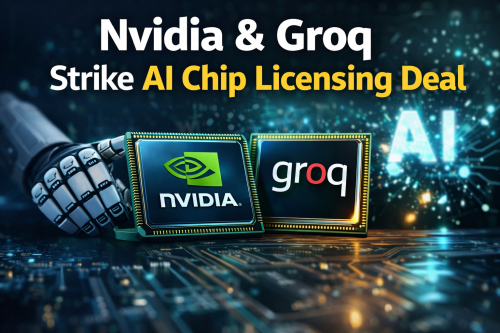
A chip licensing deal is not usually the kind of headline that makes people spit out their coffee. This one should. Nvidia’s chip licensing deal with Groq is a smart, strategic move that combines technology access with talent acquisition without calling it an acquisition, and that structure matters almost as much as the tech itself.
This is the kind of maneuver that shapes the next year of AI infrastructure decisions, from how cloud providers price inference to how founders think about hardware risk. It also highlights a pattern we are seeing more often: megacap tech companies finding ways to get the benefits of a buyout without triggering the full regulatory and operational baggage of one.
What Actually Happened
Groq announced it entered a non exclusive licensing agreement with Nvidia for Groq’s inference technology. Alongside the licensing arrangement, Groq said founder Jonathan Ross and president Sunny Madra, plus other members of the team, would join Nvidia. Groq also said it will continue operating as an independent company under a new CEO, and its cloud offering will continue.
Reuters reported this as part of a wider trend where Big Tech secures technology and leadership through licensing and hiring rather than outright acquisitions, often with antitrust scrutiny in mind.
Why Inference Is the Prize Right Now
If you want to understand why Nvidia cares, start with one word: inference.
Training is when an AI model learns patterns from data. Inference is when the model answers your question, generates an image, summarizes a document, or powers a chatbot response. In 2026, inference is where the money and the pain live. It is the ongoing cost center for every AI product that ships, because inference happens every time a user clicks “send.”
That is why “faster and cheaper inference” is the new hardware arms race. Groq has positioned itself around low latency inference performance, and this chip licensing deal gives Nvidia a way to pull that capability into its roadmap without waiting for internal R and D cycles to catch up.
Industry analysts have also been pointing to a shift where inference becomes a larger share of total AI workloads over time. That makes inference focused chip IP and leadership talent increasingly valuable.
The Tech Angle, What Groq Brings to the Table
Groq’s architecture is often discussed as an alternative approach to AI acceleration that targets predictable, low latency output. Reuters described Groq’s inference technology as a challenger in a market that is increasingly focused on real time inference, and noted Groq’s approach to memory and performance as part of that positioning.
The important point for a general tech audience is not the specific chip micro architecture details. It is the practical impact:
– Lower latency means more responsive AI experiences.
– More efficiency can mean lower cost per query.
– Better inference throughput can help providers handle demand spikes without melting down.
If Nvidia can blend its ecosystem dominance with Groq’s inference strengths, it can defend its position even as hyperscalers and competitors keep investing in alternatives.
The Deal Structure Is the Real Story
Here is where the “loophole” framing comes from, and it is not conspiracy stuff. It is structure.
This chip licensing deal is reported as non exclusive. That means Groq can, at least in theory, license to others too. It also means Nvidia can argue this is not a traditional acquisition that removes a competitor from the market. :contentReference[oaicite:6]{index=6}
At the same time, the deal includes key executive talent moving to Nvidia. That is not a side detail. That is the second half of the strategy. You get IP access and you get the people who know how to push it forward inside your organization.
Founders should notice this because it signals a broader market reality: talent plus IP access can be the functional equivalent of an acquisition, even if the corporate entity remains independent.
What It Means for Pricing and Availability
Most readers care about this for one reason: will AI get cheaper and more available, or will it stay expensive and capacity constrained?
This chip licensing deal hints at two competing futures:
1) Cheaper inference through better hardware competition
If Groq’s approach spreads through Nvidia’s pipeline and products, inference efficiency could improve. That can push costs down for developers over time.
2) More concentration of advantage in the Nvidia ecosystem
If Nvidia absorbs key inference expertise and integrates it into its platform faster than competitors can respond, it reinforces Nvidia’s gravity. That can keep developers locked into Nvidia optimized stacks, which can influence pricing power.
In other words, this could help the market, or it could help Nvidia more than the market. Both can be true.
The Founder Signal, Do Not Miss This
A chip licensing deal with leadership migration is a serious strategy pattern, not a one off. It tells you how megacap companies may “buy” momentum in 2026:
– License the IP
– Hire the leadership
– Leave the startup alive enough to reduce regulatory heat
– Move fast internally
If you are building in AI hardware, AI infrastructure, or even software that depends on inference costs, you should treat this as a macro signal. The competition line is not just “GPU versus GPU” anymore. It is “platform ecosystem plus deal structure.”
What to Watch Next
A few practical watch points as this develops:
– Whether regulators scrutinize these licensing plus talent deals more aggressively
– Whether Groq signs additional partnerships, since the license is described as non exclusive :contentReference[oaicite:7]{index=7}
– Whether Nvidia explicitly positions new inference offerings tied to this technology
– Whether cloud providers change inference pricing or bundling in response